Литий выдаёт тайны молодых звёзд экспресс
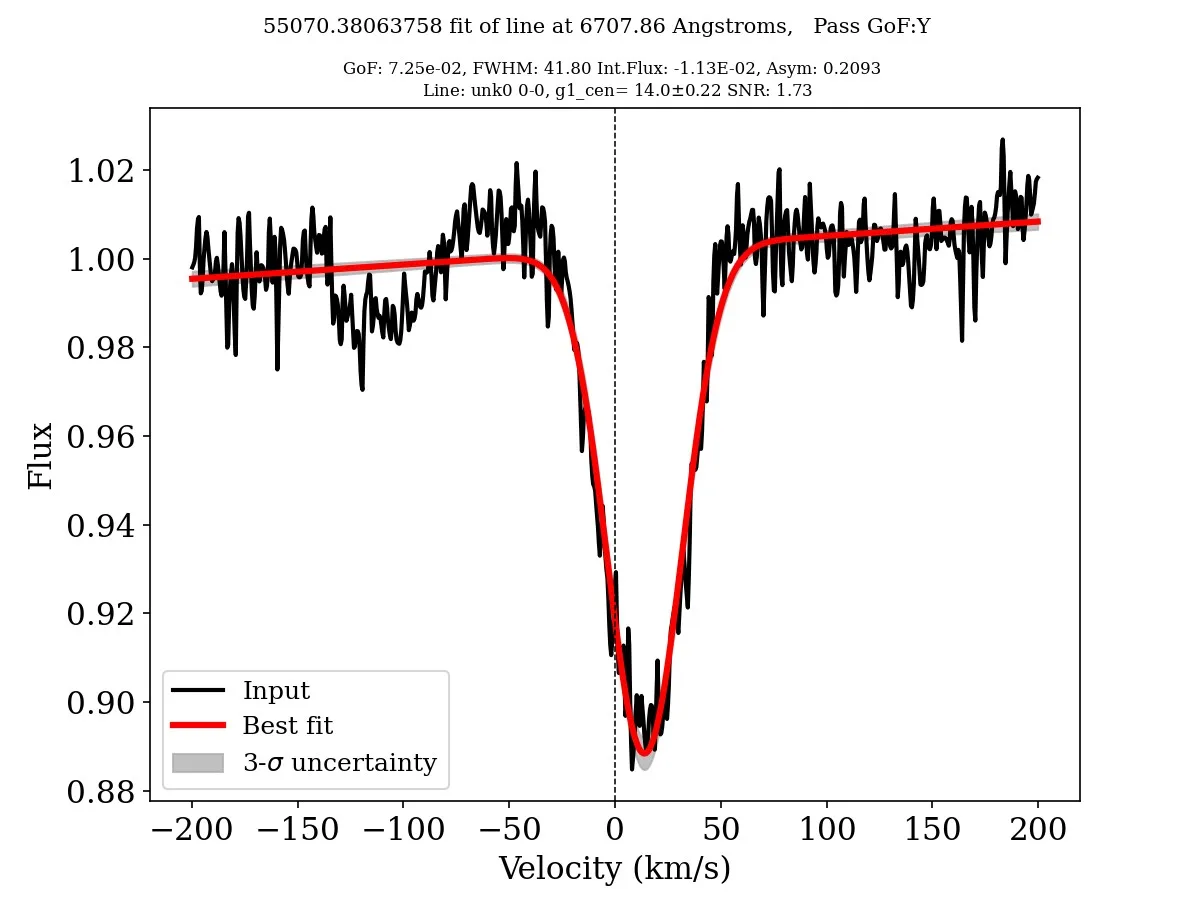
Литий — как термометр, опущенный в недра звезды. Этот лёгкий элемент разрушается при температуре около 2,5 миллиона градусов, поэтому его количество на поверхности рассказывает, насколько глубоко перемешивалось вещество звезды.
Спектры 71 молодой звезды средней массы (от 1,5 до 3,5 масс Солнца) показали: у 25–30% из них лития заметно меньше, чем было в исходном облаке. У лёгких звёзд такое случается чаще, а вот для средних это неожиданность. Причина — в быстром вращении: звезда, как фигурист, прижимающий руки, раскручивается, и это усиливает перемешивание, которое уносит литий вглубь, где он гибнет.
У средних звёзд этот переход происходит примерно вдвое быстрее, чем у лёгких. Магнитное поле звезды, которое раньше цеплялось за диск, сжимается, и звезда начинает крутиться втрое быстрее, а вещество из диска падает на неё вчетверо активнее. Это похоже на то, как у велосипедиста, отпустившего руль, колесо набирает обороты.
Возможно, та же связь между литием и вращением объясняет, почему у звёзд с планетами лития меньше: планеты могли повлиять на раннее вращение звезды, а то, в свою очередь, — на судьбу лития. Это кольцо: от диска и планет к вращению, от вращения к литию.
Оригинальная аннотация
как её написали авторы, на английском arXiv:2604.05040
(Abridged) We contribute to our understanding of the evolution of young intermediate-mass stars by providing a comprehensive analysis of their lithium (Li) content. A sample of 71 intermediate-mass T Tauri (IMTT) and Herbig stars within the mass range 1.5 -- 3.5 M$$_{\odot}$$ was carefully selected for the analysis. Metallicities, rotational velocities, and accretion rates were obtained from spectra. The curves of growth for stars hotter than 8000 K were built to infer the Li abundances, which were interpreted considering standard models of stellar interiors and non-standard processes affecting Li depletion. Li is generally less strongly depleted in intermediate-mass stars than in their lower-mass counterparts, as expected from standard evolution models. However, Li abundances significantly below the cosmic value are observed in 25 -- 30$$\%$$ of intermediate-mass stars. It is also unexpected that the results show no significant difference between the 1.5 --2.5 M$$_{\odot}$$ and 2.5 -- 3.5 M$$_{\odot}$$ subsamples. Evidence is provided showing that disk-locking works in young intermediate-mass stars. This constitutes independent support for the hypothesis that magnetospheric accretion scenario operates in these sources. We found that disk-locking is effective for a timescale that is about twice shorter than for lower-mass stars, before magnetospheres reduce their sizes during the transition from the IMTT to the Herbig regime. This contraction of the magnetosphere can explain the increase in rotation by a factor of about 3 and in accretion by a factor of about 4 that is observed during this transition. We propose a complex scenario linking rotation, accretion, and the surface Li abundance. Finally, we tentatively suggest that the known relation between the presence of planets and Li depletion might also be present in intermediate-mass main sequence (MS) stars and might originate in the pre-MS.
Литий — один из трёх элементов, родившихся в первые минуты после Большого взрыва, вместе с водородом и гелием. Звёзды его в основном разрушают, а не создают.
В романе «Задача трёх тел» Лю Цысиня инопланетяне изучают звёзды, чтобы понять их эволюцию; литиевый тест — из того же арсенала астрофизической разведки.