Black Hole Shadows Put Quantum Gravity to the Test экспресс
Тень чёрной дыры — не просто силуэт. Это край бездны, где пространство и время закручены так, что даже свет вынужден кружить, словно щепка в водовороте. Такой «космический водоворот» возникает из-за чудовищной массы, искривляющей пространство-время.
Физики проверили, что будет, если добавить в этот водоворот квантовые эффекты — крошечные поправки из теории петлевой квантовой гравитации, где само пространство состоит из микроскопических петель. Расчёты показали: квантовые поправки едва заметно расширяют тень. Но главное — даже если убрать «сливное отверстие», то есть горизонт событий, воронка всё равно остаётся замкнутой, а тень — кольцом. Настоящий сюрприз: внутри такой чёрной дыры нет точки сингулярности, лишь запутанный клубок петель.
Оригинальная аннотация
как её написали авторы, на английском arXiv:2605.28871
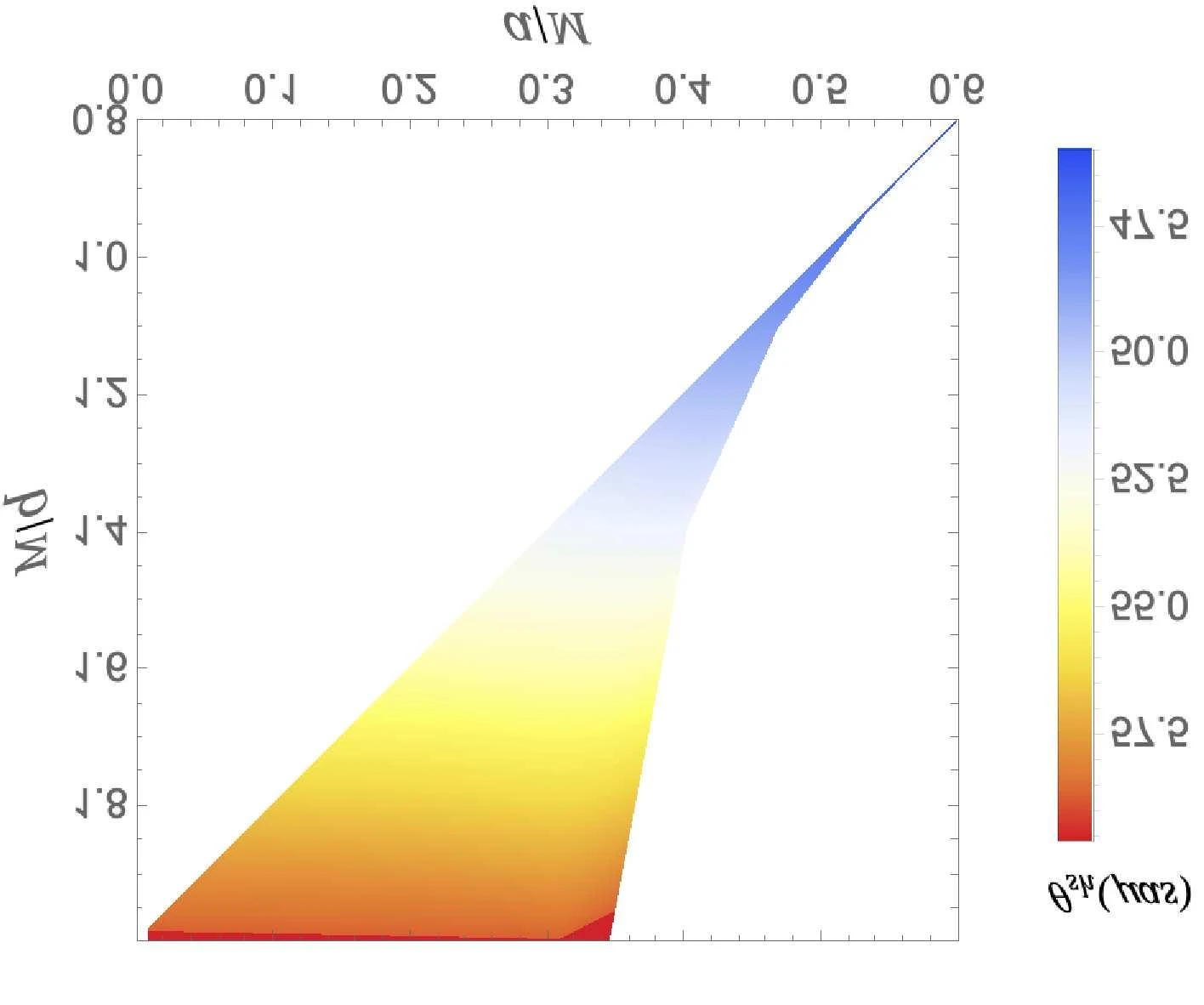
The Event Horizon Telescope (EHT) has provided a new tool for testing the strong-field regime of gravity by imaging the shadows of M87* and Sgr A*. These observations provide the first real opportunity to test whether quantum gravity--specifically loop quantum gravity--leaves observable imprints on spacetime. We use the EHT observations of M87* and Sgr A* to examine the observational signs of rotating holonomy-corrected black holes (RHCBHs). We discover that, in comparison to the typical Kerr black hole, the quantum correction parameter $$b$$ increases the size of the black hole shadow. As the deviation parameter $$b$$ increases in RHCBH, the prograde photon orbits shift outward, indicating a weaker effective gravitational field near the central region. Unlike Kerr naked singularities, which produce open arc-like shadows, the RHCBH spacetime can still produce closed shadow rings even in the absence of an event horizon. We find that photon rings continue to exist in the parameter range $$b_E \leq b \leq b_p$$, due to the presence of unstable circular photon orbits.We apply the Kumar--Ghosh method based on the shadow observables: the shadow area $$A$$ and the oblateness $$D$$ that together allow a unique determination of the spin parameter $$a$$ and the quantum correction parameter $$b$$. At $$\theta_o=17$$\textdegree~, the angular diameter bound of M87$$^{*}$$ yields $$b \leq 0.1319\,M$$ at $$a = 0\,$$ and $$b \leq 0.421\,M$$ at $$a = 0.784\,M$$, while at $$\theta_o=50$$\textdegree~, the angular diameter bound of Sgr A$$^{*}$$ yields $$b \leq 0.5764\,M$$ at $$a = 0\,$$ and $$b \leq 0.7482\,M$$ at $$a = 0.6253\,M$$ the Sgr~A$$^{*}$$. Our results show that nonzero values of the holonomy correction parameter are consistent with current EHT data, indicating that RHCBHs provide viable alternatives to the classical Kerr geometry in the strong-gravity regime and are strong astrophysical black hole candidates.
Свет в тени чёрной дыры может накручивать круги, создавая бесконечную череду отражений, как в зеркальном коридоре.
В «Интерстеллар» тень Гаргантюа смоделирована по классическим уравнениям; квантовые поправки сделали бы её чуть более овальной.