Танец пыли и света вокруг молодой звезды экспресс
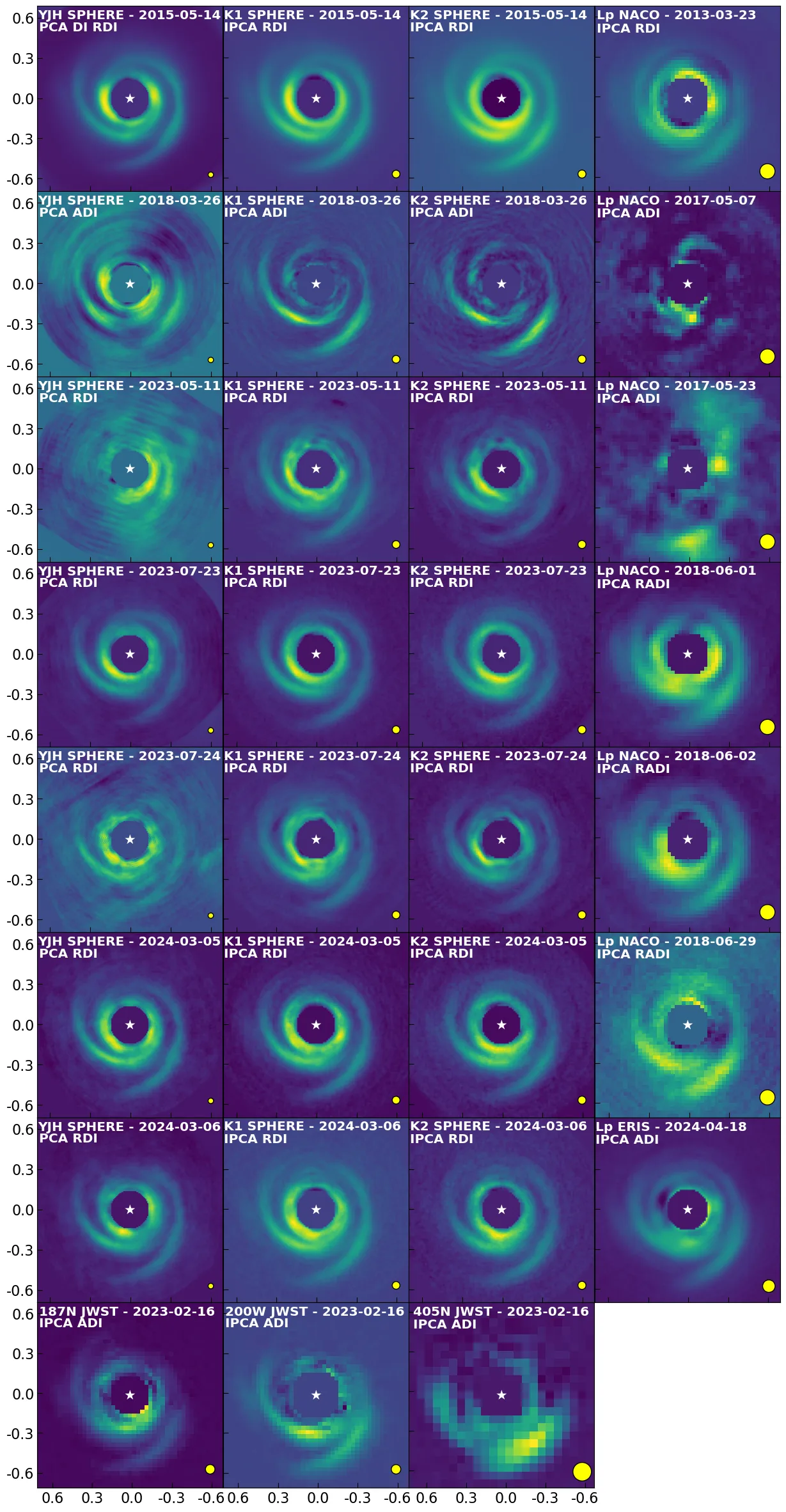
В 460 световых годах от нас, вокруг звезды HD 135344B, кружит плотный газопылевой диск. Он похож на гигантскую грампластинку, которую кто-то надломил: в диске зияет разрыв, а через него, словно тонкий мост, тянется пылевая нить. Рядом с этой нитью в рассеянном свете заметна закрутка — изгиб спирального рукава, будто его на мгновение придержали, а потом отпустили.
Астрономы собрали снимки с четырёх инструментов — VLT/NACO, VLT/SPHERE, VLT/ERIS и JWST/NIRCam — за десять лет. Они применили алгоритмы, которые убирают помехи от яркого света звезды, не искажая протяжённые структуры. Оказалось, что закрутка движется вместе со спиралью со скоростью 0,81±0,05 градуса в год. Это почти совпадает с более ранними измерениями — 0,85±0,05 градуса в год.
Такое движение естественно объяснить, если в разрыве прячется планета-гигант. Её орбитальная скорость на расстоянии 69±4 астрономических единиц (вдвое дальше, чем Нептун от Солнца) совпадает с наблюдаемым смещением закрутки. Недавний снимок, на котором вроде бы видна сама планета, оказался лишь дефектом обработки — призраком, рождённым алгоритмом. Но закрутка, спираль, разрыв и пылевая нить складываются в единый узор, который рисует невидимая рука.
Оригинальная аннотация
как её написали авторы, на английском arXiv:2606.10624
The HD 135344B (SAO 206462) disk exhibits strong signposts of planet formation. ALMA images in the sub-mm revealed a gap-crossing dust filament whose position coincides with a twist detected in the scattered-light spiral structure. Analysis of the spirals in polarized light also hints at a spiral-driving protoplanet in the sub-mm gap. We aim to study the spirals dynamics, as well as the twist, over a 10-year baseline, in different bands. We also seek to assess the authenticity of a recently claimed candidate protoplanet. We use high-fidelity post-processing algorithms such as IPCA to minimize the biases induced by ADI on extended sources and analyze archival VLT/NACO, VLT/SPHERE, VLT/ERIS and JWST/NIRCam datasets to obtain the spiral traces and measure their orbital motion in multiple scattered light bands. We measure an average spiral orbital motion of 0.81$$\pm$$0.05 deg/yr, in agreement with the literature value of about 0.85$$\pm$$0.05 deg/yr at all wavelengths. With simple modeling of the twist morphology, we confirm that it is co-moving with the spiral in which it is embedded. While the position angle of the twist coincides with the dust filament, it is located at a smaller angular separation from the star, which we attribute to the fact that the spiral trace moves away from the central star with increasing wavelength. We find that a recently claimed protoplanet candidate can be explained as a post-processing artifact. Our confirmation that the motion of the scattered light twist is consistent with the orbital velocity of a planet at 69$$\pm$$4 au over a 10-year baseline suggests that the spirals, the gap, the dust filament, and the twist, could indeed be attributed to the same hypothetical protoplanet embedded within the spiral. A perplexing trend for a wavelength-dependence of the angular distance of the spiral traces to the central star remains to be explained.
Одна астрономическая единица — это расстояние от Земли до Солнца. Планета-невидимка в диске HD 135344B находится в 69 раз дальше от своей звезды, чем Земля от Солнца, то есть почти на окраине Солнечной системы, если бы её перенести к нам.
В романе «Свидание с Рамой» Артура Кларка люди исследуют загадочный объект, скрывающий свои секреты за стеной. Так и здесь: планета остаётся невидимой, но её присутствие выдаёт гравитационный почерк в пыли и свете.