Из чего испекли планету-гиганта экспресс
Планета WASP-121 b — это не просто горячий шар. Это мир, где железо испаряется, а небо светится собственным жаром. Новый взгляд на неё помог понять, из каких «продуктов» она собралась.
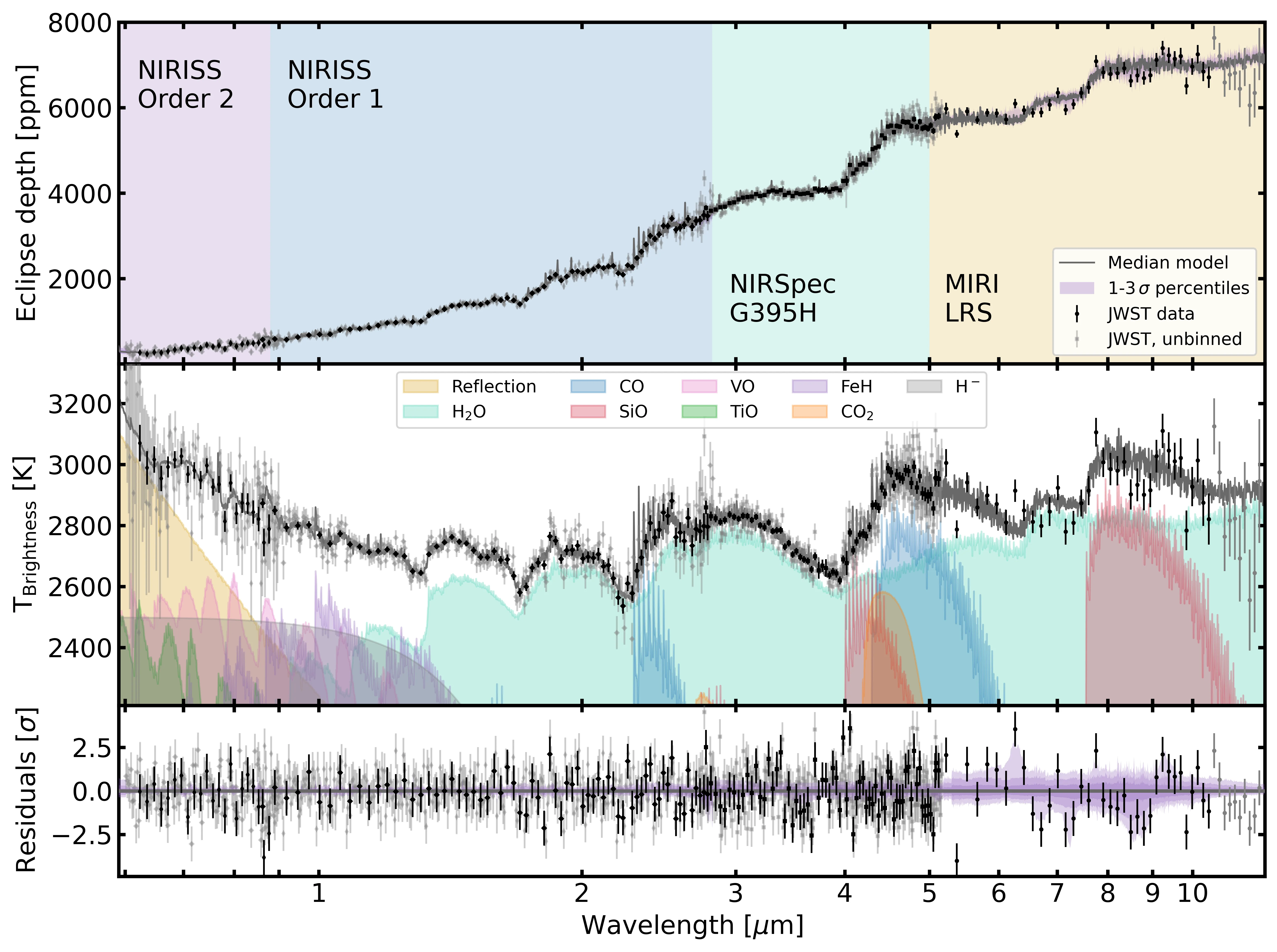
Учёные смешали свежие данные с трёх приборов «Уэбба» и добавили наземные измерения состава родительской звезды. Получилась полная картина: в воздухе планеты есть и лёгкие газы (вода, угарный газ), и тяжёлые элементы (кремний, железо). Но самое интересное — соотношение. Кремния относительно кислорода и углерода оказалось в три с лишним раза больше, чем в звезде. Такой «рецепт» не мог получиться из одного источника. Похоже, планета в молодости собирала вещество из разных зон протопланетного диска — часть в виде твёрдых тел, часть в виде газа. А потом она пережила встряску, которая наклонила её орбиту почти на 90 градусов к оси вращения звезды. Моделирование показало, что это могло быть тесное сближение с другой планетой или долгий танец с далёкой звездой-компаньоном.
Оригинальная аннотация
как её написали авторы, на английском arXiv:2606.21855
One path to understand how planets form is to link their present-day atmospheric composition to predictions from planet formation models. For the hottest planets, the abundances of refractory species can provide a useful formation tracer, complementing the traditionally used C/O and overall metallicity. Here we investigate the refractory abundance in the atmosphere of the ultra-hot Jupiter WASP-121 b, combining new JWST MIRI/LRS observations with archival NIRSpec/G395H and NIRISS/SOSS data to obtain a panchromatic dayside emission spectrum from 0.6 to 12 $$\mu$$m. Our retrieval analysis detects the refractory tracer SiO gas at high confidence, in addition to previously detected volatile species. The atmosphere is enriched in volatile and refractory species, with enhanced refractory-to-volatile ratios of Si/O=$$3.54^{+0.86}_{-0.69}$$x stellar and Si/C=$$3.05^{+1.12}_{-0.80}$$x stellar, relative to new stellar abundance constraints from ESPRESSO data. In addition, we confirm the depletion of TiO and the need for an additional source of reflected light opacity with a geometric albedo of $$0.22\pm0.03$$. The retrieved dayside temperature profile has a strong inversion layer, with a more complex structure than standard parameterizations can accommodate, and an eclipse map analysis indicates a small eastward hotspot offset of $$4.8^{+2.7\circ}_{-2.8}$$. Comparing our results with models of planet formation, we find that the measured enrichment pattern was shaped by accretion from multiple reservoirs, either through a mixture of solid and gas accretion interior to the water ice line or through continued solid accretion during inward migration from farther out in the disk. Finally, we model the planet's dynamical history and find that it could reach its current high-obliquity orbit as a consequence of a post-formation dynamical event, such as planet-planet scattering or von Zeipel-Lidov-Kozai cycles.
Температура на дневной стороне WASP-121 b достигает 3000 градусов Цельсия — этого достаточно, чтобы расплавить сталь, и в атмосфере там плавают пары металлов.
Похожий мир описан в романе «Свидание с Рамой» Артура Кларка — только там раскалённый объект прилетел к нам из межзвёздного пространства.