ثنائي نجمي يولد تموجات في نسيج الفضاء سريع
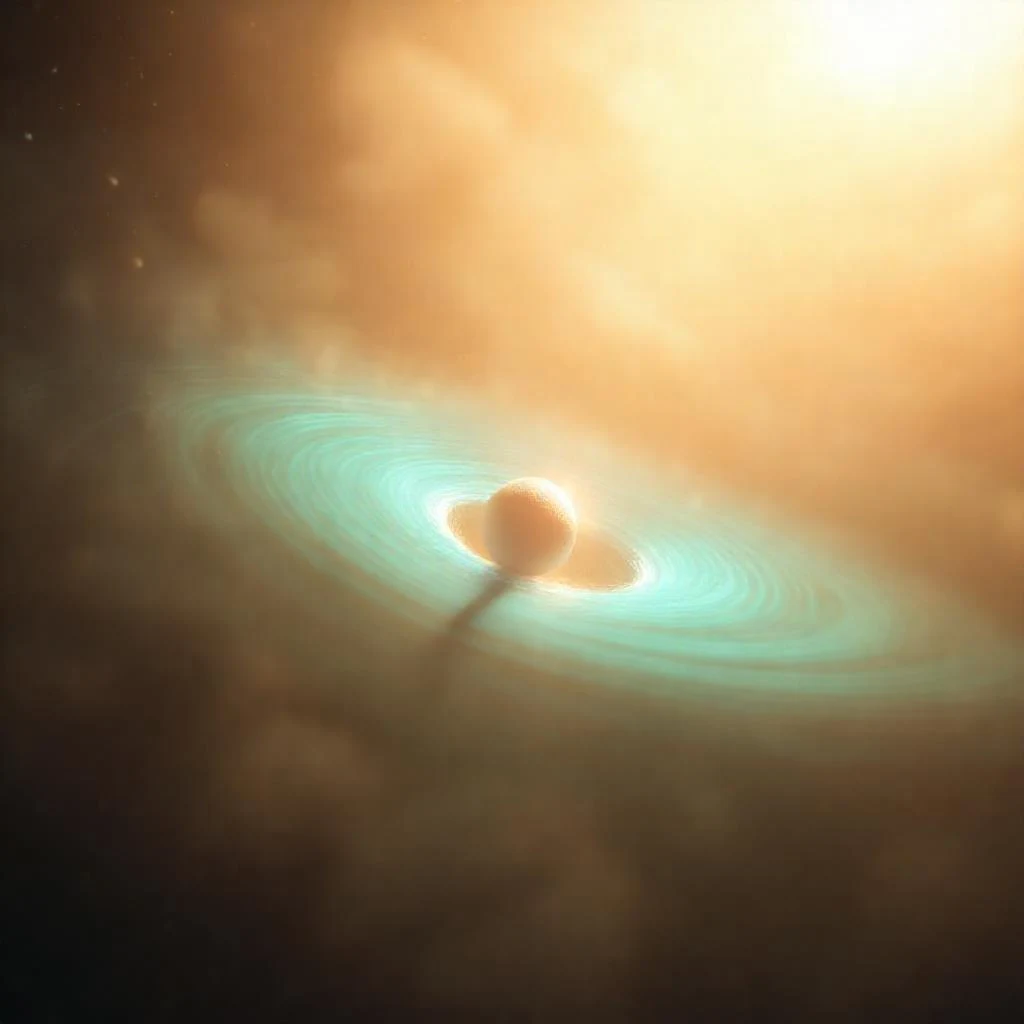
وجد علماء الفلك زوجًا من النجوم تزداد رقصته سرعةً كل عام. إنهما أقزام بيضاء – بقايا نجوم هامدة بحجم الأرض. أحد الراقصين يسحب الهيليوم من شريكه، ويلفه في وشاح متلألئ. ينكمش مدارهما، وتنطلق إلى الفضاء موجات جاذبية – تموجات كالدوائر على سطح الماء.
كل 8.6 دقائق، تُحدث النجوم كسوفات مصغرة، حيث يحجب كل منهما الآخر بدوره. أظهرت قياسات السطوع الدقيقة أن المدار يصبح أقصر بمقدار جزء من مليون من الثانية كل عام. وعلى مدى عقد من الرصد، أكد تحليل الضوء أن القرص حول النجم مكون من الهيليوم. الطاقة المتسربة مع الأمواج تفوق سطوع عشرات الشموس.
بعد ملايين السنين، سيندمج هذا الثنائي في نجم واحد: نجم نيوتروني أو حتى ثقب أسود. وسيلتقط كاشف LISA المستقبلي الأوتار الأخيرة لرقصتهما خلال أربع سنوات فقط من الرصد، كما تنبأ كيب ثورن.
الملخص الأصلي
كما كتبه المؤلفون، بالإنجليزية arXiv:2601.07925v4
We report the discovery of ATLAS J101342.5-451656.8 (hereafter ATLAS J1013-4516), an 8.56 minute orbital period mass transferring AM Canum Venaticorum binary with mean Gaia magnitude G=19.51. The system was identified via periodic variability in Asteroid Terrestrial-impact Last Alert System light curves of Gaia white dwarf candidates. Follow-up spectroscopy with the Large Lenslet Array Magellan Spectrograph reveals a helium dominated accretion disk, while high speed ULTRACAM photometry shows pronounced primary and secondary eclipses. We construct a decade long orbital timing baseline using ATLAS and Gaia survey photometry together with high speed observations from ULTRACAM on the NTT and proto Lightspeed on the Magellan Clay telescope. From this baseline we measure an orbital period derivative Pdot = -1.60 +/- 0.07 x 10^-12 seconds per second. Interpreted in the context of stable mass transfer, the magnitude and sign of Pdot indicate orbital evolution governed by the interplay between gravitational wave driven angular momentum losses and mass transfer, directly probing the donor star structural response to mass loss. Assuming angular momentum loss dominated by gravitational radiation, we constrain the component masses and infer the characteristic gravitational wave strain. We predict a four year Laser Interferometer Space Antenna signal to noise ratio greater than 10, establishing ATLAS J1013-4516 as a strong prospective space based gravitational wave source that probes long term orbital evolution in the mass transferring regime.
لو كان هناك مراقب على بعد مئة كيلومتر من هذا النظام، لرأى ظلامًا كل 8.5 دقائق، حيث يحجب أحد النجمين الآخر للحظات.