خيوط كونية تشد في اتجاهين متعاكسين سريع
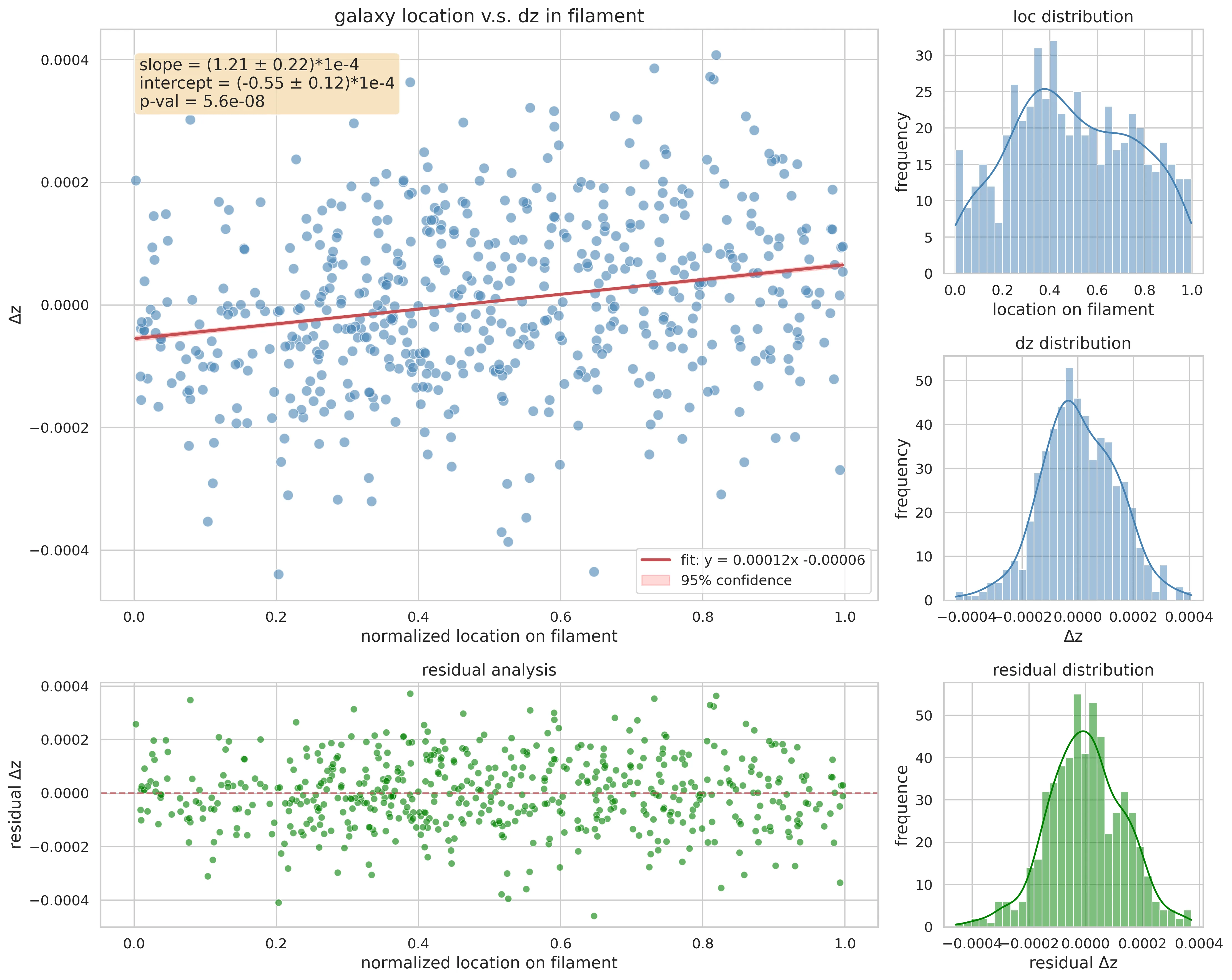
على المقاييس الكبيرة، يشبه الكون شبكة عنكبوت هائلة: عناقيد المجرات الساطعة مترابطة بخيوط طويلة من المجرات والغاز والمادة المظلمة. كان يُعتقد سابقًا أن المادة تتدفق عبر هذه الخيوط نحو العناقيد، كما تتدفق عبر الأنابيب. لكن دراسة جديدة تُظهر أن الخيط بين عنقودين ليس مجرد قناة، بل ساحة لشد الحبل.
أخذ العلماء بيانات عن آلاف المجرات من مسح سلووان الرقمي للسماء، وحددوا الخيوط التي تربط أزواجًا من العناقيد. لاحظوا أن المجرات داخل الخيط تتحرك في اتجاهين متعاكسين: تلك القريبة من عنقود تتجه نحوه، وتلك القريبة من العنقود الآخر تتجه نحوه. في منتصف الخيط، تتغير السرعة إشارتها — وكأن حبلًا مطاطيًا مشدودًا قُطّع من منتصفه، فانكمش كل نصف نحو طرفه.
هذه النتيجة مهمة ليس فقط لفهم الشبكة الكونية. من خلال طريقة تفرق المجرات في الخيط، يمكن قياس كتلة العناقيد بدقة أكبر دون الاعتماد على طرق أخرى أكثر تعقيدًا. كما أنها وسيلة جديدة لاختبار ما إذا كانت فهمنا للجاذبية على مسافات شاسعة صحيحًا — فإذا تصرفت الخيوط بشكل مختلف عما تتنبأ به النظرية، فقد يشير ذلك إلى فيزياء جديدة.
الملخص الأصلي
كما كتبه المؤلفون، بالإنجليزية arXiv:2601.18434
Velocity fields in the cosmic web are fundamental to structure formation but remain difficult to observe directly beyond the linear regime. Here we present observational evidence that galaxy filaments connecting pairs of galaxy clusters undergo a split infall, with opposite velocity flows toward the two clusters. Using spectroscopic galaxies from the Sloan Digital Sky Survey, we isolate the internal filament velocity field by subtracting its rigid-body background motion and Hubble flow, and detect this effect at greater than $$5\sigma$$ significance across a wide range of cluster and filament selections. The measured velocity profile exhibits a sign reversal near the filament midpoint and a maximum infall amplitude of $$\sim30$$ km/s ($$\sim20$$ km/s projected onto the line-of-sight) for clusters of mass $$\sim10^{14.3}M_\odot$$, substantially lower than expected for infall from an average cosmic environment. Multiple results on density-velocity correlation, mass-dependency, and validation with simulation indicate that filaments dynamically respond to competing gravitational potentials rather than acting as passive mass transport channels. Our results establish a new observational window on quasi-linear velocity fields in the cosmic web and provide a promising probe of mass measurement, testing gravity and velocity reconstruction with upcoming wide-field spectroscopic surveys.
تتحرك المجرات في الخيط بسرعة حوالي 30 كيلومترًا في الثانية — أي أسرع بنحو 100 مرة من سرعة الرصاصة، لكنها أبطأ بآلاف المرات من سرعة الضوء.