Peng Wang

5 articles · 20 co-authors · latest: 2026-06-26
16 citations · h-index 1 · 3 papersData: Semantic Scholar

We have retold 5 papers by this author. most often about: large-scale structure of the universe, galaxy cluster, galaxy. 20 co-authors across our retellings.

Links in the knowledge graph
Cosmology2026-01-261 minarXiv:2601.18434express
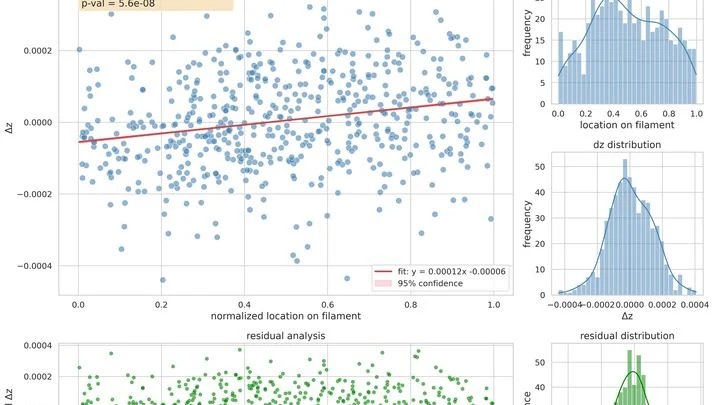
Cosmic filaments pull in two directions
On large scales, the universe resembles a giant spiderweb: bright galaxy clusters are connected by long filaments of galaxies, gas, and dark matter. Previously, it was thought that matter flows along these filaments like water through pipes, heading toward the clusters.

Nuclear Theory2026-03-081 minarXiv:2603.07596express
How Nuclear Shape Changes Its Size
An atomic nucleus isn't always round. It can stretch out like a melon or flatten like a pumpkin. And its size depends on this shape — just as the size of a pie depends on the shape of the dough. Scientists calculated the shapes and sizes of nuclei of berkelium isotopes — a heavy element produced in reactors.
General Relativity2026-04-282 minarXiv:2604.25223express
When a Weak Voice Outshouts a Loud One
Drop a stone into a pond — ripples spread across the water. The most visible ripple comes from the strongest splash. That's roughly how physicists picture the growth of perturbations around a black hole: if a system has an instability, its 'loudest' component, the one that grows fastest, should show up first.
HEP Theory2026-05-151 minarXiv:2605.15776express
The Perfect Mirror: Quantum Fields on a Donut and the Geometry Within
On a donut-shaped ring, the theory lives on the surface, while inside hides a curved space — like a saddle widening toward the edge. According to the holographic principle of Juan Maldacena, everything happening inside can be described by data on the boundary.
General Relativity2026-06-261 minarXiv:2606.28161express
Gravitational atoms of axions sing in black hole pairs
A black hole, like a spinning wheel, twists a cloud of light particles, axions, around itself. These particles are the leading candidates for dark matter. The cloud follows the laws of quantum mechanics, resembling a giant atom: there are levels, and there are transitions between them.