كوكبان لا يهدآن: خفيفان لكن مختلفان في الداخل سريع
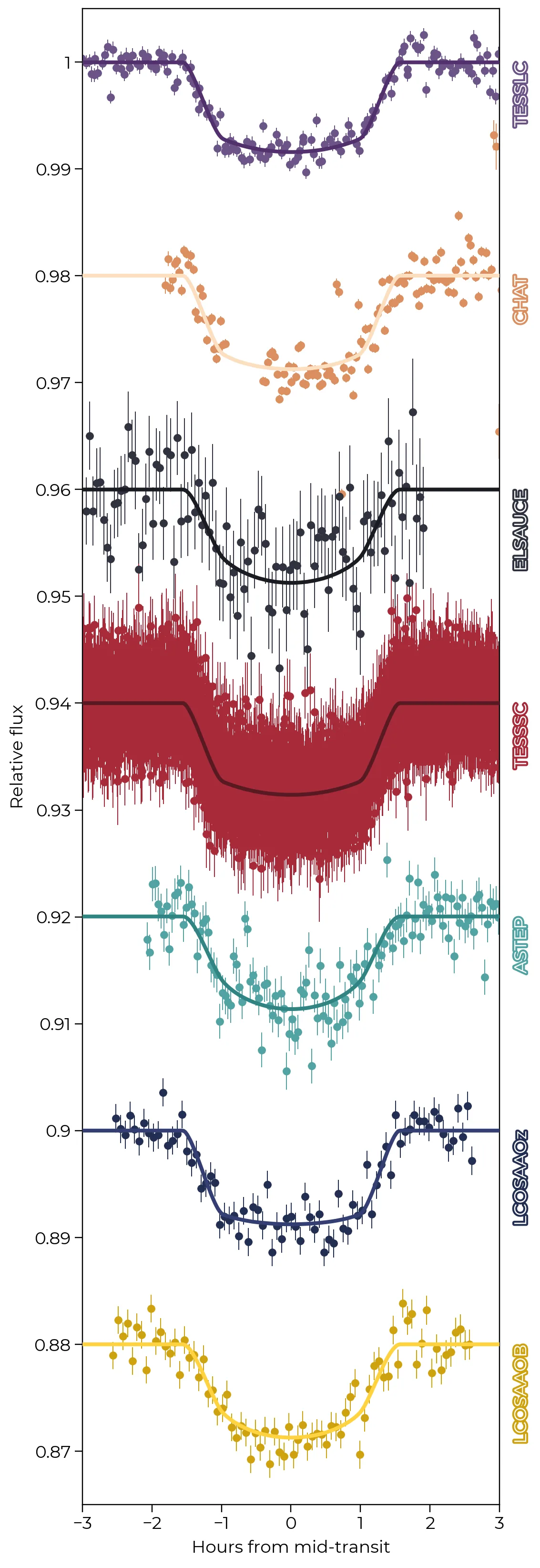
يراقب التلسكوب الفضائي TESS آلاف النجوم ويلتقط اللحظة التي يمر فيها كوكب أمام قرص نجمه، فيخفت ضوء النجم قليلًا. هكذا رصد علماء الفلك كوكبين بالقرب من نجمين يشبهان شمسنا. أحدهما، TOI-883 b، يكمل دورة حول نجمه في عشرة أيام، والآخر، TOI-899 b، في ما يقرب من ثلاثة عشر يومًا. الكوكبان حاران: تبلغ درجة الحرارة عليهما حوالي ثمانمئة درجة مئوية، مثل فرن لحرق الفخار.
ثم دخلت التلسكوبات الأرضية على الخط. قامت بقياس كيفية تمايل النجوم قليلًا بفعل جاذبية الكوكبين — وهذه الطريقة تشبه طفلًا ثقيلًا على أرجوحة يجعل الهيكل كله يهتز. اتضح أن الكوكبين أخف من زحل: أحدهما يزن مثل 39 أرضًا، والآخر مثل 68 أرضًا. لكن الغريب هنا: مع تساوي الوزن تقريبًا وتشابه النجوم المضيفة، يختلف حجم الكوكبين. الأول أكبر قليلًا من نصف نصف قطر المشتري، والثاني بحجم المشتري تقريبًا. إذن، داخلهما مختلف.
هذا الاختلاف رغم تشابه ظروف النشأة لغز. ربما تشكل الكوكبان في جزأين مختلفين من القرص الكوكبي الأولي، أو ربما تعرض أحدهما لاصطدام غيّر داخله. الآن الكوكبان مختبران ممتازان: يمكن دراسة غلافيهما عندما يمران أمام نجميهما، ومن خلال تكوين الغازات يمكن فهم أين وكيف نشآ.
الملخص الأصلي
كما كتبه المؤلفون، بالإنجليزية arXiv:2602.16646
Context. Characterization of warm giants is crucial to constrain giant planet formation and evolution. Measuring the mass and radius of these planets, combined with their moderated irradiation, allows us to estimate their planetary bulk composition, which is a key quantity to comprehend giant planet formation and structure. Aims. We present the discovery of two transiting warm giant planets orbiting solar-type stars from the Transiting Exoplanet Survey Satellite (TESS), which were characterized by further spectroscopic and photometric ground-based observations. Methods. We performed a joint analysis of photometric data with radial velocities to confirm and characterize TOI-883 b and TOI-899 b, two sub-Saturns orbiting solar-like stars. Results. TOI-883 b and TOI-899 b have masses of $$0.123 \pm 0.012$$ $$M_J$$ and $$0.213 \pm 0.024$$ $$M_J$$, radius of $$0.604 \pm 0.028$$ $$R_J$$ and $$0.991 \pm 0.044$$ $$R_J$$, periods of $$10.06$$ d and $$12.85$$ d and equilibrium temperature of $$1086 \pm 19$$ K and $$1040 \pm 19$$ K, respectively. Conclusions. While having similar masses, orbital periods and stellar host properties, these planets seem to have different internal compositions, which could point to distinct formation histories. Both planets are suitable targets for atmospheric studies to further constrain formation scenarios of planets in the Neptune-Saturn mass range
درجة الحرارة على هذين الكوكبين حوالي 800 درجة مئوية — عند هذه الحرارة ينصهر الرصاص ويبدأ الزجاج في الليونة.