Chelsea X. Huang

5 articles · 30 co-authors · latest: 2026-08-25
55 citations · h-index 4 · 14 papersData: Semantic Scholar

We have retold 5 papers by this author. 1 of them with a full read. most often about: exoplanet, planetary migration, asteroid. 30 co-authors across our retellings.

Links in the knowledge graph
Exoplanets2026-01-192 minarXiv:2601.13302express
Exoplanets2026-01-271 minarXiv:2601.19870express
One Transit, One Year
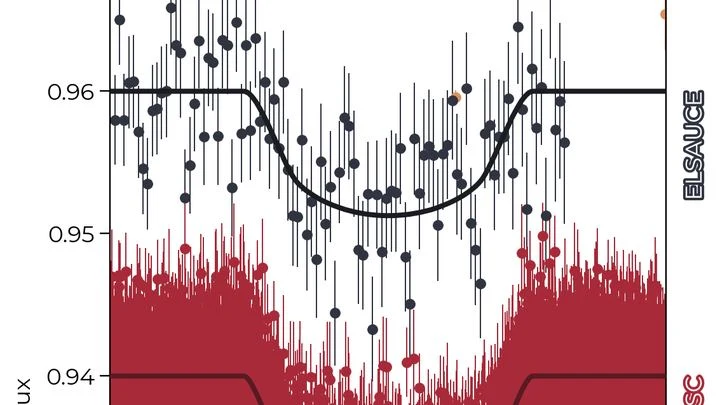
For ten hours, the star HD 137010 dimmed a little, like a lamp with a speck of dust on it. The K2 telescope caught this in 2017, and in all the observing time, it happened only once. Astronomers realized: a planet had passed in front of the star. This way of finding worlds is called the transit method. When a planet crosses the star's disk, the star briefly fades.
Exoplanets2026-02-181 minarXiv:2602.16646express
Two Restless Planets: Light but Different Inside
NASA's TESS space telescope monitors thousands of stars, catching the moment when a planet crosses its star's disk — the star's light dims slightly. That's how astronomers spotted two planets orbiting stars similar to our Sun. One, TOI-883 b, completes an orbit in ten days; the other, TOI-899 b, takes nearly thirteen.
Exoplanets2026-03-191 minarXiv:2603.19402express
A Quiet Star: How They Searched for a Planet and Found Nothing
The Gaia space telescope measures star positions with an accuracy of a microarcsecond, like spotting a coin on the Moon from Earth. In 2022, it noticed that the bright star HD 12800 was wobbling slightly, as if tugged by an invisible companion. Astronomers hypothesized that a planet orbits the star. But a wobble can be deceiving.
The Neighbor Who Wasn't Kicked Out
On a sunny street, there's a house with a big family: a giant father who always sits by the window and a small child running around the yard. That's the TOI-4468 system: a gas giant hot Jupiter hugs the star, while a bit farther out circles a sub-Neptune — a planet smaller than Neptune but larger than Earth.