Jeffrey D. Crane

4 articles · 30 co-authors · latest: 2026-07-01
342 citations · h-index 7 · 45 papersData: Semantic Scholar

We have retold 4 papers by this author. 1 of them with a full read. most often about: exoplanet, free-floating planet, planetary migration. 30 co-authors across our retellings.

Links in the knowledge graph
Exoplanets2026-01-161 minarXiv:2601.11280express
Cold Jupiters: Invisible Giants on the Outskirts
Jupiter is a colossal ball of gas that sits five times farther from the Sun than Earth. Now imagine a similar ball, but around another star, at a distance tens of times greater. These are called cold Jupiters, and they remain a puzzle: how did they get there? Astronomers studied four such planets around distant stars.
Exoplanets2026-02-181 minarXiv:2602.16646express
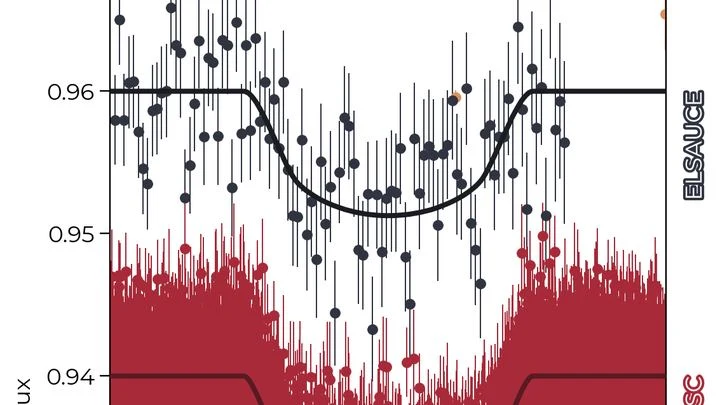
Two Restless Planets: Light but Different Inside
NASA's TESS space telescope monitors thousands of stars, catching the moment when a planet crosses its star's disk — the star's light dims slightly. That's how astronomers spotted two planets orbiting stars similar to our Sun. One, TOI-883 b, completes an orbit in ten days; the other, TOI-899 b, takes nearly thirteen.
Exoplanets2026-04-201 minarXiv:2604.18579express
Quiet Stars, Loud Discoveries
The TESS telescope photographed the sky for a full year, but its standard pipeline skipped over dim stars. The T16 project took the same images and cleaned them from scratch — resulting in 83,717,159 light curves, like EKGs for every star. Planets passing in front of their star briefly dim it, and these dips in the EKGs are what we look for.
Cosmic Carving: Birth of a Bloated Neptune from a Jupiter
A ball, almost weightless for its size, circles its star every four days. Planet TOI-2195 A b is a real riddle: by mass it's slightly heavier than Neptune, yet bloated to Jovian volumes. If there were an ocean big enough, this exoplanet would float on its surface like a giant inflatable ball.
