حيث تولد النجوم: خيوط الكون سريع
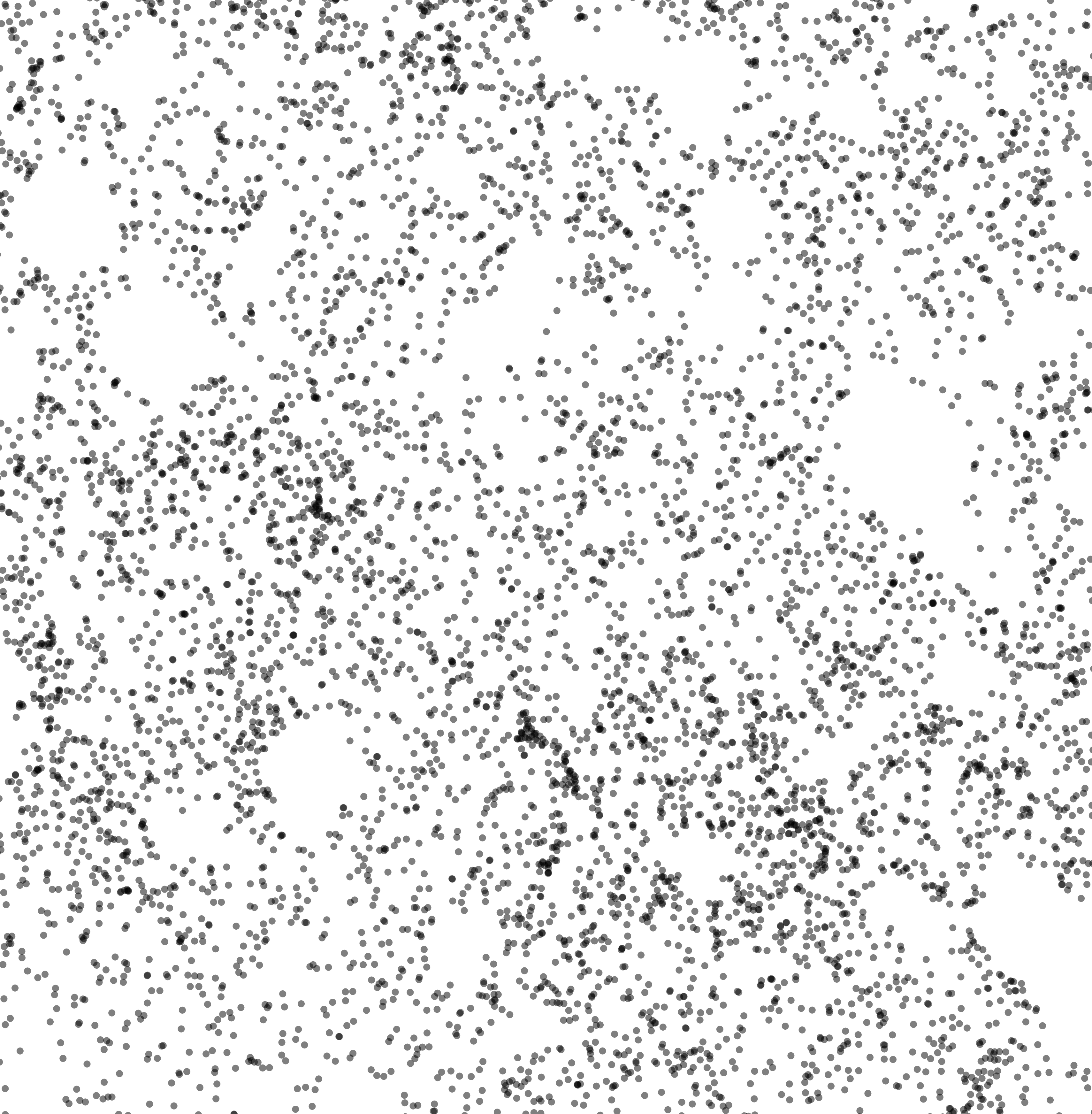
يشبه الكون شبكة عنكبوتية عملاقة: فالمجرات ليست متناثرة عشوائيًا، بل تتجمع في عُقد وعلى امتداد خيوط. داخل الخيوط توجد كميات كبيرة من الغاز، وهناك غالبًا ما تتوهج نجوم جديدة. ولكن كيف تغير هذا الأمر مع مرور الزمن؟ قارن العلماء بيانات من نموذج حاسوبي مع ملاحظات حقيقية لآلاف المجرات.
اتضح أنه في الكون الفتي، كانت المجرات التي تشهد ولادة نجوم عنيفة تقترب بالفعل من الخيوط. أما في الأزمنة الأحدث، فقد ابتعدت على العكس من ذلك. والمجرات الهادئة، التي لا تولد فيها نجوم تقريبًا، كانت تقترب أكثر فأكثر من الخيوط مع مرور الوقت. أما المجرات ذات المعدل الطبيعي لتكوين النجوم فبقيت في المنتصف.
هذه ليست مجرد حقيقة طريفة. بل تعني أن البنية واسعة النطاق للكون — الخيوط والفراغات — تتحكم مباشرة في حياة المجرات. وهذا واضح حتى على مسافات تبلغ مليارات السنين الضوئية.
الملخص الأصلي
كما كتبه المؤلفون، بالإنجليزية arXiv:2602.21890
Cosmological simulations suggest that various galaxy properties depend on their location within the cosmic web. Yet direct observational evidence of the dependence of star formation activity on distance to filaments remains scarce and is missing at z>1. We investigate how starburst, main-sequence (MS), and quenched galaxies are distributed with respect to cosmic web filaments, and how this distribution evolves with redshift. We first use the SIMBA cosmological simulation to predict the redshift evolution of the mean distance to the closest filament from z=3 to z=0 for different galaxy populations after removing stellar-mass dependencies. We then measure the corresponding signal in the COSMOS field, using COSMOS2020 and COSMOS-Web data, where accurate photometric redshifts enable reconstruction of the projected cosmic web from z=2 to z=0.5, and starbursts are identified through far-infrared spectral energy distribution fitting. In agreement with the results from SIMBA, starburst galaxies are found closer to filaments at z>1 and at larger distances at z<1, MS galaxies occupy intermediate environments with little evolution, and quenched galaxies show progressively shorter distances to filaments toward low redshift, with a crossing between starburst and MS populations around z~1. In COSMOS-Web, the relative evolution in the average distance to filaments between starburst and MS galaxies is detected at a significance level of at least 5{\sigma}. We show that a minimal toy model in which the only environmental ingredient is the sSFR-filament distance modulation measured in simulations is sufficient to reproduce the observed differential evolution of the average filament distance between starburst and MS galaxies. These results show that the imprint of large-scale environmental effects on the star formation activity of galaxies, predicted by simulations, is detectable from z=2 down to z=0.5.
ألمع ومضات ولادة النجوم في الكون الفتي حدثت بالقرب من الخيوط الكونية، وبعد مليارات السنين انعكست الصورة.