الجار الخفي للنجم النابض سريع
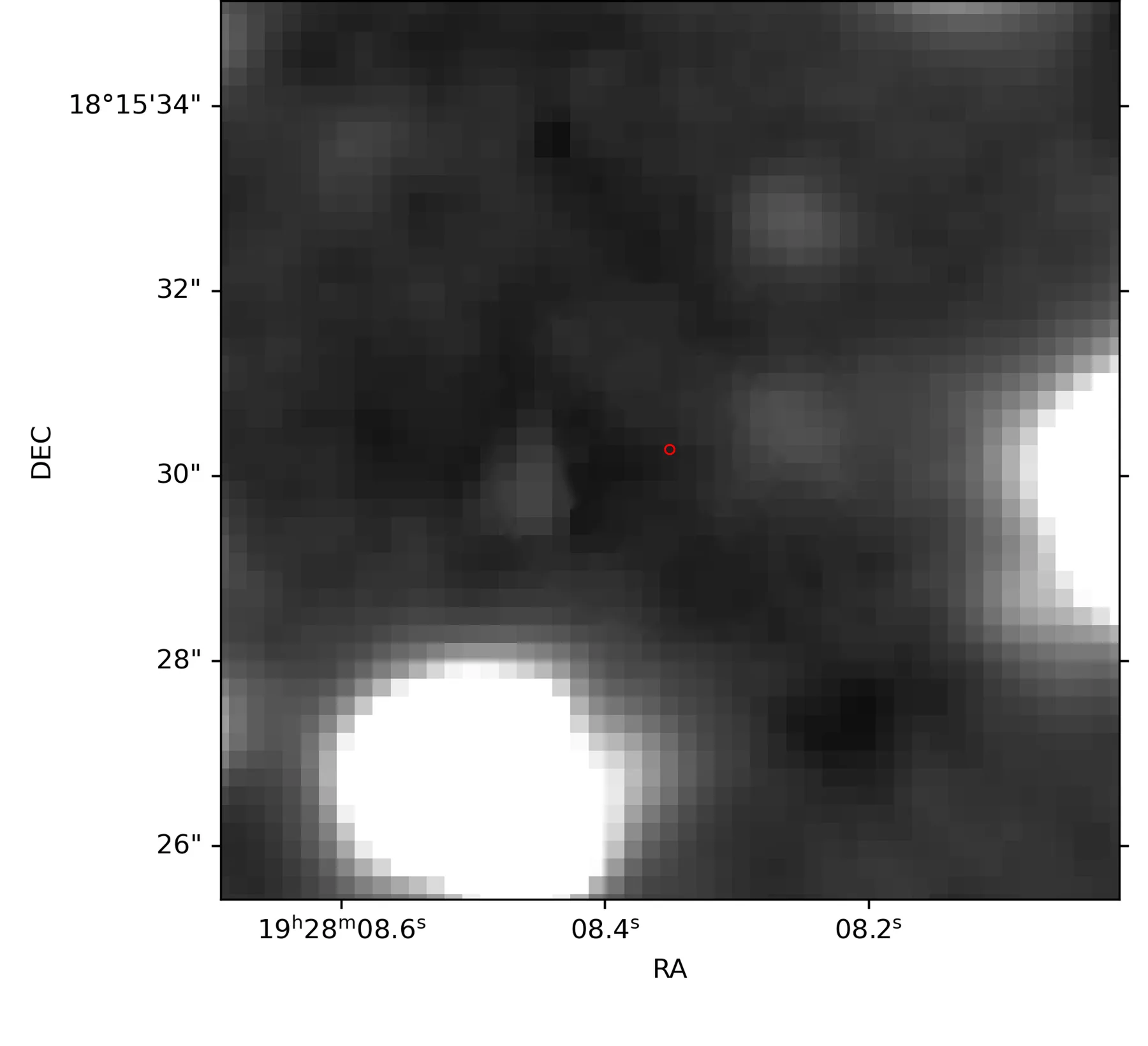
النجم النابض هو نجم ميت يدور بسرعة هائلة ويطلق نبضات راديوية مثل المنارة. لكن بالنسبة إلى PSR J1928+1815، تنطفئ الإشارة أحيانًا لمدة 3.6 ساعة. شيء ما يحجب المنارة. يدور حول النجم النابض نجم رفيق، ويلقي بظله علينا.
لفترة طويلة، اعتقد العلماء أن الرفيق هو نجم هيليوم عارٍ: نواة نجم سابق فقدت طبقاته الخارجية. يجب أن يلمع مثل هذا النجم بشدة في نطاق الأشعة تحت الحمراء. وجه علماء الفلك تلسكوب كيك المزود بالبصريات التكيفية (adaptive optics) نحو النجم النابض، وهو نظام يزيل ارتعاش الغلاف الجوي مثل مثبت الكاميرا. نظروا بعمق حتى القدر 21.3 في مرشح Ks. ولم يروا شيئًا. لا شيء.
يبقى القزم الأبيض (white dwarf) — بقايا نجم كثيفة مثل شمسنا. إنه خافت ولا يُرى. ولكن كيف يخلق جار هادئ كهذا حجبًا راديويًا؟ هناك فكرتان. الأولى: القزم الأبيض لا يزال شابًا وساخنًا، وتهب منه رياح — تيار من الجسيمات يمتص موجات الراديو الصادرة عن النجم النابض. الثانية: النجم النابض نفسه ينفخ المادة من القزم بإشعاعه. الاحتمال الأول أكثر منطقية: بعد مرحلة معينة من تطور النظام الثنائي، يولد قزم أبيض كتلته حوالي 1.2 كتلة شمسية، وهو قادر على إطلاق رياح لعشرات الآلاف من السنين. هذا يكفي لإخفاء النجم النابض.
إذن، نحن نرصد النظام في لحظة قصيرة من عمره. ستخفت الرياح، وسيتوقف النجم النابض عن الاختفاء. لذلك، هذه الأزواج نادرة: معظمها إما غير مرئي لنا أو لم يولد بعد. PSR J1928+1815 يشبه لقطة من فيلم حيث تومض المنارة ثم تنطفئ في ضباب رياح غريبة.
الملخص الأصلي
كما كتبه المؤلفون، بالإنجليزية arXiv:2604.03385
PSR J1928+1815 is a 10.55 ms millisecond pulsar in a 3.6 hr orbit with a massive ($$1.0$$-$$1.6\,M_{\odot}$$) companion that produces extended radio eclipses. The companion, proposed to be a stripped helium star, is undetected in optical and infrared surveys. We present deep near-infrared imaging using Keck/NIRC2 with laser guide star adaptive optics. No source is detected at the pulsar position down to a $$5\sigma$$ limit of $$K_s \approx 21.3$$. Using stripped-star atmosphere models and conservative extinction estimates, we show that any plausible helium star companion would have been detected, ruling out this interpretation. A massive white dwarf (WD) companion remains consistent with the non-detection. We consider two possible origins for the eclipses: (1) absorption in a wind driven by a young, hot WD, and (2) material ablated from the WD by the pulsar. The former can naturally arise following Case BB mass transfer, which produces $$\sim 1.2\,M_\odot$$ WDs capable of sustaining winds of $$\dot{M} \gtrsim 10^{-12}$$-$$10^{-13}\,M_\odot\,{\rm yr}^{-1}$$ for $$\sim 10^4$$-$$10^5$$ yr, sufficient to obscure the pulsar at GHz frequencies. The latter requires efficient coupling of the pulsar's spin-down luminosity to the companion to drive the needed mass loss, which may be difficult to achieve. If the eclipse is powered by a WD wind, the system is likely observed in a short-lived phase; alternatively, if the companion is an older WD, the origin of the eclipsing material remains unclear. The apparent uniqueness of PSR J1928+1815 is consistent with a short detectability lifetime, though formation rate estimates remain uncertain.
النجم النابض PSR J1928+1815 يدور 95 دورة في الثانية — أسرع من شفرات خلاط المطبخ.
في مسلسل «ستار تريك»، استُخدمت النجوم النابضة كمنارات ملاحية طبيعية للسفن الفضائية.