عدسة كونية تكشف كتلة غير مرئية من المادة المظلمة سريع
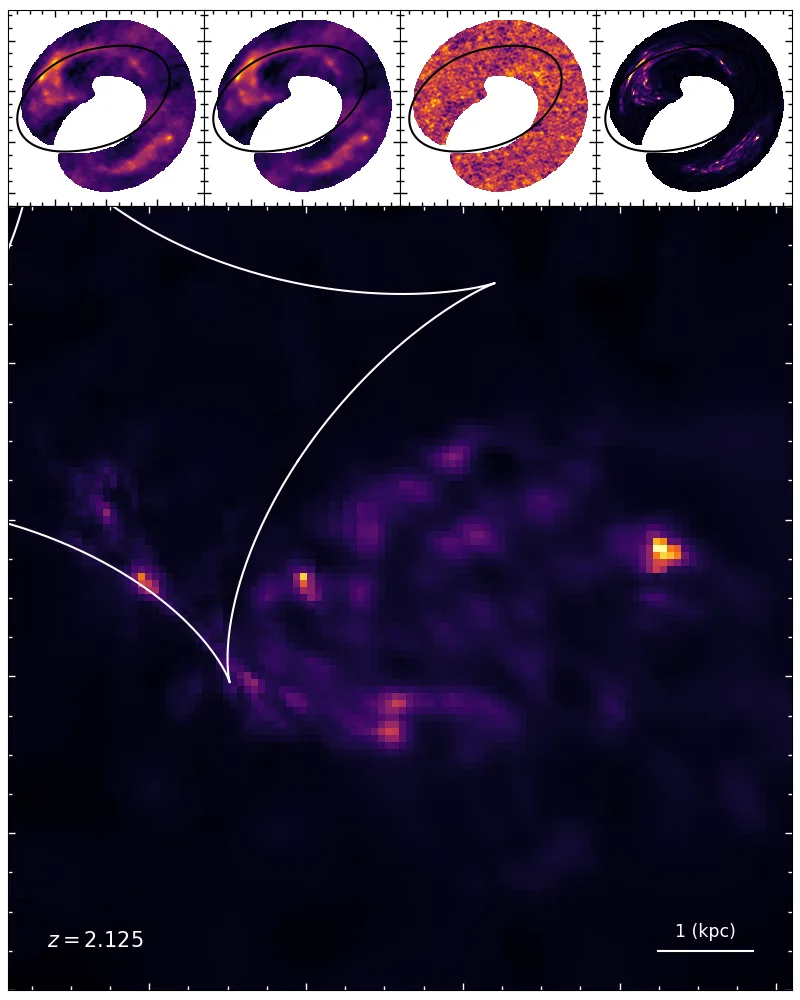
تعمل العدسة المكبرة على تجميع ضوء الشمس في نقطة مضيئة. إذا كان هناك عيب صغير في الزجاج، فسيتشوه قرص الضوء. هذا هو تقريبًا مبدأ عدسة الجاذبية: مجرة ضخمة تعمل على انحناء أشعة الضوء القادمة من مصدر أبعد، مما يخلق صورة مكبرة ومشوهة أحيانًا. في نظام PJ011646، استخدم علماء الفلك تلسكوب ALMA للنظر عبر العدسة الكونية — وهي مجرة إهليلجية — إلى مجرة أبعد تُرى في نطاق المليمتر.
في صورة المجرة ذات العدسة، لاحظ العلماء انكسارات وإزاحات طفيفة لا يمكن تفسيرها بشكل شكل المجرة العدسة وحدها. تحدث مثل هذه التشوهات عندما يصادف ضوء جسمًا ضخمًا غير مرئي — كتلة من المادة المظلمة (مادة غامضة لا تصدر أو تمتص الضوء، ولكنها تظهر من خلال الجاذبية). أظهر التحليل أن هذه الكتلة تزن حوالي 28 مليار شمس، لكنها تتركز في منطقة حجمها بضعة آلاف من السنين الضوئية فقط. للمقارنة: إذا كان حجم شمسنا بحجم حبة البازلاء، فإن هذه الكتلة ستكون مثل كرة قدم مكونة من ملايين من هذه البازلاء.
الأكثر إثارة للاهتمام هو أن كتلة هذا الجسم — حوالي 28 مليار كتلة شمسية — تقع في النطاق الذي تتنبأ فيه نظريات المادة المظلمة الباردة والدافئة بأعداد مختلفة من هذه الكتل. تسمح المادة المظلمة الباردة (المكونة من جسيمات بطيئة وثقيلة) بوجود العديد من الكتل الصغيرة، بينما تسمح المادة الدافئة (جسيمات أخف وأسرع) بعدد أقل بكثير. يؤكد الاكتشاف أن طريقة عدسة الجاذبية عالية الدقة قادرة على النظر في هذا النطاق الحرج من الكتل، وستساعد في المستقبل على الاختيار بين الفرضيات المتنافسة.
الملخص الأصلي
كما كتبه المؤلفون، بالإنجليزية arXiv:2605.21212
We present a strong lensing analysis of the system PJ011646 using high-resolution ($$\sim$$0.1 arcsec) Atacama Large Millimeter/submillimeter Array (ALMA) dust-continuum observations to test for the presence of dark matter substructures. The lens mass distribution is modelled with an elliptical power law and third- and fourth-order multipoles (PL+MP; $$m=3,4$$), plus external shear. The multipoles have amplitudes of $$\simeq$$1.5 per cent of the convergence, consistent with nearby early-type galaxies, and improve the fit by $$\Delta\ln Z = 52.1$$ relative to a pure PL model. Using this best-fitting macromodel, we perform a grid-based subhalo search in the image plane, parametrising the perturber as a spherical NFW. A subhalo in two locations in the image plane improves the fit by $$\Delta\ln Z>10$$. Both correspond to the same location in the source plane, so they are partially degenerate; follow-up analysis suggests that only one is physically real. This is a subhalo of mass $$M_{200} = {2.78}_{-0.66}^{+0.43} \times 10^{10} \, M_\odot$$ and concentration $$c_{200} = 30_{-7}^{+5}$$, detected at $$\sim$$5.8$$\sigma$$ significance (relative to the PL+MP). This concentration is consistent with that expected for a typical tidally stripped Navarro-Frenk-White subhalo. The enclosed projected mass is most tightly constrained within a radius of 2 kpc, where we infer $$M_{\rm sub} = {3.57}_{-0.14}^{+0.16}\times 10^9 \, M_\odot$$. From grid cells consistent with no detection ($$\Delta \ln Z < 10$$), we derive limits on the minimum subhalo mass that could have been detected at $$3\sigma$$ significance, finding $$M_{200} \approx 8 \times 10^{8} \, M_\odot$$ in the most sensitive regions of the lensed arcs. This demonstrates that ALMA continuum imaging at sub-arcsecond resolution can probe dark matter substructure in a mass regime where cold and warm dark matter models predict different abundances of subhalos.
المادة المظلمة في الكون تزيد بنحو خمسة أضعاف عن المادة العادية — تلك التي تتكون منها النجوم والكواكب ونحن. لكننا ما زلنا لا نعرف من أي جسيمات تتكون.
في رواية "الغابة المظلمة" للكاتب ليو تسيشين، تُستخدم المادة المظلمة كسلاح — كتل غير مرئية قادرة على تدمير أساطيل بأكملها. الواقع ربما ليس دراميًا بهذا القدر، لكنه غامض بنفس القدر.