Sumatra's Cyclone Factory: Ten Years of Observations
Sumatra's mountain range works like a stamping press: easterly winds hitting the slopes leave a chain of rotating imprints in the air behind the island. These vortices, like blanks on an assembly line, detach from the land and drift over the ocean, where some of them grow into tropical cyclones. Ten years of observations, from 2008 to 2017, showed that this factory operates almost nonstop: during that period, 1141 vortices were born off the coasts of Sumatra, the Malay Peninsula, and Java.
Previously, scientists had only short observation series, leaving it unclear how typical the pattern seen over a couple of years was. Now, a decade of statistics has confirmed: about 70% of vortices are born during easterly winds, and at Sumatra's southern tip, anomalous easterlies quadruple their number, from one to four per month. Meanwhile, the connection with El Niño and the Indian Ocean Dipole proved weak almost everywhere except southern Sumatra, where the correlation coefficient reached 0.36.
Why the southern part of the island is so sensitive to wind anomalies remains a mystery. It may be due to the shape of the coastline or how the mountains interact with monsoon flows there. Answering this question could improve seasonal cyclone forecasts: if we know which wind conditions switch the factory to full capacity, we can warn coastal areas in advance.
The factory does not run uniformly throughout the year. In northern regions, the production peak occurs in January and February, when the winter monsoon drives easterly winds across the equator. In southern regions, by contrast, the maximum comes in July and August. These rhythms resemble shift changes: the conveyor belt never stops, but in different months it has different operators.
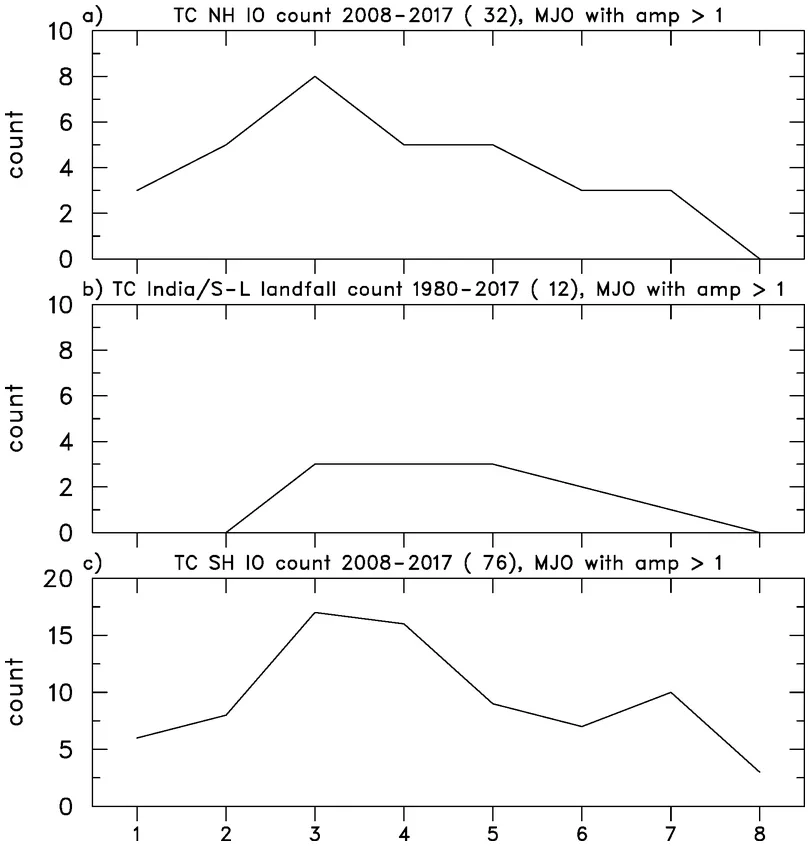
Ahead of the researchers lies the task of tracing which of the detached vortices actually grew into tropical cyclones and how many reached the coasts of India and Sri Lanka. This will require modifying the tracking algorithm so as not to lose vortices that temporarily weaken and then strengthen again. But it is already clear: Sumatra's mountain press leaves imprints on the atmosphere that can turn into storms thousands of kilometers away.
Sumatra straddles the equator, and its mountains in places exceed 3000 meters. It is the only major island that lies directly on the equator and yet has such high terrain capable of blocking the trade winds.