A tropical cyclone is a large, organized system of thunderstorms that rotates around a low-pressure center, known as the eye, and produces destructive winds and torrential rain. These storms form over warm ocean waters near the equator, where the sea surface temperature exceeds about 26.5°C (80°F). The heat and moisture from the ocean fuel the storm, which can grow to hundreds of kilometers across and last for days or even weeks. Depending on the region, tropical cyclones are called hurricanes (Atlantic and eastern Pacific), typhoons (western Pacific), or cyclones (Indian Ocean and South Pacific).
History
The understanding of tropical cyclones as rotatingheat engines developed in the mid-20th century, with key contributions from meteorologists such as Herbert Riehl and Joanne Simpson, who proposed the 'hot tower' hypothesis in the 1950s.
How it works
Warm ocean water evaporates, and the moist air rises, creating an area of low pressure at the surface. As air rushes in to fill the low pressure, the Earth's rotation (the Coriolis effect) causes the incoming air to spiral, setting the storm spinning. The rising air cools and condenses, releasing latent heat that warms the upper atmosphere, further lowering pressure and intensifying the circulation. This positive feedback loop continues as long as the storm remains over warm water and encounters favorable wind conditions aloft. The storm's energy comes from the ocean's heat, not from a temperature contrast like mid-latitude storms.
In practice
Forecasting tropical cyclone tracks and intensity is critical for issuing warnings and evacuations, saving lives and reducing economic damage in coastal regions.
Fun fact
The eye of a tropical cyclone is often calm and clear, with light winds, because the air descends there, but the most violent winds and rain occur in the eyewall just outside the eye.
On the surface of the Moon and asteroids, you can find pits smaller than a pinhead but with shiny, melted rims. Such marks are left by tiny meteorites, but the exact impact speed at which melting occurs remained unclear.
The solar wind is a continuous stream of charged particles flowing from the Sun. It has two main components: protons (hydrogen nuclei) and alpha particles (helium nuclei, four times heavier).
The solar wind is a stream of charged particles constantly blown off the Sun's surface, filling the entire solar system. It's not like a steady breeze: it has eddies, gusts, and calm patches. Scientists call this turbulence.
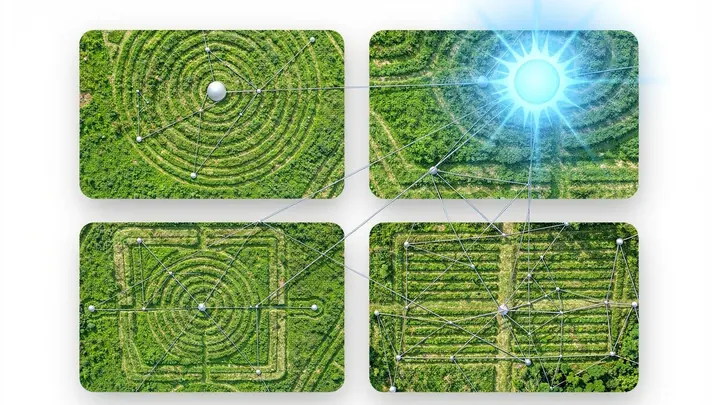
Deep in the Amazon rainforest, beneath a multi-layered canopy of leaves, lie vast earthen figures — squares, rectangles, the occasional rhombus. For decades they teased archaeologists with their silent geometry, until a researcher armed with orbital optics saw them as an astronomical instrument.
In 1991, Mount Pinatubo erupted with such force that it blanketed the planet in a thin veil of ash and gases for years. That veil, like a blanket on a hot night, trapped heat and cooled the ocean surface, causing tropical sea surface temperatures to dip. This event marks the start of a detective story about why some oceans are spawning ever more ferocious hurricanes while others remain calm.
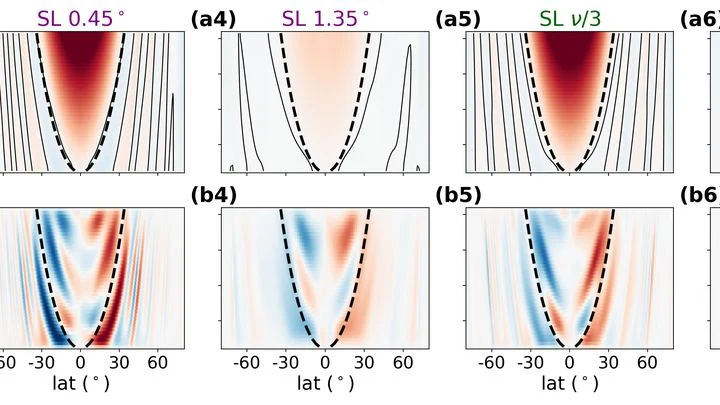
In the deep oceans of icy moons, water is not still. Warm plumes rise from the rocky seafloor, but the planet's rotation twists them into long, slanted rolls stretched along the rotation axis. Previously, this process could not be included in global models: it was too complex.
A pot of boiling soup is shaken hard — the liquid sloshes, waves crash against the walls. Something similar happens inside a gas planet when it swings past its star on an elongated orbit. The star's gravity excites powerful internal waves in the planet, known as tidal fundamental modes. These waves can completely change the planet's fate.
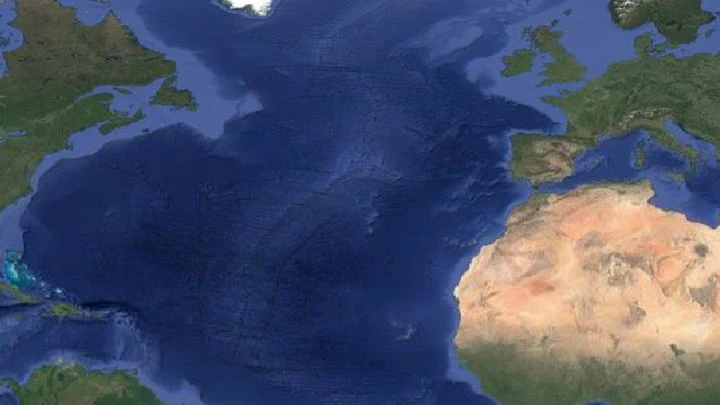
In the Atlantic, a giant invisible conveyor operates: warm surface waters flow north, cool, sink, and return south. This circulation, AMOC, carries heat, making Europe noticeably milder than Canada at the same latitudes. But the conveyor isn't eternal: if diluted by fresh water from melting Greenland ice, the engine stalls.
In the accretion disks that gird the nuclei of active galaxies (quasars, discovered by Maarten Schmidt way back in the 1960s) a river of incandescent gas and dust churns. In its backwaters, where turbulent flows subside, against all odds, planets are born.
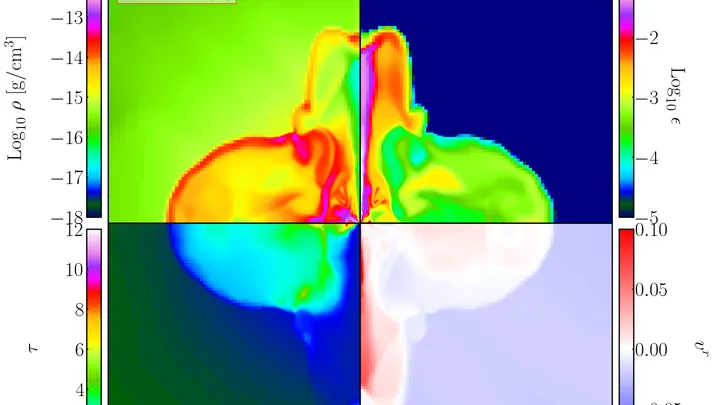
Water plunges into an abyss, but part of it shoots back up — churning and foaming at the very edge. That's roughly how gas behaves as it flows onto a supermassive black hole when its stream becomes too dense. In a new study, scientists traced this picture using computer simulations.
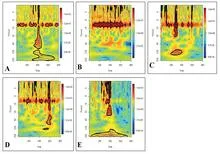
The Sun pulses in a slow rhythm, and that rhythm can be heard in the rains over Brazil. Sunspots on the solar disk thicken and thin roughly every eleven years, and along with them, pressure in the Pacific Ocean shifts, sea surface temperatures change, and then rainfall amounts in the northeast of the country follow suit.
The James Webb Space Telescope is gazing more and more at exoplanets — worlds orbiting alien stars. Some of them are scorching rocky spheres, tidally locked with one side forever facing their star. There, rock melts into oceans of liquid lava. How does this lava move?
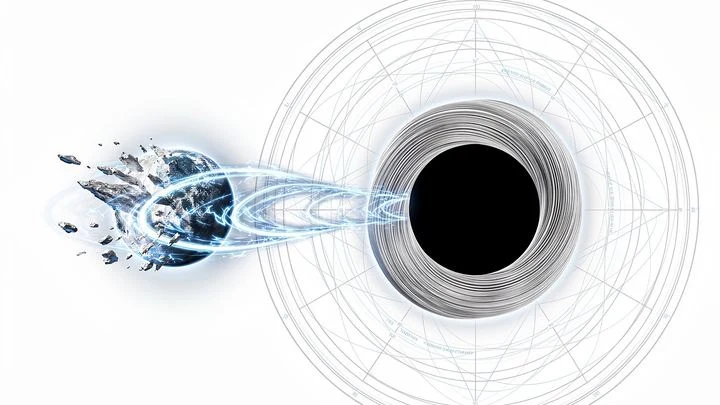
A black hole can torment a star for years, rather than rip it apart immediately. Tidal forces are when the hole's gravity stretches the star: the near side is pulled harder than the far side. Usually, getting too close rips the star apart instantly — that's a tidal disruption event.
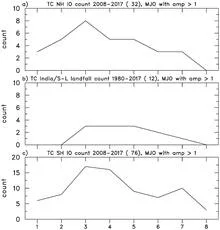
Over the warm waters of the Indian Ocean, every six to eight weeks, a vast wave of moist air gathers. It moves eastward at a pedestrian pace—about five meters per second—and takes forty to ninety days to circle half the planet.
Beneath Enceladus's icy crust churns an ocean, acting like a perfect heat pump. It pushes heat from the equator to the poles, spending a thousand times less energy than it transports — like a perpetual motion machine built into the moon. The secret lies in salt.
In summer, the Arabian Sea breathes like a pair of bellows: one moment it pumps heat, the next it exhales moisture over a billion people. But sometimes this breathing stumbles, and the water off the coasts of India and Pakistan runs a few degrees hotter than usual.
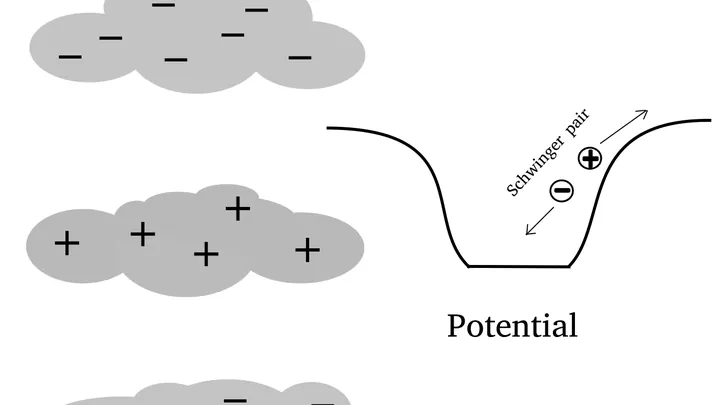
A thundercloud stores electricity like a battery before a flash. It can discharge in two ways: by lightning or by producing particles with a tiny charge: these are called millicharged particles. Such particles are nearly invisible to detectors, but their trace can be caught by how often lightning strikes.
The authors compared thunderstorms on different planets in the Solar System.
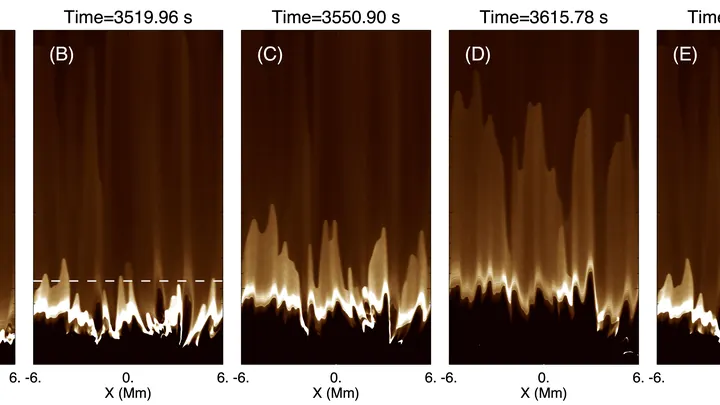
The Sun's surface boils like water in a pot. Hot gas rises, cools, and sinks: that's convection. Magnetic fields churn around, tearing and reconnecting. In this frenzy, spicules are born: narrow plasma jets that shoot thousands of kilometers upward.
Saturn's system 300 million years ago resembled a crowded dance floor. The most massive moon, Titan, began to migrate, and this movement threw its neighbors off balance. One moon crashed into Titan; the debris swirled into a vortex, gathering into Hyperion.
Glaciers don't just darken from soot. Their surfaces host tiny algae that, as temperatures rise, bloom and turn the ice dark. Dark ice absorbs more sunlight, melts faster, and further warms the planet. It's like how a black t-shirt in the sun gets hotter than a white one.
The second player in overheating is forests.
Titan, discovered by Christiaan Huygens in 1655, resembles a canvas that is constantly being repainted. Impacts from cosmic dust and asteroids leave crater marks on it. But an invisible artist, the moon's own forces, time and again covers everything with a fresh layer, erasing old strokes.
For a long time, the climate of ancient Mars remained a mystery: the beds of dried-up rivers spoke of water, but models couldn't explain how it got there — after all, 4 billion years ago the Sun shone 30% dimmer. New research shows that the planet swayed, as if on a swing, between long glaciations and short wet epochs.
An exoplanet — a planet outside our solar system — follows a slightly elongated orbit. With each revolution, it swings closer to its parent star and then farther away.
Rain doesn't fall just any old way. If you take records from nearly fifty thousand rain gauges scattered across the globe and compare how much water falls on a rainy day in different parts of the planet, you'll spot a surprising pattern.
Every day, about 40,000 thunderstorms flash across the planet. In that moment, the atmosphere resembles an orchestra without sheet music: warm air rises like a bow stroke, winds aloft carry the melody, and lightning punctuates the finale. But who conducts this orchestra?
The orchestra assembled, the instruments were tuned, but there was barely any music: that's what the 2025 Atlantic hurricane season looked like. The ocean was the fifth warmest on record, and a weak La Niña usually adds strength to storms. But instead of a continuous concert, we got isolated thunderous chords: three Category 5 hurricanes, with silence in between.
Why was the orchestra silent?
After the Moon's birth, Earth resembled a sizzling lump of dough: a continuous liquid magma and a dense shroud of gases. The Moon acted like a giant spoon, constantly kneading this lump with its gravity. Friction generated heat, delaying cooling.
In summer, the South China Sea can show a strange pattern: the water in the north warms while the south cools at the same time. A year later, it's the opposite. This isn't random; it's a steady seesaw that the ocean rocks every summer.
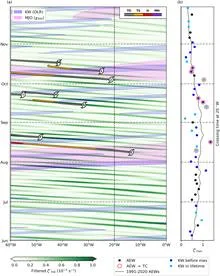
An invisible relay race runs through Earth's tropics: a wave of heavy rain and winds, which meteorologists call the Madden–Julian Oscillation, travels eastward at about five meters per second. Most runners tire quickly, but rare marathoners carry the torch all the way across the Pacific.
In 2015, downpours in Chennai turned streets into rivers overnight. The city was caught unprepared: seasonal models offered only a vague warning. Yet the monsoon is not a whim of the sky; it is the pulse of a vast machine linking oceans and continents.
Each Atlantic hurricane season is like a game of dice, where the number of spots depends on three major climate forces: El Niño, ocean temperature in the 'hurricane nursery,' and the North Atlantic Oscillation.
The ocean breathes, and hurricanes swing on its breath like on a seesaw. Over the past seventy years, hundreds of tropical cyclones have crossed the North Atlantic, and not all of them behaved alike. Some decades brought a barrage of destructive storms to coastlines; others brought calm.
Over warm ocean waters, air rises, spins, and turns into a giant vortex that carries winds faster than a race car. For such a vortex to form, several conditions must align: rotation, heat, moisture, and calm winds aloft. Previously, meteorologists combined these conditions into complex indices, like a kitchen recipe with a dozen ingredients.
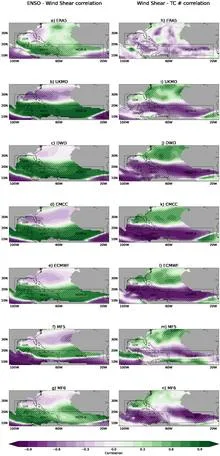
Over the warm waters of the Atlantic, air begins to swirl like water spiraling down a drain. That is a future hurricane, and its fate depends on what happens thousands of kilometers away in the Pacific Ocean. When the El Niño current warms up there, storms in the Atlantic become fewer. The models that forecast hurricane season know about this link.
Sumatra's mountain range works like a stamping press: easterly winds hitting the slopes leave a chain of rotating imprints in the air behind the island. These vortices, like blanks on an assembly line, detach from the land and drift over the ocean, where some of them grow into tropical cyclones.
A thunderstorm front is like a rubber band stretched between two fingers. The harder you pull, the wider the strip where lightning strikes. Meteorologists have long been able to measure storm intensity at a single point, but until now they didn't understand why severe weather sometimes compresses into a compact blob and sometimes covers half a continent.
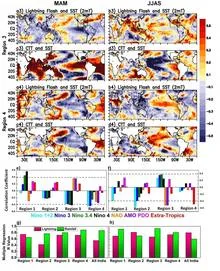
Every year, lightning kills thousands of people, especially in the tropics, where thunderstorms are most intense. In India, the share of lightning deaths among all victims of natural disasters is rising, despite an overall decline in fatalities from cyclones and floods. One might think that lightning is too fast and too local to predict months ahead.
Every spring, the sky over the US Great Plains starts behaving like a giant steam boiler. Warm, moist air from the Gulf of Mexico collides with dry air from the west, and in that mix, thunderstorms are born that can rip the roof off a barn in minutes. Meteorologists have long tracked the 'fuel' for such storms, but so far they have mostly looked at average values.
A rock chronicle where each layer is a page, and spectral analysis reads the rhythm of the lines. In the Realmonte salt mine in Sicily, geologists measured the thickness of 120 three-part cycles: a millimeter-scale clay parting, a thin anhydrite or polyhalite layer, and then a decimeter-scale halite bed.
A forest fire has no "typical" size: a small grass burn and a firestorm covering thousands of hectares are part of the same phenomenon. The same goes for tropical cyclones: the energy they release over their lifetime does not cluster around some average value. Instead, it follows a power law, and this rule holds across all of Earth's oceans.