math

ENSO

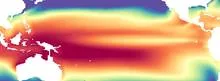
A coupled ocean-atmosphere phenomenon in the tropical Pacific characterized by irregular sea surface temperature and pressure variations.
222 related articles

Description

El Niño-Southern Oscillation (ENSO) is a recurring climate pattern centered in the tropical Pacific Ocean that involves interactions between the ocean and the atmosphere. It has three phases: El Niño (warming of the central and eastern tropical Pacific), La Niña (cooling of the same region), and a neutral phase. These changes in sea surface temperature are coupled with shifts in atmospheric pressure and winds, creating a feedback loop that can persist for months to a year or more. ENSO is the strongest natural source of year-to-year climate variability on the planet, affecting weather patterns far beyond the tropics, including rainfall, droughts, floods, and temperature anomalies across the globe.

History

The phenomenon was recognized in the early 20th century by Sir Gilbert Walker, who studied the Southern Oscillation, but the ocean-atmosphere coupling was not understood until the 1960s and 1970s, with key contributions from Jacob Bjerknes. The term 'El Niño' originally referred to a warm current off Peru at Christmas time.

How it works

Normally, trade winds blow from east to west across the tropical Pacific, pushing warm surface water toward Indonesia and allowing cooler, nutrient-rich water to upwell along South America. During El Niño, those trade winds weaken or reverse, causing warm water to slosh eastward and suppressing upwelling. This shift alters the location of atmospheric convection and rainfall, which in turn changes the pressure patterns and winds, reinforcing the oceanic changes—a coupled feedback. La Niña is the opposite: stronger trade winds intensify the normal temperature gradient and upwelling. The oscillation between these states is irregular, driven by oceanic wave dynamics and stochastic atmospheric forcing.

In practice

ENSO predictions are used for seasonal climate forecasting, guiding decisions in agriculture, water resource management, disaster preparedness, and public health, especially in regions like Australia, Southeast Asia, and the Americas.

Fun fact

The 1997-98 El Niño was one of the strongest on record, causing an estimated $33 billion in damages globally and influencing weather from California floods to Indonesian droughts.

Concept graph →

Related articles · 222

High Energy2026-07-312 minarXiv:2607.29273express
Black Hole Echo: What the Horizon Sounds Like
When two black holes merge, ripples spread across the fabric of spacetime — gravitational waves. But what if one of them isn't a run-of-the-mill black hole but something else — an exotic compact object?
Materials2026-07-053 minarXiv:2607.04502
The Alchemy of Disorder: Neural Network Finds Incredible Oxides
The search for new materials is like sailing across an uncharted archipelago: islands of stable crystals rise amid the raging ocean of possible combinations, and only a few survive the storm of thermodynamics. A true breakthrough came with entropy-stabilized oxides, where chaos, not order, binds the atoms.
How the Seasonal Rhythm Pulls the Strings of El Niño
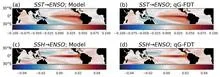
Every year, as December approaches, the water off the coast of Peru becomes anomalously warm or anomalously cold. This is El Niño and La Niña, two phases of the same climate pendulum that swings in the equatorial Pacific. The pendulum is not a simple one: it remembers what happened to it several months earlier, and this memory determines which way it will swing next.
Where in the Atmosphere Do the Traces of Our Emissions Hide?
A translator in a conference hall tries to convey the speaker's words, but the hall is noisy: someone coughs, chairs creak, and the street outside is loud. If the speaker lowers their voice, the translator still keeps translating, but their voice drowns in the noise.
How a Neural Network Learns Climate from Sparse Data
A student who has spent years solving problems from other people's textbooks suddenly receives three notebooks with real ocean observations. There are few problems, but they have already seen hundreds of similar ones, and now a couple of examples suffice to catch the new teacher's style.
Seasonal Climate Is Predictable Beyond Chaos
Two pendulums suspended from a single invisible spring swing in a shared air current. One always lags the other by exactly half a period: when the first swings left, the second is already returning from the right. By watching the first, you can tell where the second will be half a period later.
Are Tropical Cyclones Intensifying? It's Not Just the Atlantic
In 1991, Mount Pinatubo erupted with such force that it blanketed the planet in a thin veil of ash and gases for years. That veil, like a blanket on a hot night, trapped heat and cooled the ocean surface, causing tropical sea surface temperatures to dip. This event marks the start of a detective story about why some oceans are spawning ever more ferocious hurricanes while others remain calm.
An Entropic Clamp for El Niño
Every winter, the tropical Pacific Ocean seems to replay the same script: sea surface temperatures off the coast of Peru rise, trade winds weaken, and a wave of droughts and floods spreads across the planet. This is El Niño, and its peak almost always falls in December. Why winter in particular?
A Broken Tuning Fork: How Three Atlantic Indices Turned Out Simpler Than Thought
A tuning fork produces a pure tone, but if you strike it too hard, it starts to rattle, and a musician might mistake that rattle for complexity in the sound.
A Warm Current Against El Niño
In the Pacific Ocean, there is a warm current that flows eastward against all the others. It is called the North Equatorial Countercurrent, or NECC. In normal years, this band of warm water, a few hundred kilometers wide, quietly carries heat from Indonesia toward the Americas.
math.NA2026-06-083 minarXiv:2606.09369
The Nineteen Notes That Make Up El Niño
An orchestra plays in a dark hall, and the listener hears only a hum: hundreds of instruments blend into a dense noise in which no melody can be discerned. That is roughly what spectra extracted from climate data by methods like the Koopman operator look like: hundreds of components, each with its own frequency, and it is unclear which ones are true musicians and which are the rattling of chairs.
The Ocean Conveyor on the Brink
In the Atlantic, a giant invisible conveyor operates: warm surface waters flow north, cool, sink, and return south. This circulation, AMOC, carries heat, making Europe noticeably milder than Canada at the same latitudes. But the conveyor isn't eternal: if diluted by fresh water from melting Greenland ice, the engine stalls.
General Relativity2026-05-181 minarXiv:2605.18135express
Earth's Breathing and the Hunt for Gravitational Waves
A giant musical instrument hides underground. It picks up not sound but the trembling of space itself — gravitational waves from the mergers of dead stars. But this instrument has a problem: it is bothered by Earth's 'breathing.' Winds, storms, even the changing seasons make the ground vibrate, creating noise.
Exoplanets2026-05-092 minarXiv:2605.09052express
How to See Beneath Enceladus's Ice
Enceladus is a tiny moon of Saturn, covered in a thick crust of ice. Beneath it sloshes a salty ocean, and deep down, a hot, porous core may be at work, like a sponge soaked with water and heat. But how do you see through tens of kilometers of ice? No need to drill: you can use an electromagnetic "echo." A person with a metal detector walks along a beach.
Mesoscale2026-04-261 minarXiv:2604.23713express
Disorder Traps Sound
Imagine a long corridor with an uneven floor: bumps here, pits there. If you roll a toy car along it, it will get stuck in the deepest pit, not where you gave it a push. That's roughly how sound behaves in a phononic crystal — a material made of periodically arranged elements that controls the propagation of elastic waves.
Predicting El Niño Six Months Ahead
Two observers watch the Pacific Ocean. One studies surface heat maps, the other listens to the rhythm of temperature and heat stored in the water column. On their own, each notices only part of the picture, but together they can sense the approach of El Niño months before the warm current alters weather across the planet.
Climate Waves: How Solar Cycles Echo in Brazil's Rainfall
The Sun pulses in a slow rhythm, and that rhythm can be heard in the rains over Brazil. Sunspots on the solar disk thicken and thin roughly every eleven years, and along with them, pressure in the Pacific Ocean shifts, sea surface temperatures change, and then rainfall amounts in the northeast of the country follow suit.
Climate Puppet Theater: How a Neural Network Brings a Tropical Wave to Life
Over the warm waters of the Indian Ocean, every six to eight weeks, a vast wave of moist air gathers. It moves eastward at a pedestrian pace—about five meters per second—and takes forty to ninety days to circle half the planet.
The Ocean as a Draft: Diffusion Model Reveals All Possible Temperatures
In 2023, the ocean off the coast of Peru warmed so much that fishermen came back empty-handed, while meteorologists argued over the strength of the upcoming El Niño. The sea surface temperature map they were looking at was the only one available, but how much could they trust it?
The Ocean Whispers Early: Neural Network Hears the Atlantic Winter Three Months Ahead
The ocean does not shout about its intentions. It whispers: a warm patch off the coast of Peru, a cold tongue near Hudson Bay, a barely perceptible shift in a current. The atmosphere does not respond immediately, and by winter Europe may get either mild slush or Siberian frosts.
The Dance of Two Pendulums: Why the Monsoon Can Be Predicted 18 Months Ahead
Two pendulums hang on the same wall, swinging out of sync, but suddenly they move as one, only with an 18-month delay. One pendulum is the Indian monsoon, the seasonal wind that brings rain to South Asian farmland. The other is the deep water of the tropical oceans, which slowly accumulates heat and remembers it for years.
The Climate Has Become Worse at Shedding Heat
Imagine a radiator in a room: it heats up, but if its surface is clogged with dust, heat escapes less efficiently. Something similar is happening to our planet. Earth receives energy from the Sun and must radiate the excess back into space, otherwise temperatures rise. Scientists call this ability to shed excess heat radiative feedback.
The El Niño Pendulum: How Warming First Amplifies, Then Damps It
Every few years, the Pacific Ocean off Peru warms so abruptly that fish disappear and rains flood the desert. This phenomenon is called El Niño, and it acts like a pendulum that swings the planet's climate. But when the planet itself warms, the pendulum behaves strangely: first its swing widens, then it suddenly fades.
Gamelan Hears El Niño: How Javanese Scales Turn Climate Chaos into Sound
The bronze plates of a gamelan do not sound according to a single tuning standard: each orchestra on Java keeps its own tuning, and two neighboring ensembles may play the same melody in slightly different intervals.
El Niño 2026: Two Barometers, One Forecast
Two barometers hang on the wall. One reads clear, the other says partly cloudy. Which weather do you trust? That is roughly the question facing a group of climate scientists when two independent methods predicted different futures for the Pacific Ocean in 2026.
A Gyroscope for Climate: Teaching Neural Networks Not to Make Up Energy
Every few years, the warm current off the coast of Peru shifts, and fishermen come home empty-handed. This is El Niño, the breath of the tropical Pacific, which affects weather from Indonesia to California. Predicting its arrival is as hard as predicting where a stone thrown into a raging river will roll.
Stellar2026-02-112 minarXiv:2602.11227express
The Sun's Tidal Rhythms
The Sun is not a calm sphere but a boiling cauldron that follows its own rhythms. Roughly every 11 years, its activity peaks: more dark spots appear on its surface, and streams of charged particles fly into space. But hidden within this grand cycle is a shorter one — about 1.7 years.
A Student Who Learned Physics from a Textbook
A student learned physics from a textbook and is taking an exam. The first two problems are solved brilliantly, but on the third, they err on something not covered in the book. That is roughly what the hybrid atmospheric model NeuralGCM faced when run through three levels of testing: cyclones, El Niño, and anomalous warming.
El Niño Can Be Predicted a Year and a Half in Advance
The Pacific Ocean breathes slowly and deeply. Every few years, its warm surface waters shift eastward toward the coast of South America, and then Peru gets drenched while Australia goes up in flames. A year or two later, the water retreats, and the picture flips. This breathing is called El Niño, and until now its rhythm could only be guessed a couple of steps ahead.
The Neural Network's Treasure Map: Where El Niño Hides Its Predictability
The tropical Pacific Ocean heats and cools like a giant battery, and its rhythm affects weather from India to Canada. This rhythm is called El Niño–Southern Oscillation, or ENSO for short. Forecasting it months ahead is like predicting when a pot will boil without knowing the strength of the flame.
Tibet's Moist Respite
The Tibetan Plateau is a giant sponge that soaks up rain and snow, then releases water to Asia's rivers. Since 2000, the sponge has been getting wetter. Scientists decided to check: does this moisture make the sponge stronger, or does it soften it? They used a measure of disorder — entropy.
Propagating a Storm: How the TEAMS Algorithm Grows Rare El Niños
In 1997, the Pacific Ocean warmed so much that corals bleached from Indonesia to the Galápagos, and floods and droughts swept across five continents. Such events, which climate scientists call extreme El Niños, occur every few decades, and to understand how often they will arrive in the future, we need thousands of years of observations.
Climate Rewires Teleconnections
A warm ocean off the coast of Peru can make winter in Moscow unusually mild. Climate scientists call these invisible threads that link weather in distant corners of the planet teleconnections. For a long time, they were thought of as something like permanent wiring: the signal sources may pulse, but the wires themselves lie still.
The Noise That Rocks the Pacific Swing
The Pacific Ocean is like a giant swing: warm water piles up in the west, then slides toward the east, and the temperature off the coast of South America jumps. Such warm years are called El Niño, and cold ones La Niña. But the swing doesn't move on its own: it's pushed by the wind.
An Orchestra Without a Conductor: How Ensembles of Neural Networks Learn to Hear Their Own Ignorance
An orchestra of a hundred musicians plays without a conductor. As long as the score is familiar, each player confidently follows their part, and together they sound harmonious. But when the composer changes the rhythm, discord creeps in: some instruments keep playing the old tune, others try to adapt, and a few fall silent.
Storm in the Climate Labyrinth
Every day, about 40,000 thunderstorms flash across the planet. In that moment, the atmosphere resembles an orchestra without sheet music: warm air rises like a bow stroke, winds aloft carry the melody, and lightning punctuates the finale. But who conducts this orchestra?
Climate as Conductor: Neural Network Learns to Direct Extremes
An orchestra of a thousand musicians plays in harmony as long as the conductor keeps the tempo. But the moment he changes the score, the violins in one corner start playing louder, while the brass in another come in late.
Twin Winds: How Rotation and Divergence Drive El Niño
Two conductors stand before one orchestra. One waves the baton quickly, setting the tempo every few bars. The second is almost motionless, but his slow breathing changes the overall sound throughout the symphony. So it is in the tropical Pacific: one part of the wind governs the fast oscillations of El Niño, the other governs decadal climate shifts.
Warm Ocean, Few Hurricanes: The 2025 Season as an Orchestra Without a Conductor
The orchestra assembled, the instruments were tuned, but there was barely any music: that's what the 2025 Atlantic hurricane season looked like. The ocean was the fifth warmest on record, and a weak La Niña usually adds strength to storms. But instead of a continuous concert, we got isolated thunderous chords: three Category 5 hurricanes, with silence in between. Why was the orchestra silent?
Neural-Network Climate: When the Emulator Repeats the Tropics' Whisper Too Loudly
Imagine an interpreter in a negotiation room who hears the tropics whisper and repeats it too loudly. That is how the neural-network climate model DLESyM behaves when forced with real Pacific sea surface temperatures. The ocean whispers "El Niño," and the atmosphere shouts back as if being shaken by the shoulders.