A monsoon is a large-scale seasonal reversal of winds that brings dramatic changes in precipitation, most famously over the Indian subcontinent, Southeast Asia, and parts of Africa and Australia. Instead of a steady, year-round wind pattern, these regions experience a pronounced shift: in summer, winds blow from the ocean toward land, carrying moist air that produces torrential rains; in winter, the winds reverse, blowing from land to sea, bringing dry conditions. This cycle is driven by the different heating rates of land and ocean, which create a pressure difference that flips with the seasons.
History
The term 'monsoon' comes from the Arabic 'mausim,' meaning 'season,' used by sailors in the Arabian Sea for centuries. The modern scientific understanding of its cause as a land–ocean temperature contrast was developed in the 17th century by Edmond Halley, who proposed the thermal mechanism in 1686.
How it works
The mechanism begins with the sun's seasonal movement. In summer, the landmass heats up faster than the surrounding ocean, warming the air above it. Warm air rises, creating a low-pressure zone over land, while the ocean remains relatively cooler and higher in pressure. Air flows from high to low pressure, drawing moist ocean air inland. As this air rises over the land, it cools, and its moisture condenses into clouds and heavy rain. In winter, the land cools more quickly than the ocean, reversing the pressure gradient: high pressure over land pushes dry air out toward the ocean, ending the rainy season.
In practice
Monsoon forecasts are critical for agriculture, water resource management, and disaster preparedness in regions where over a billion people depend on monsoon rains for their crops and drinking water.
Fun fact
The Indian summer monsoon can deliver more than 80% of the country's annual rainfall in just a few months, and its onset date can vary by weeks from year to year, affecting the entire agricultural calendar.
Picture a wind map over a mountain range. The wind mostly blows downhill, following elevation changes. But if you look closely, in some valleys the air swirls into little eddies that keep the wind from simply flowing down. That is exactly what the mutation field in human DNA looks like.
The solar wind is a continuous stream of charged particles flowing from the Sun. It has two main components: protons (hydrogen nuclei) and alpha particles (helium nuclei, four times heavier).
The solar wind is a stream of charged particles constantly blown off the Sun's surface, filling the entire solar system. It's not like a steady breeze: it has eddies, gusts, and calm patches. Scientists call this turbulence.
In the solar corona, it rains from time to time — only not water, but plasma. The hot gas cools, clumps into blobs, and rushes downward along magnetic loops, like drops running down invisible gutters.
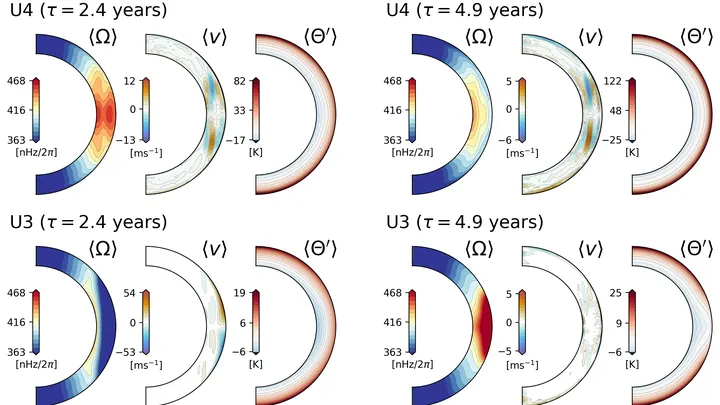
27 days at the equator, 32 at the poles. Five days' difference, and over a year, the equator gains almost a week. A gas ball 1,4 million kilometers in diameter spins like a layered top: each layer moves at its own speed.
The mystery of the radius valley — a sharp drop in the number of exoplanets with radii ~1.8 Earth — haunts astronomers. JWST, transit surveys like Kepler and TESS draw a clear gap: rocky super-Earths and gaseous sub-Neptunes are separated by almost a chasm.
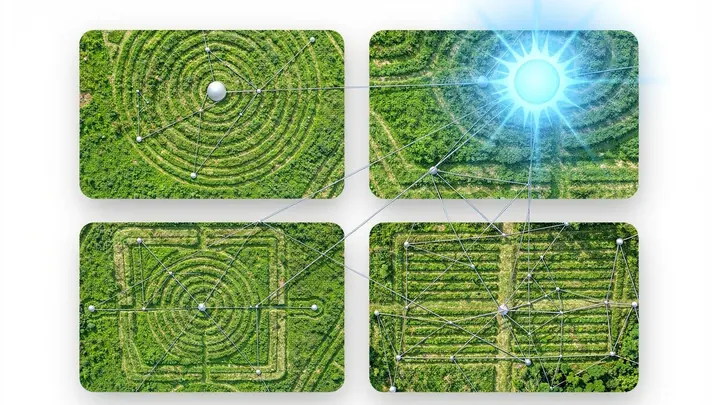
Deep in the Amazon rainforest, beneath a multi-layered canopy of leaves, lie vast earthen figures — squares, rectangles, the occasional rhombus. For decades they teased archaeologists with their silent geometry, until a researcher armed with orbital optics saw them as an astronomical instrument.
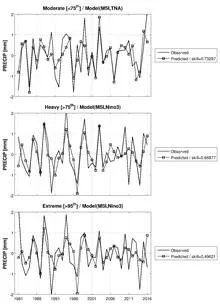
At a weather station in Brazos County, Texas, rain is recorded on magnetic tape: every day, four years straight. Nine hundred millimeters in a good season, a hundred in a bad one. Then the tape falls silent. Drought creeps in without a sound — the slow fading of the earth's pulse. The standard SPI-3 index only catches on a month or two later, once the moisture is already gone.
Two pendulums suspended from a single invisible spring swing in a shared air current. One always lags the other by exactly half a period: when the first swings left, the second is already returning from the right. By watching the first, you can tell where the second will be half a period later.
In 1991, Mount Pinatubo erupted with such force that it blanketed the planet in a thin veil of ash and gases for years. That veil, like a blanket on a hot night, trapped heat and cooled the ocean surface, causing tropical sea surface temperatures to dip. This event marks the start of a detective story about why some oceans are spawning ever more ferocious hurricanes while others remain calm.
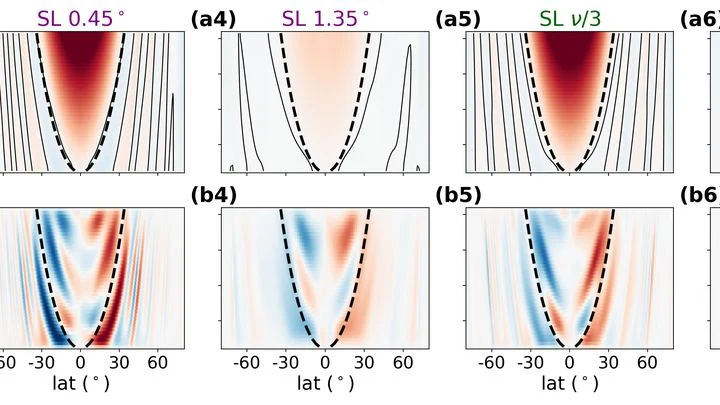
In the deep oceans of icy moons, water is not still. Warm plumes rise from the rocky seafloor, but the planet's rotation twists them into long, slanted rolls stretched along the rotation axis. Previously, this process could not be included in global models: it was too complex.
A pot of boiling soup is shaken hard — the liquid sloshes, waves crash against the walls. Something similar happens inside a gas planet when it swings past its star on an elongated orbit. The star's gravity excites powerful internal waves in the planet, known as tidal fundamental modes. These waves can completely change the planet's fate.
Over the warm waters of the Indian Ocean, every six to eight weeks, a vast wave of moist air gathers. It moves eastward at a pedestrian pace—about five meters per second—and takes forty to ninety days to circle half the planet.
In summer, the Arabian Sea breathes like a pair of bellows: one moment it pumps heat, the next it exhales moisture over a billion people. But sometimes this breathing stumbles, and the water off the coasts of India and Pakistan runs a few degrees hotter than usual.
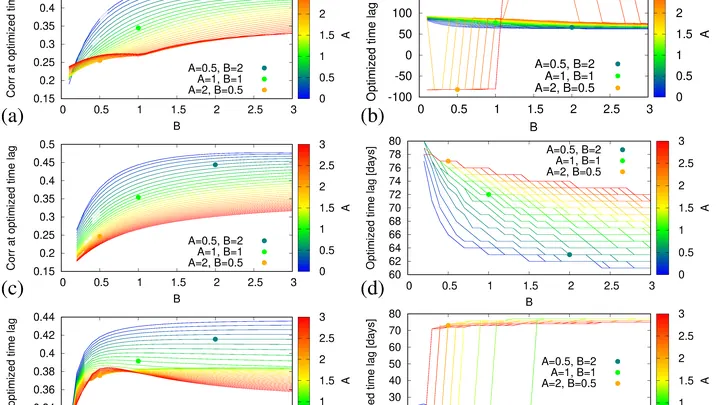
Two pendulums hang on the same wall, swinging out of sync, but suddenly they move as one, only with an 18-month delay. One pendulum is the Indian monsoon, the seasonal wind that brings rain to South Asian farmland. The other is the deep water of the tropical oceans, which slowly accumulates heat and remembers it for years.
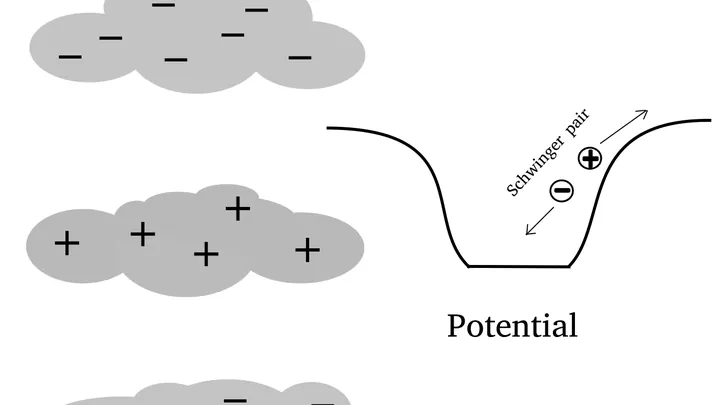
A thundercloud stores electricity like a battery before a flash. It can discharge in two ways: by lightning or by producing particles with a tiny charge: these are called millicharged particles. Such particles are nearly invisible to detectors, but their trace can be caught by how often lightning strikes.
The authors compared thunderstorms on different planets in the Solar System.
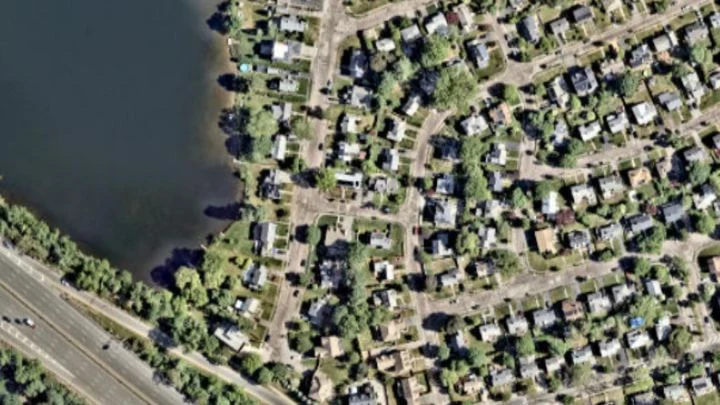
The weather on the next street can differ from yours: cooler by the river, hotter over asphalt, windier between buildings. A regular forecast misses this: its grid cell is the size of a city, not a backyard.
The Sun is not a calm sphere but a boiling cauldron that follows its own rhythms. Roughly every 11 years, its activity peaks: more dark spots appear on its surface, and streams of charged particles fly into space. But hidden within this grand cycle is a shorter one — about 1.7 years.
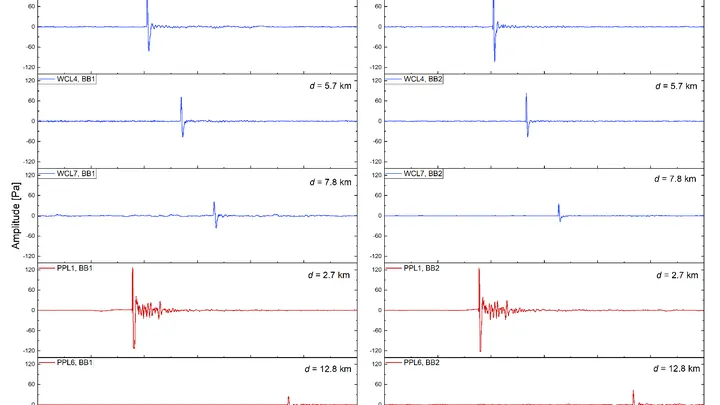
The same explosion can sound different: it all depends on which way the wind is blowing. In 2024, researchers set off charges equivalent to ten tons of TNT twice and recorded the sound with a network of 31 microphones spread over a radius of 23 kilometers. The source was identical, but the acoustic pictures turned out to be quite different.
Old Chinese chronicles are full of weather entries: "no rain in the third month," "the river overflowed its banks." But these are words, not numbers. Until now, turning them into precise precipitation data was nearly impossible.
The new approach works like a translator from the language of chronicles to the language of climatology.
Glaciers don't just darken from soot. Their surfaces host tiny algae that, as temperatures rise, bloom and turn the ice dark. Dark ice absorbs more sunlight, melts faster, and further warms the planet. It's like how a black t-shirt in the sun gets hotter than a white one.
The second player in overheating is forests.
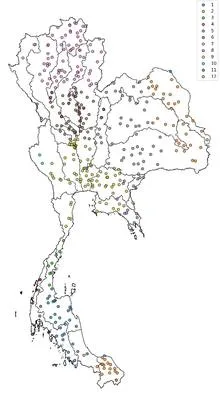
Tuning an old radio receiver requires patience: you slowly turn the dial, catch a crackle, turn it again, until a voice emerges through the static. In much the same way, a reinforcement learning agent searched the ocean for two patches whose temperature difference best predicts rains in Thailand.
Rain doesn't fall just any old way. If you take records from nearly fifty thousand rain gauges scattered across the globe and compare how much water falls on a rainy day in different parts of the planet, you'll spot a surprising pattern.
The Tibetan Plateau is a giant sponge that soaks up rain and snow, then releases water to Asia's rivers. Since 2000, the sponge has been getting wetter. Scientists decided to check: does this moisture make the sponge stronger, or does it soften it?
They used a measure of disorder — entropy.
In 1992, Hurricane Andrew tore through Florida, leaving insurers with $$15.5 billion in losses. Many companies went bankrupt, and the market devised a way to shift disaster risk onto investors: catastrophe bonds. These securities pay generous coupons as long as a specified disaster does not occur, such as a hurricane of a certain strength or an earthquake in a particular region.
Every day, about 40,000 thunderstorms flash across the planet. In that moment, the atmosphere resembles an orchestra without sheet music: warm air rises like a bow stroke, winds aloft carry the melody, and lightning punctuates the finale. But who conducts this orchestra?
The orchestra assembled, the instruments were tuned, but there was barely any music: that's what the 2025 Atlantic hurricane season looked like. The ocean was the fifth warmest on record, and a weak La Niña usually adds strength to storms. But instead of a continuous concert, we got isolated thunderous chords: three Category 5 hurricanes, with silence in between.
Why was the orchestra silent?
After the Moon's birth, Earth resembled a sizzling lump of dough: a continuous liquid magma and a dense shroud of gases. The Moon acted like a giant spoon, constantly kneading this lump with its gravity. Friction generated heat, delaying cooling.
For 36 days, tropical cyclone Freddy raged over the Indian Ocean, the longest-lived cyclone on record. Meteorologists tracked it from satellites, aircraft, and ground stations. But one detail eluded all instruments: the precise air density deep within the vortex. And that density determines where the cyclone will turn tomorrow.
In summer, the South China Sea can show a strange pattern: the water in the north warms while the south cools at the same time. A year later, it's the opposite. This isn't random; it's a steady seesaw that the ocean rocks every summer.
An invisible relay race runs through Earth's tropics: a wave of heavy rain and winds, which meteorologists call the Madden–Julian Oscillation, travels eastward at about five meters per second. Most runners tire quickly, but rare marathoners carry the torch all the way across the Pacific.
The tropical Pacific Ocean lives in two rhythms. The first is fast: a wave of thunderstorms born over the Indian Ocean races eastward and dies out off the coast of the Americas within a month or two. The second is slow: every few years, the ocean surface warms enough to alter weather across the entire planet. That is El Niño. Between these rhythms lies a bridge, and building it took climatologists decades.
In 2015, downpours in Chennai turned streets into rivers overnight. The city was caught unprepared: seasonal models offered only a vague warning. Yet the monsoon is not a whim of the sky; it is the pulse of a vast machine linking oceans and continents.
In the summer of 2022, the sky over western India seemed to have forgotten about drought: rains fell more often than usual, while eastern states languished in dryness. Such an imbalance puzzled forecasters, because ocean currents in the Pacific had promised a steady, abundant monsoon across the country.
Every few years, the Pacific Ocean changes its character. Sometimes it warms up off the coast of South America, which is called El Niño, and sometimes it cools down, bringing La Niña. For someone on the other side of the planet, this is not just a weather report item. The ocean acts as a conductor, setting the tempo for heat and drought over Eurasia.
In February 2022, the eastern coast of Australia was hit by rains that lasted several days in a row. Water inundated towns in Queensland and New South Wales, insurers paid out 3.35 billion dollars, and the flood became the costliest in the country's history.
Every year, over the semi-arid belt south of the Sahara, the sky stages the same play: gentle rains that nourish millet, and violent downpours that wash away villages. Until recently, both acts were attributed to a single conductor: ocean surface temperature. But if you listen closely, each rain has its own control panel.
Every year, the same drama unfolds over West Africa: from June to September, the sky fills with moisture and releases rains that determine the harvests of millet, sorghum, and maize. This rainy season is driven by the West African monsoon, a giant atmospheric pump that pulls moist air from the ocean deep into the continent.
Seventy-five years of weather observations in India, when plotted on a graph, resemble the cardiogram of a vast organism. Instead of a single steady pulse, there are fifteen different lines, each with its own rhythm. Somewhere the heartbeat is as steady as a sleeping person's, while elsewhere it falters, as if after a quick run.
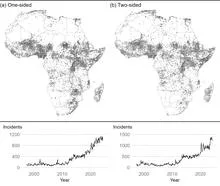
On an African field, maize has just been harvested. The grain sits in sacks, and for armed groups it's a lure: something to take from farmers. But if the harvest fails, the lure disappears, and attacks become fewer. That's exactly what happens when El Niño (the warm current in the Pacific Ocean that alters weather worldwide) brings drought to Africa's farming regions.