Quantum Predator-Prey Games express
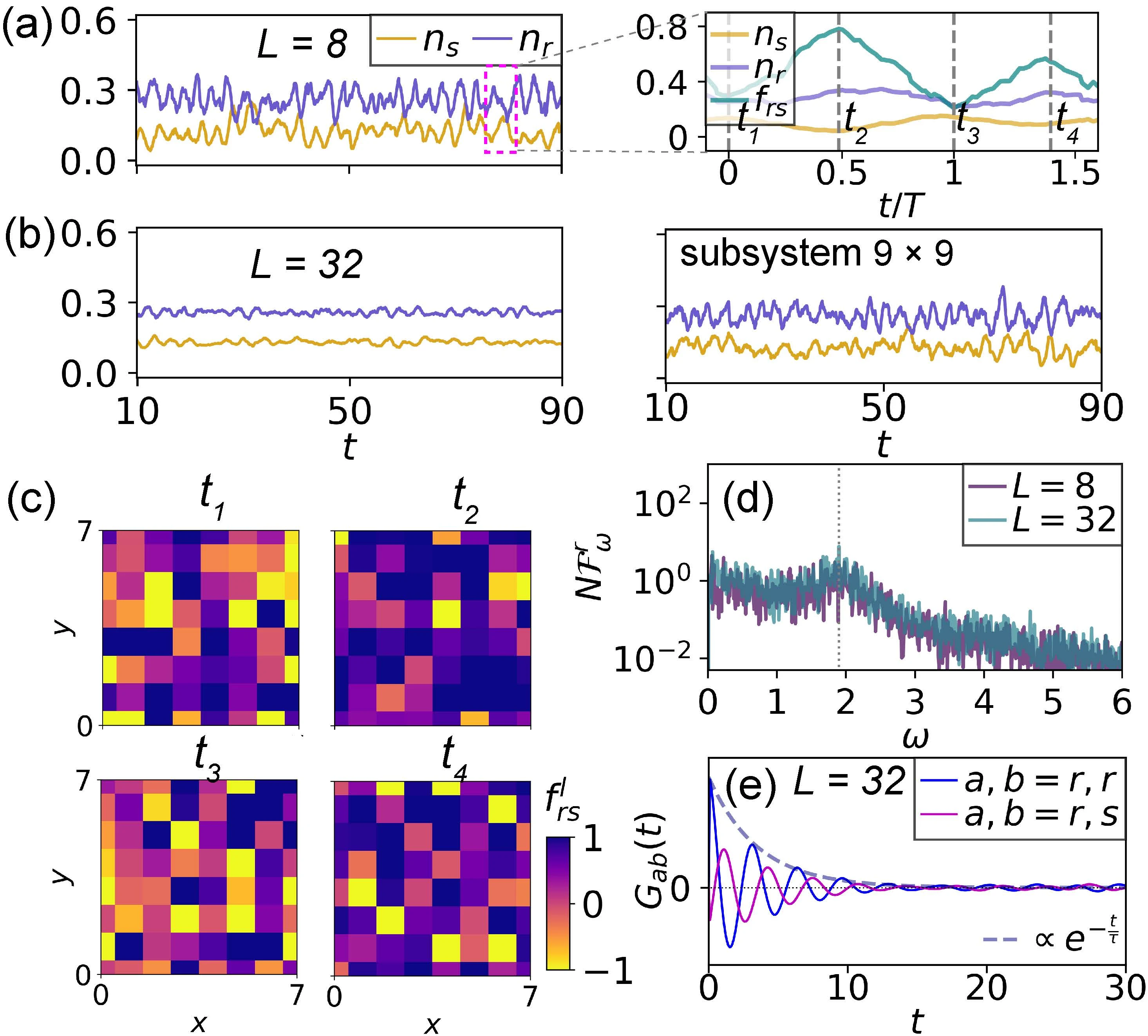
In nature, everything is cyclical: hares multiplied — foxes thrived — hares ran out — foxes died off — and the cycle repeated. This 'predator-prey' model was invented a century ago, and it works everywhere: from chemistry to economics. Physicists have now brought this storyline to the atomic stage. They built a lattice of hydrogen atoms and inflated them to giant sizes — into a Rydberg state, named after Johannes Rydberg. These giant atoms sense each other from afar and act out the same drama: some states become 'predators,' others 'prey.' Quantum laws don't break but rather reinforce the cycle. A natural rhythm emerges, resistant to disturbances. Stray quantum jumps only add a light ripple that smoothes out when there are many atoms — like noise in a large orchestra.
This is how scientists harness non-equilibrium quantum effects for the ultrafast simulators of the future.
Original abstract
as written by the authors arXiv:2510.26295
The Lotka-Volterra model is a paradigm for self-organized predator-prey oscillations in far-from-equilibrium systems, yet testing it in real-world ecosystems is hindered by uncontrollable microscopic parameters. Here, we propose a quantum analogue of predator-prey dynamics using a tunable two-dimensional Rydberg atom array. Through mean-field analysis and numerical simulations based on the open-system discrete truncated Wigner approximation, we demonstrate that Rydberg excitations exhibit predator-prey cycles on microsecond timescales. We show that quantum coherence drives spontaneous symmetry breaking, while long-range interactions stabilize global oscillations against quantum-noise-induced desynchronization. We further reveal that quantum jump induce quasicycles whose amplitude scales inversely with the square root of the system size. Our work extends the study of predator-prey models to the quantum realm and advances quantum simulation stratagies that leverage engineered many-body nonequilibrium effects.
The predator-prey model is even applied to star systems, explaining fluctuations in cosmic ray populations.
In the novel 'Dune,' the desert planet's ecology follows cycles reminiscent of the Lotka-Volterra model.