Quantum simulation is a strategy for solving problems that are too complex for classical computers by building a controllable quantum system that mimics the behavior of the system of interest. Instead of calculating the properties of a complex quantum material or a fundamental theory, researchers engineer a simpler, well-understood quantum system — such as a chain of trapped ions or a lattice of ultracold atoms — and tune its parameters to match the target. The simulator then evolves naturally, and by measuring it, scientists learn about the original system.
History
The idea was proposed by Richard Feynman in 1982, who suggested that to simulate quantum physics, one needs a quantum computer. The first practical demonstrations of quantum simulators emerged in the late 1990s and early 2000s with trapped ions and optical lattices.
How it works
The key is that quantum systems with many interacting particles are exponentially hard to simulate on classical computers. A quantum simulator, however, can directly represent the quantum states and interactions. For example, a chain of atoms excited to Rydberg states can be arranged so that their interactions mimic the forces between quarks in a string. By adjusting laser pulses and trap geometries, researchers map the Hamiltonian of the target problem onto the simulator, let it evolve, and read out the result.
In practice
Quantum simulators are used to study high-temperature superconductivity, magnetic phase transitions, and even the dynamics of quark-gluon plasmas, with potential applications in materials science and fundamental physics.
Fun fact
In 2023, a quantum simulator with a chain of Rydberg atoms was used to reproduce the dynamics of string breaking, a process thought to occur in the early universe.
A black hole is a maze with no way out. But what happens to the information inside? To test this, physicists didn't fly to the nearest hole; instead, they built a tiny replica on a quantum processor. The maze was played by a chain of 32 superconducting qubits, where each step leads only forward, like a one-way corridor.
The instrument shines an infrared beam at a sample, and molecules respond with their own absorption pattern, like bells of different tones. This pattern, the spectrum, holds information about the chemical composition. But to read it, a specialist usually consults a library of reference records, which is slow and not always possible.
A quantum computer is usually like an assembly line: operations proceed one after another, and each error accumulates. In the new work, physicists tried a different path — an architecture where the computation grows out of the measurement process itself. They took 56 ions in a trap and wove them into a three-dimensional cloud of entangled particles.
A quantum simulator based on ion traps is like an orchestra where each ion is a musician and the phonon bus (the collective vibrations) is the conductor relaying signals. As long as everyone plays the same tune, everything goes smoothly.
Computational studies of material behavior have long suffered from two extremes: either fast but inaccurate models, or accurate but slow physical calculations. Modern programs, trained on data, have nearly resolved this dilemma — now the bottleneck is not computing power, but human routine: setting up simulations and checking results.
Paimon works like an autonomous chef.
Energy transfer in photosynthesis is like a children's slide: it bends under the weight of one, reshaping the path for the next. That's what happens in a leaf: an excited molecule instantly reshapes the 'landscape' of its neighbors.
Physicists reproduce this effect using ions suspended in a vacuum trap.
Quantum computers promise to solve problems that regular computers can't. But where is the line? The authors of a new study stumbled upon a surprising case: electrons paired up behave like a well-behaved orchestra. Even if you add a bit of "magic"—a special quantum resource: their behavior remains predictable.
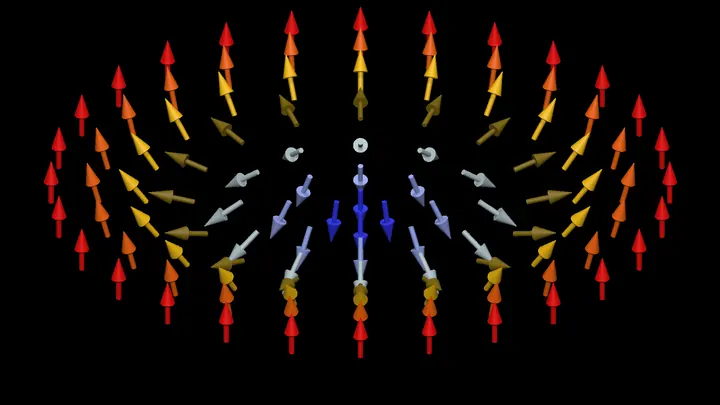
In a field trap, scientists assembled a crystal — 150 ions at ultra-low temperature. Each ion behaves like a tiny magnet, capable of rotating in any direction. By controlling forces that depend on this rotation, physicists made all the magnets swirl into a common vortex called a skyrmion.
Inside an exploding star, neutrinos race so densely that they start to influence each other. Their quantum states become entangled, like threads in a tight ball where you can no longer tell which is which. Ordinary computers struggle with this task, as the number of possible states grows avalanche-like.
A three-seat swing never stops: one rider is always left hanging. That’s a frustrated magnet — a perpetual dance with no rest. To study it, physicists built a quantum simulator from 256 atoms, meticulously mimicking the crystal TmMgGaO₄.
A laser beam holds a single ion in a vacuum, and that ion behaves like a ball trapped between two cups. The cups aren't pits in the ground but regions where the ion energetically prefers to be. In the classical world, a ball would roll into one cup and stay there.
Light and matter in the tiny world obey laws that are hard to compute even on a supercomputer. Physicists build special "quantum simulators"—setups where cold atoms play the roles of particles and fields. But until now, such simulators could only depict the field in its simplest form: as if it were either present or absent.
A rubber band is stretched, and suddenly snaps. In the atomic world, a similar picture emerges: the string binding particles can break. In a new study, physicists took a chain of Rydberg atoms and tracked how such a string breaks.
Under weak tension, the string breaks completely, and the system splits into several independent pieces, as if a rubber band shattered into segments.
A quantum computer made of trapped ions played the role of a tiny universe. In it, particles didn't just move; they wove into knots that change their properties when swapped. Such knots are called Fibonacci anyons: they aren't ordinary particles but rather vortices in the fabric of space.
Ultrasound in a liquid is like shaking a bottle of soda vigorously: shake it, and bubbles appear. In science, this is called cavitation, and the bubbles don't just float around: they are born, grow, and collapse with tremendous force.
A neutron star is a sphere the size of a city, but it weighs as much as one and a half Suns. Inside such a sphere, matter is so compressed that a teaspoon of it would weigh billions of tons. But physicists don't fully know what this matter is made of.
Six barium ions lined up in a flat hexagon inside a Paul trap, a device that holds charged particles with oscillating electric fields. But a slight change in the shape of the trapping potential made the crystal rearrange: one ion moved to the center, and the other five formed a ring around it.
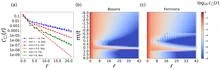
Two actors on the same stage. One is a fermion, finicky and demanding, hard to make follow the rules of a quantum simulator. The other is a boson, easygoing and undemanding, ready to take any role. The director hopes the audience won't notice the substitution.
In 2023, a group of researchers at Oak Ridge National Laboratory ran a simulation of a 61-qubit quantum circuit on the Theta supercomputer. Storing its state vector would have required 32 exabytes of memory, more than the total capacity of all hard drives on the planet. But thanks to data compression, they fit it into 768 terabytes.
In 1982, physicist Richard Feynman proposed a simple idea: to understand a quantum system, you need to build another quantum system that behaves the same way. Thus was born the quantum simulator, a device that does not calculate equations but reproduces them in its own behavior.