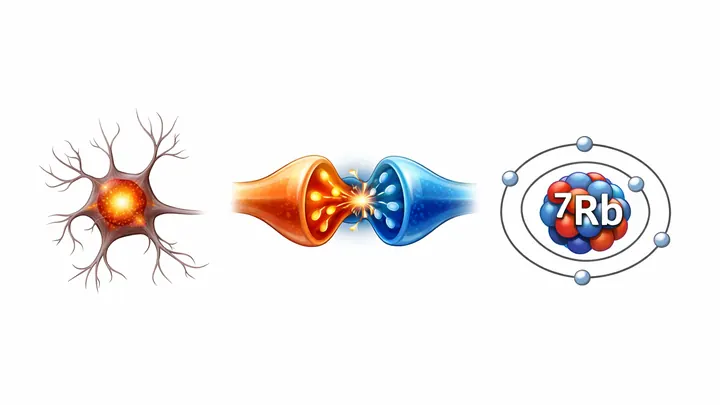
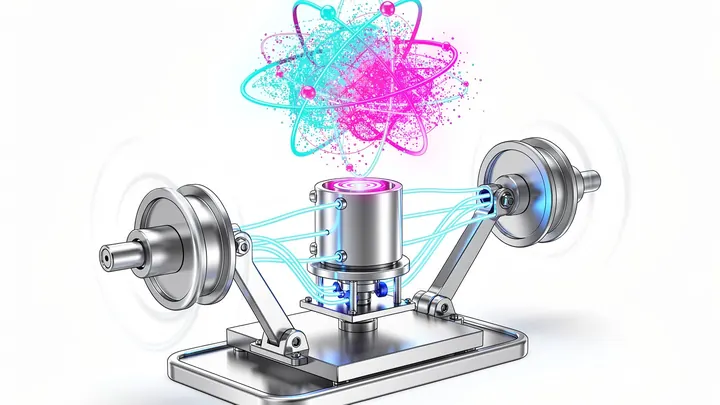
A Rydberg atom simulator is a specialized quantum device that uses highly excited atoms — called Rydberg atoms — to mimic the behavior of other, more complex quantum systems. In a Rydberg atom, one or more electrons are promoted to very high energy levels, far from the nucleus, making the atom extremely sensitive to electric fields and to its neighbors. By arranging these atoms in arrays with laser light and tuning their interactions, researchers can recreate models of magnetism, particle transport, or even the dynamics of black holes, all in a controlled laboratory setting.
History
The concept of using Rydberg atoms for quantum simulation was proposed in the early 2000s, with pioneering experimental demonstrations around 2010 by groups at the University of Wisconsin and the Max Planck Institute of Quantum Optics. The field has since expanded rapidly, becoming one of the leading platforms for programmable quantum simulation.
How it works
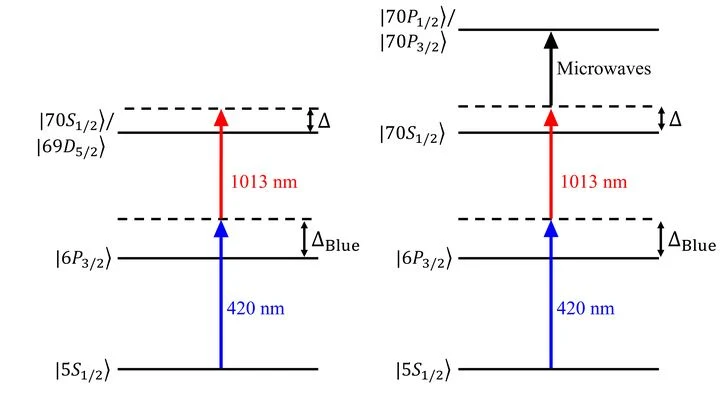
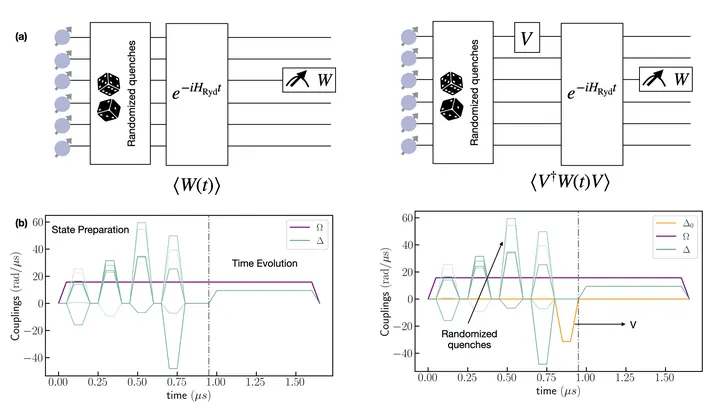
The simulator works by trapping neutral atoms (often rubidium or cesium) in optical tweezers — focused laser beams that hold each atom in place. A laser excites the atoms into Rydberg states, where their electron orbits are so large that atoms interact strongly with each other via dipole forces. By carefully choosing the laser frequencies and the geometry of the atom array, physicists can program the interactions to match a target quantum Hamiltonian — the mathematical description of the system they want to study. The resulting collective behavior of the atoms is then measured, revealing properties of the simulated system that would be impossible to compute directly.
In practice
Rydberg atom simulators are used to study quantum magnetism, high-temperature superconductivity models, and quantum phase transitions, providing insights that could inform the design of new materials and quantum algorithms.
Fun fact
A single Rydberg atom can be so large that its electron orbit spans several micrometers — nearly the size of a small bacterium — making the atom effectively a giant dipole that strongly influences its neighbors.
A courtroom interpreter catches every word, every breath, every whisper in the corner. They have no right to miss a detail, because the meaning of the whole conversation depends on it. Quantum state tomography works in much the same way: it reconstructs the full quantum state of a system from a set of measurements, leaving no detail out.
You can walk a long road, or you can fold it into a shorter route without losing the key landmarks. In quantum computing, that road is the time evolution of a state: it demands ever longer chains of operations, which quickly drown in noise on a real processor. Physicists have found a way to compress each step of the evolution into a compact, tunable circuit while keeping accuracy above 99%.
Earth's magnetic field is not constant: it trembles from the solar wind, from distant thunderstorms, and from the subway running nearby. To notice these tremors, you need an instrument that doesn't tremble itself. Physicists have built such an instrument from ytterbium atoms cooled to nearly absolute zero.
In a noisy hall, an interpreter tries to catch every word, but rustles and echoes muddle the meaning. That's roughly how conventional computer methods handle complex quantum systems: the more particles and the stronger their correlations, the faster calculations drown in interference.
Two dancers on stage must move in perfect sync, but if one hesitates, the whole routine is ruined. That's roughly how quantum computers with neutral atoms work: two atoms are entangled by putting them into a Rydberg state (as huge as a balloon compared to an ordinary atom), and then you wait for them to 'dance' their part.
Empty space is not as empty as it seems. According to quantum theory, the vacuum is filled with particles that constantly pop in and out of existence. In 1976, physicist Bill Unruh showed that if an observer moves with acceleration, this 'quantum soup' turns into a genuinely warm bath for them — the Unruh effect.
A cloud of atoms cooled to near absolute zero suddenly starts behaving like a brain. One excited atom triggers a chain reaction — neighbors light up in turn, and an avalanche of activity sweeps through the gas. Physicists call this Rydberg facilitation: atoms are easier to excite when an excited one is nearby.
Water from a faucet boils quickly, but in the last moment before the boiling point, everything seems to freeze — bubbles hesitate, the temperature stalls. So it is in quantum systems: when a material approaches a critical point, its internal clock stretches to infinity.
A network of tiny magnets seeks the state with the lowest total energy: that's roughly what the quantum Max Cut problem looks like, one of the toughest in physics. Scientists have been hunting for its solution since the days of Werner Heisenberg.
The quantum world is full of transformations. Sometimes a system made of one type of particle starts behaving as if it harbors completely different ones. For example, in a chain of bosons, sociable particles that like to crowd into the same state, fermions from the Standard Model may unexpectedly appear, even though they usually keep to themselves.
A lithium battery is like a tiny city: lithium ions are the residents who move between electrode neighborhoods, generating current. But to understand how much energy the city can deliver, you need to know not only the street layout (the material's structure) but also how residents interact with neighbors, transportation, and even the weather.
Computational studies of material behavior have long suffered from two extremes: either fast but inaccurate models, or accurate but slow physical calculations. Modern programs, trained on data, have nearly resolved this dilemma — now the bottleneck is not computing power, but human routine: setting up simulations and checking results.
Paimon works like an autonomous chef.
Energy transfer in photosynthesis is like a children's slide: it bends under the weight of one, reshaping the path for the next. That's what happens in a leaf: an excited molecule instantly reshapes the 'landscape' of its neighbors.
Physicists reproduce this effect using ions suspended in a vacuum trap.
If you toss a handful of coins into a box with dividers, each coin lands in its own compartment and stays there forever. Roughly the same happens to atoms in a special optical lattice when excited by a laser. These atoms are called Rydberg atoms: one electron in each is promoted to a very distant orbit, making the atom sensitive to its neighbors.
The early universe resembled a rapidly inflating balloon: it expanded so fast that light couldn't keep up with its own edges. Then this frantic acceleration gave way to calm expansion. The balloon was no longer being blown up, and it began to slowly deflate. At the moment of the regime change, emptiness didn't stay empty: from it, as if from an overheated boiler, pairs of particles burst forth.
A superfluid gas behaves like a frictionless liquid. Two clouds of such gas are connected by a narrow bridge, and a stream of particles flows through it. This resembles the Josephson effect in superconductors, but here the particles are neutral atoms instead of electrons.
An orchestra where every musician plays their own part, and the conductor tries to catch the overall melody. That's roughly how physicists view electrons in cuprates — ceramic materials that conduct electricity without resistance at temperatures above liquid nitrogen.
A laser is tuned to a frequency at which a rubidium atom normally does not get excited. But if an excited atom is already nearby, it shifts the energy levels of its neighbor, and the neighbor starts absorbing light. So the pair of atoms acts like a duo: one helps the other light up.
Inside an exploding star, neutrinos race so densely that they start to influence each other. Their quantum states become entangled, like threads in a tight ball where you can no longer tell which is which. Ordinary computers struggle with this task, as the number of possible states grows avalanche-like.
A spoon drops into a cup of hot coffee, and ripples spread across the surface. They show how quickly the disturbance moves away from the point of impact. In the quantum world, physicists look for similar 'ripples on water'—how information spreads along a chain of atoms.
A regular laser is a light amplifier in which atoms, after receiving energy, collectively emit waves of a single frequency. A maser does the same thing, but for microwaves — the invisible radiation that heats food in a microwave oven and carries signals in phones.
A three-seat swing never stops: one rider is always left hanging. That’s a frustrated magnet — a perpetual dance with no rest. To study it, physicists built a quantum simulator from 256 atoms, meticulously mimicking the crystal TmMgGaO₄.
A cloud of cesium atoms was made to behave like a single quantum string. By shining a laser and letting the particles interact, scientists launched self-sustaining oscillations — a rhythm emerged without an external conductor.
Radio waves acted like frets on a fingerboard: it was possible to smoothly vary the sounding frequency.
A laser beam holds a single ion in a vacuum, and that ion behaves like a ball trapped between two cups. The cups aren't pits in the ground but regions where the ion energetically prefers to be. In the classical world, a ball would roll into one cup and stay there.
A pot of water on the stove is just water, but inside each molecule, a continuous dance goes on. Hydrogen and oxygen atoms jitter, even at absolute zero, because that's how the quantum world works. These jitters change how much heat water stores and how it flows.
Inside a proton, quarks are held together by gluons, like springs. Let go of one quark — the spring stretches and snaps, creating a new quark. That's the strong force at work, and simulating it in real time on a regular computer is nearly impossible: there are too many possibilities, all tangled together.
Enter the quantum computer.
Physicists took 114 rubidium atoms, cooled them to near absolute zero (as in experiments with liquid helium), and neatly arranged them in a honeycomb pattern. They then smoothly adjusted the interaction strength, as if slowly turning up the heat under a pot.
Light and matter in the tiny world obey laws that are hard to compute even on a supercomputer. Physicists build special "quantum simulators"—setups where cold atoms play the roles of particles and fields. But until now, such simulators could only depict the field in its simplest form: as if it were either present or absent.
Inside every cell, chemical reactions are constantly underway, like a tiny kitchen where protein chefs whip up essential compounds. But seeing exactly how a chef prepares a dish is tricky when you're surrounded by a crowd of other molecules.
A quantum computer made of trapped ions played the role of a tiny universe. In it, particles didn't just move; they wove into knots that change their properties when swapped. Such knots are called Fibonacci anyons: they aren't ordinary particles but rather vortices in the fabric of space.
Two electrons in a narrow tube don't want to be close. Both carry a negative charge and push each other apart, like two magnets with like poles facing. If the tube is very thin, they can't move sideways, so they line up one behind the other. Physicists call this Wigner localization: the particles take fixed positions, like beads on a taut string.
In the world of atoms, any external influence can turn a neat order into chaos. Usually, energy losses only increase entropy — a measure of disorder. But physicists discovered the opposite: sometimes losses help the system maintain stability.
Atoms, like strands in a braid, follow a strict rule: if one strand is 'charged', its neighbors must stay silent. This phenomenon, Rydberg blockade, allows stable quantum patterns to be woven.
In such patterns, topological order emerges: a structure where the overall weaving pattern matters more than individual loops.
In nature, everything is cyclical: hares multiplied — foxes thrived — hares ran out — foxes died off — and the cycle repeated. This 'predator-prey' model was invented a century ago, and it works everywhere: from chemistry to economics. Physicists have now brought this storyline to the atomic stage.
Ordinary light scatters in all directions, but physicists turned it into something like a conveyor belt — a one-way stream that doesn't turn back. To do this, they sent two counter-propagating beams through a cloud of Rydberg atoms, bloated to the size of a tiny dust speck.
Topological phases usually hide inside cryostats. Superconducting circuits, ultracold atoms, laser pulses: all of them shield quantum order from thermal noise.
Among the fundamental symmetries of nature, mirror parity holds a special place. The Standard Model already knows one violation of it, in the weak interaction, but hypothetical long-range forces that don't conserve left and right could reveal a lot about dark matter.
A supercomputer simulating laser plasma is like a kitchen where hundreds of chefs are preparing a single dish. If ten people crowd around one stove while another stands empty, the work grinds to a halt. The same happens in simulations: plasma particles bunch up in certain regions of space, leaving others nearly empty.