Quantum dynamics is the theoreticalframework for describing how quantum systems evolve over time. It provides the mathematical tools to simulate the time-dependent behavior of particles, fields, and interacting many-body systems, from simple two-level atoms to complex chemical reactions. In practice, quantum dynamics is used to model processes like molecular vibrations, electron transfer, and photochemical reactions, where classical mechanics fails to capture quantum effects such as superposition, tunneling, and coherence. By solving the time-dependent Schrödinger equation or using approximations like path integrals, researchers can predict reaction rates, spectra, and dynamical properties that are otherwise inaccessible.
History
The foundations were laid by Erwin Schrödinger in 1926 with his wave equation, and later extended by Paul Dirac and Richard Feynman with path integralformulations. Practical computational methods emerged in the mid-20th century with the advent of digital computers.
How it works
The core equation is the time-dependent Schrödinger equation, iℏ∂ψ/∂t = Hψ, where H is the Hamiltonian operator representing the system's total energy. Solving this equation yields the wavefunction ψ(t), from which observable properties can be extracted. For complex systems, exact solutions are rare, so approximations are used: the Born-Oppenheimer approximation separates nuclear and electronic motion, while methods like time-dependent density functional theory (TDDFT) or quantum master equations handle larger systems. These approaches propagate the quantum state in small time steps, often using numerical integration techniques on powerful computers.
In practice
Quantum dynamics simulations are used in computational chemistry to design catalysts, in materials science to predict charge transport, and in photovoltaics to understand energy conversion processes.
Fun fact
Quantum dynamics simulations of photosynthesis have revealed that coherence between electronic states may enhance energy transfer efficiency, a phenomenon still debated in the field.
When a fluid flows around an obstacle, it spawns vortices and shock waves. Describing their behavior means solving a nonlinear equation in which the flow velocity depends on itself. Classical supercomputers spend days on this, while quantum computers have barely been used: their native language is linear operations, but fluids are inherently nonlinear.
A drop of ink in a glass of water spreads in intricate swirls. Similarly, a quantum particle exchanging energy with its environment changes its state in a complex and entangled manner. Describing this dance between particle and environment has long baffled scientists.
A kitchen mixer runs at a single speed, but start jabbing the button and the mixture whips up differently. Chemical reactions behave much the same way when the rates of their individual steps are not constant but pulse over time.
The universe is expanding at an accelerating rate, like dough that keeps rising faster even though the yeast ran out long ago. For twenty years, astronomers have been searching for the cause and call it dark energy. But what it is remains a mystery.
New work proposes an unexpected source: the vacuum inside the atomic nucleus.
You can think of a political system as a vast galaxy — a gravitationally bound system of stars, gas, and dust. In this analogy, parties are the stars, radiating the light of public activity, while their supporters are dark matter, the invisible substance that emits no electromagnetic radiation but whose mass holds the whole structure…
In the scorching heart of a dying star, an invisible stream is born — a neutrino gas. The particles race through matter almost without stopping, but when their density is enormous, they start to feel each other. Old calculations described this as a jostle in a crowd: each shove changes direction, but no connection arises between passersby.
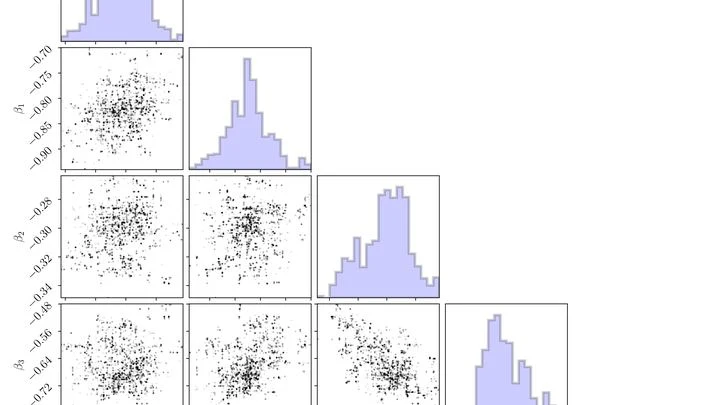
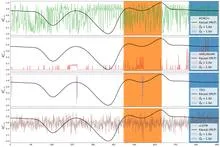
An orchestra plays without a conductor, and you hear the tempo speeding up and slowing down. All you have is a recording of the sound, not the score. Can you tell from that recording which string to pluck to make the whole orchestra play more steadily?
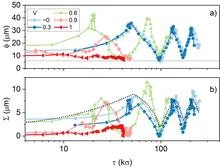
A candle flame in a draft dances: now it flares up, now it almost goes out. Quasars behave much the same way — supermassive black holes in the centers of distant galaxies, surrounded by a scorching disk of infalling matter. Only they flicker not over seconds, but over months and years.
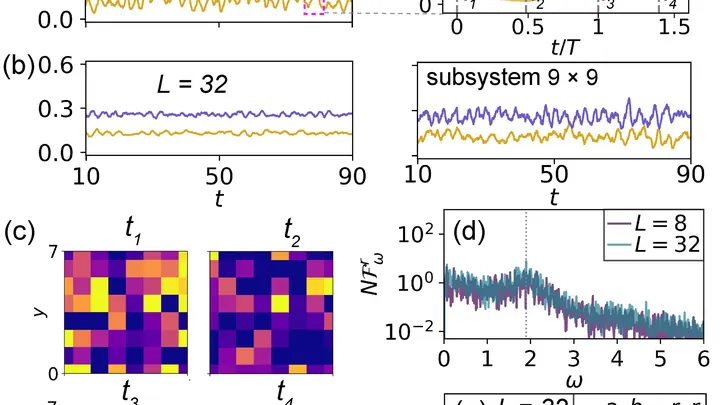
A time crystal resembles an eternal clock: its atoms spontaneously perform rhythmic movements. In ordinary clocks, a pendulum is driven by a spring or battery, but here the motion arises without an energy supply — the system simply returns to its initial state at regular intervals. This idea was proposed by Frank Wilczek in 2012.
On the surface of a tiny sphere live two invisible fields, like two kinds of ripples on a soap bubble. These fields don't just oscillate on their own: they constantly influence each other, like musicians playing in unison. In a new study, physicists derived exact equations that describe how this ripple changes over time, heats up, and descends into chaos.
When two atomic nuclei collide, the outcome depends on their energy and the angle at which the fragments fly apart. Typically, such calculations demand enormous computing power, and accuracy hits a wall due to approximations.
In everyday life, time flows on its own, like a river past its banks. But in quantum gravity, things are different: time does not flow; it emerges from relations between objects, like a pattern in a carpet that is only visible when viewed from a certain spot.
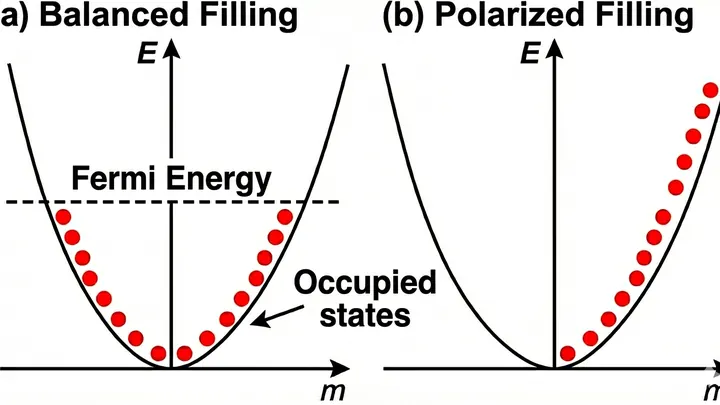
Electrons in a conductor behave like a crowd on an escalator: each one moves on its own, but together they create a flow. If you make them circle around a ring, their angular momentum (a measure of rotation) can couple to a magnetic field, like gears in a clock.
Light trapped in a tiny cavity is like a pendulum that gets pushed harder and harder. At first, it swings smoothly and predictably, like an ordinary clock. But if you push it hard enough, the motion becomes strange: the pendulum seems to be in two extreme positions at once.
A pot on a stove receives heat, but not work: the gas under the lid just heats up. But what if the stove is not ordinary, but quantum? Then heat and work can arrive simultaneously, like from an engine that also heats.
In a new study, exactly this case is described: a classical system (say, a pendulum or a small mirror) bathes in a quantum environment.
The expansion of the universe is like a dance floor stretching wider. For decades, physicists assumed that more stretching would spawn more particles, like the floor spontaneously generating new dancers. But those models ignored an obvious fact: dancers sometimes link arms. When particles interact, new simulations reveal, they actually suppress creation.
In nature, everything is cyclical: hares multiplied — foxes thrived — hares ran out — foxes died off — and the cycle repeated. This 'predator-prey' model was invented a century ago, and it works everywhere: from chemistry to economics. Physicists have now brought this storyline to the atomic stage.
In the lab, time usually ticks on the wall: hands, digits, a frequency standard. But for the Universe, there are no external clocks. The Wheeler–DeWitt equation, the main law of quantum gravity, contains no time at all, and all fundamental theories lack an inbuilt arrow of time.
Picture a translator at a meeting where everyone speaks an unfamiliar language. They don't know the words, but they notice: when one person raises their voice, another starts nodding a minute later. At first it seems like coincidence, but over time the translator learns to understand who influences whom.