Popular

Quantum Predator-Prey Games ⚡ экспресс

Original: "Quantum predator-prey cycles in dissipative Rydberg lattices"
arXiv:2510.26295 · 2025-10-30 · CC BY 4.0 · ⏱ 1 min · Quantum Physics
Physicists had atoms act out the predator-prey drama on a quantum lattice.
Abstract

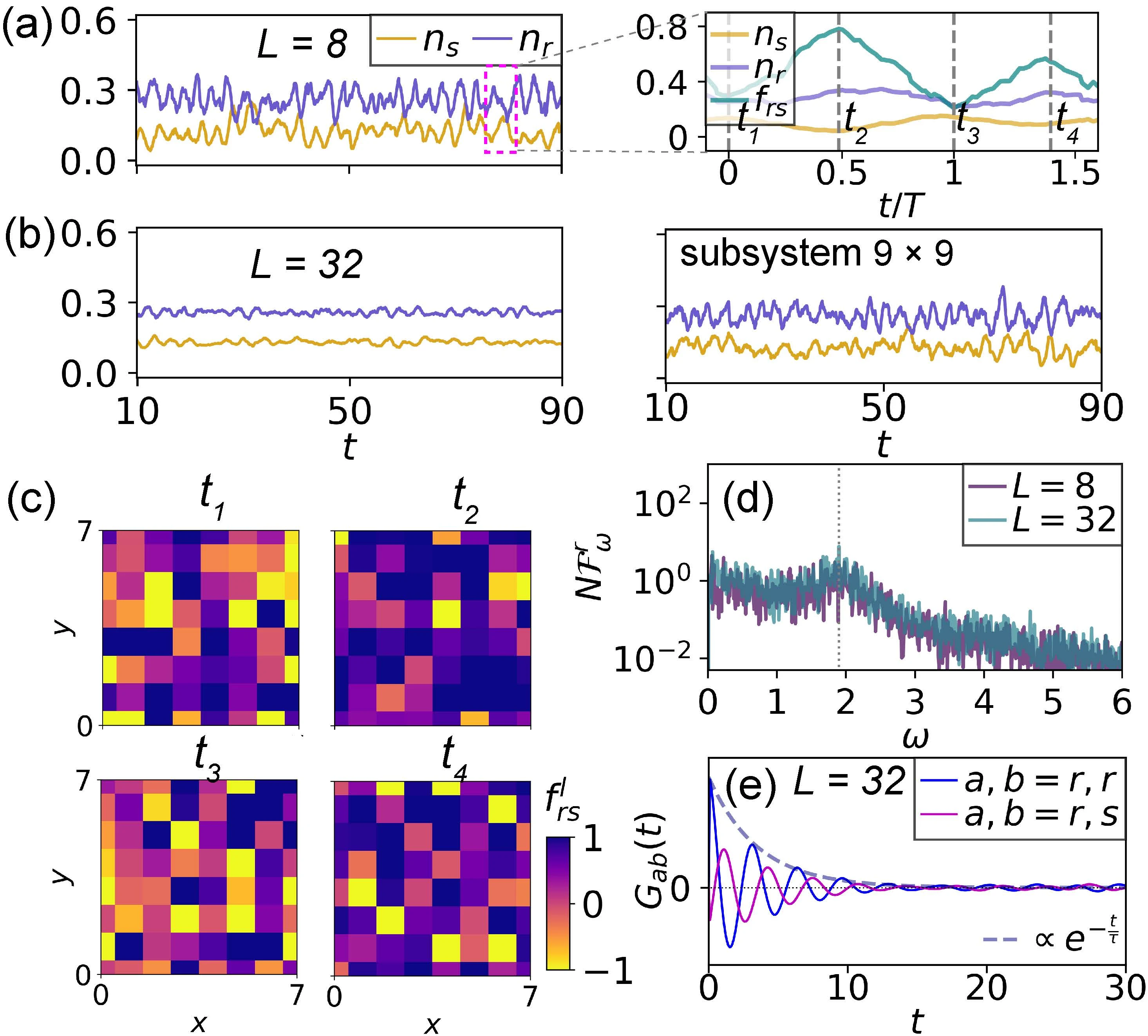
In a new study, a quantum analog of the Lotka–Volterra predator–prey model is proposed. On a two-dimensional lattice of Rydberg atoms (atoms with highly excited electrons), the authors showed that Rydberg excitations behave like populations of predators and prey, generating stable oscillations within microseconds. Quantum coherence triggers spontaneous symmetry breaking, while long-range interactions protect the cycles from desynchronization by quantum noise. Quantum jumps create "quasicycles" with amplitude decaying inversely proportional to the square root of the system size. This paves the way for quantum simulation of complex non-equilibrium phenomena.

Links in the knowledge graph 1

📄 Showing the "Simple" version — "Popular" is not ready yet. Add it to favorites to help prioritize it.

In nature, everything is cyclical: hares multiplied — foxes thrived — hares ran out — foxes died off — and the cycle repeated. This 'predator-prey' model was invented a century ago, and it works everywhere: from chemistry to economics. Physicists have now brought this storyline to the atomic stage. They built a lattice of hydrogen atoms and inflated them to giant sizes — into a Rydberg state, named after Johannes Rydberg. These giant atoms sense each other from afar and act out the same drama: some states become 'predators,' others 'prey.' Quantum laws don't break but rather reinforce the cycle. A natural rhythm emerges, resistant to disturbances. Stray quantum jumps only add a light ripple that smoothes out when there are many atoms — like noise in a large orchestra.

A single cycle lasts microseconds — billions of times faster than in a forest.

This is how scientists harness non-equilibrium quantum effects for the ultrafast simulators of the future.

🎯 The predator-prey model is even applied to star systems, explaining fluctuations in cosmic ray populations.

🎬 In the novel 'Dune,' the desert planet's ecology follows cycles reminiscent of the Lotka-Volterra model.

Scientists
Christian DopplerD. B. McLaughlinDidier QuelozMichel MayorR. A. RossiterJacob Bekenstein
Tags
spectroscopy entropy hydrogen
Laws
second law of thermodynamicsDoppler effectBekenstein-Hawking entropyCoulomb's lawMaxwell's equationsPlanck's law
Original: arXiv:2510.26295 · CC BY 4.0 · bridge42worlds