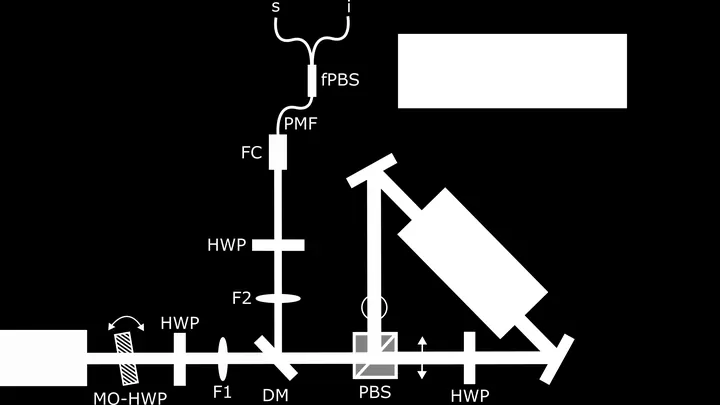
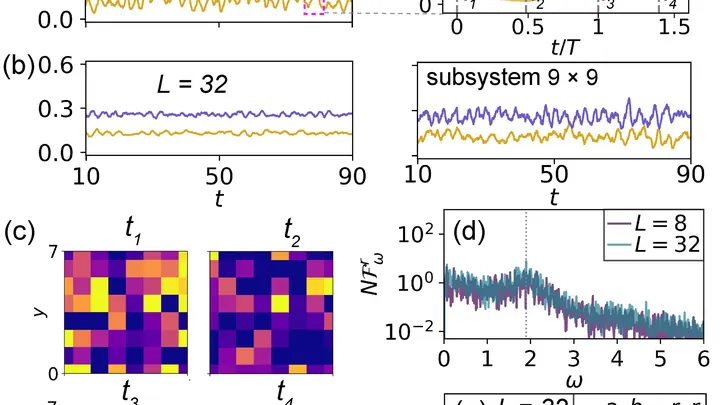
Quantum gravity is the long-sought framework that would unify general relativity with quantum mechanics, describing gravity at the smallest scales where spacetime itself is expected to fluctuate. For decades, testing quantum gravity seemed impossible because its effects are minuscule, but recent laboratory experiments have begun probing these phenomena using atomic interferometry, levitated particles, and rotational systems. These tabletop setups aim to detect signatures like gravity-induced entanglement, quantum violations of the equivalence principle, or modifications to atomic energy levels caused by gravitational fields.
History
The idea of laboratory quantum gravity tests gained traction in the 2010s, with proposals by Sougato Bose and others for entanglement-based experiments. The first serious experimental efforts emerged around 2020, though no definitive quantum gravity signal has yet been confirmed.
How it works
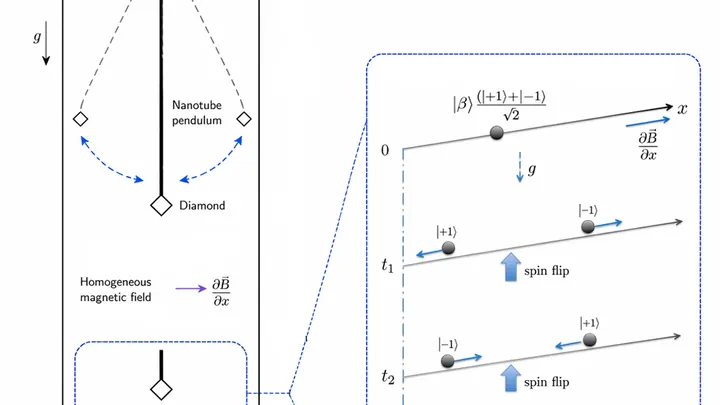
The experiments typically use ultra-cold atoms or tiny levitated objects in superposition states, where a particle exists in two places at once. By measuring interference patterns or spin precession, researchers look for deviations from standard quantum mechanics that could arise from gravitational effects. Rotational systems, such as torsion pendulums or spinning microdiamonds, are used to test how gravity couples to quantum spin or to search for exotic interactions that might mimic quantum gravity.
In practice
These experiments refine our understanding of fundamental physics and could lead to improved quantum sensors for navigation, geodesy, and tests of fundamental symmetries.
Fun fact
A single levitated microdiamond can be cooled to its quantum ground state of motion, allowing researchers to test whether gravity causes quantum entanglement without any particles actually flying.
A quantum computer is usually like an assembly line: operations proceed one after another, and each error accumulates. In the new work, physicists tried a different path — an architecture where the computation grows out of the measurement process itself. They took 56 ions in a trap and wove them into a three-dimensional cloud of entangled particles.
Two tiny weights, each about the mass of a grain of sand, hang in the dark at a temperature colder than deep space. They don't touch, but an invisible thread connects them — gravity. The experiment physicists are now building aims to catch the moment when that thread tugs one weight due to the motion of the other.
The vacuum is not as empty as it seems. If an observer moves with acceleration, the vacuum around them heats up: this was predicted by William Unruh back in the 1970s. The effect is akin to black hole radiation, but in flat space.
A magnet the size of a grain of rice floats in a vacuum without touching the walls. It is held by the magnetic field of a superconducting trap — a ring cooled to a state where current flows without resistance.
The weak equivalence principle, silently tested since the time of Galileo and laid at the foundation of general relativity, states: all bodies fall equally, regardless of their internal composition.
A stone falls into a well, and the splash reaches your ears with a delay. Something similar happens to light as it leaves Earth: its oscillations become less frequent, the beam seems to 'tire.' This is gravitational redshift — a phenomenon Einstein spoke of a century ago.
A flashlight beam in a dark room can hold a dust mote almost still: that's how optical tweezers work. But light doesn't just push the particle; it also jostles it with random kicks. Each absorbed photon strikes it like an invisible hammer. The authors of the new study have devised a light trap of a special shape.
Two balls suspended on threads swing side by side. Each moves on its own, but between them is an invisible thread — the attraction of masses. If gravity is quantum, it could bind them into a single whole: nudge one, and the other responds, even without contact.
A clock isn't just hands. Every atomic nucleus is a natural metronome: it oscillates with nearly perfect regularity. If you lift one such metronome a couple of meters, its rhythm speeds up ever so slightly — that's time warping, as predicted by Einstein.
Galileo, legend has it, dropped balls from the Tower of Pisa to prove that heavy and light objects fall equally. This law formed the foundation of Einstein's theory of gravity. Today, scientists have turned an entire space station into such a tower.
A spring scale in a geologist's backpack responds sensitively to every mountain and valley beneath their feet. But springs get tired, and their readings drift — the instrument needs frequent recalibration against a reference. An atomic gravimeter measures gravity flawlessly, but it's the size of a refrigerator and doesn't like being jostled.
In a quiet lab, a device the size of a microwave oven sits on a table. Inside, a coil glides smoothly up and down while a computer reads electrical signals. This is the tabletop Kibble balance — a machine that links mass to quantum constants.
Previously, such balances occupied a whole room and required a team of engineers.
Since the days of Galileo, it was believed that in a vacuum all bodies fall identically. Einstein elevated this to a principle: gravity travels at the speed of light and is the curvature of spacetime.
A weight about the size of a small apple hangs from a thread hundreds of times thinner than a human hair. The thread doesn't snap and barely interferes with the weight's swinging. This setup is the heart of a new lab scale for measuring gravitational attraction.
The theory of gravity by Einstein — general relativity — rarely intersects with quantum physics in direct experiments. Here, scientists built a 50-kilometer glass labyrinth on a table and sent single photons through it.
In nature, everything is cyclical: hares multiplied — foxes thrived — hares ran out — foxes died off — and the cycle repeated. This 'predator-prey' model was invented a century ago, and it works everywhere: from chemistry to economics. Physicists have now brought this storyline to the atomic stage.
In 2022, physicists observed gravity shifting the phase of a single atom's wave, the gravitational analog of the Aharonov–Bohm effect. This experiment became part of a long-standing debate: whether gravity must be quantized or remains a classical background in the quantum world.