A Rydberg atom is an atom in which one electron has been excited to a very high principal quantum number (n), meaning it orbits far from the nucleus and is only weakly bound. These atoms are enormous — with n around 100, the electron's orbit can be a micrometer across, larger than a bacterium — and they are extraordinarily sensitive to external electric fields. This sensitivity makes them ideal probes for measuring weak fields, studying quantum coherence, and exploring the boundary between quantum mechanics and classical physics.
History
The concept of highly excitedatoms dates back to the early 20th century, but the systematic study began in the 1970s with the advent of tunable lasers that could excite atoms to high n states. The term 'Rydberg atom' honors the Swedish physicist Johannes Rydberg, whose formula (1888) describes the energy levels of hydrogen-like atoms.
How it works
The electron in a Rydberg atom sits in a nearly hydrogen-like orbit, far from the core electrons. Its binding energy scales as 1/n², so for large n it is tiny, and its radius scales as n², making it huge. Because the electron is so far away and loosely bound, even a small electric field can shift its energy levels dramatically (the Stark effect) or ionize it. This extreme polarizability is the key to their usefulness: Rydberg atoms act as sensitive electric-field sensors, and their long radiative lifetimes (milliseconds or more) allow them to store quantum information.
In practice
Rydberg atoms are used in quantum sensing (electric-field meters), in quantum computing as qubits with strong interactions, and in studies of quantum chaos and ultracold plasma.
Fun fact
A Rydberg atom with n=100 is so large that if it were placed in a typical solid, it would overlap with thousands of neighboring atoms — yet it remains electrically neutral and stable in a vacuum.
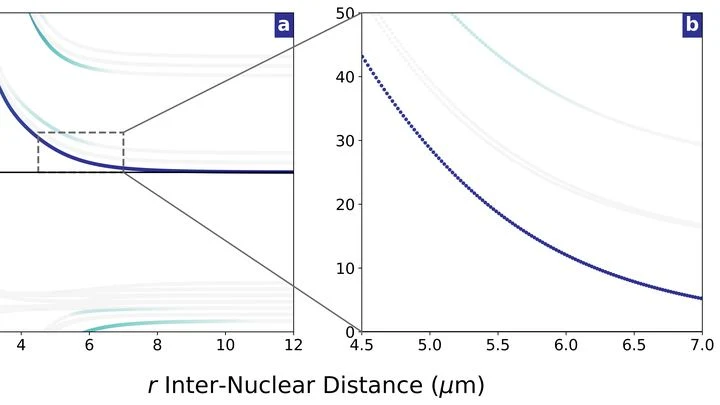
Rydberg molecules are like a pair of dancers holding hands at arm's length. One partner is an ion, the other is an atom, and the bond between them is as weak as an invisible thread. Such a pair can exist for only an instant, but that instant stretches into microseconds — an eternity by the standards of the microworld.
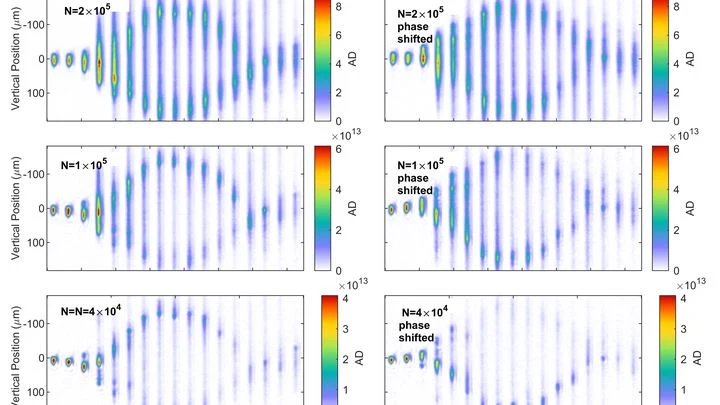
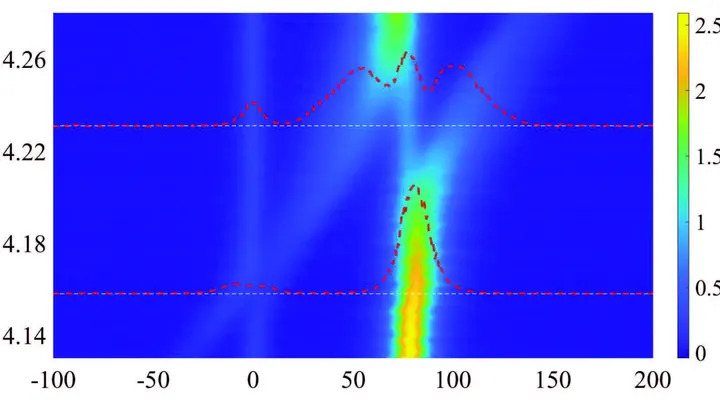
Moiré patterns are familiar to everyone. Two combs with different spacing, placed on top of each other, show dark fringes. Something similar has emerged in time. Physicists took a cloud of Rydberg atoms, particles with unusually large electron orbits, and illuminated it with two lasers.
An orchestra of billions of cesium atoms struck a single note, and it sounded for 17 hours without fading. That’s no exaggeration: Chinese physicists created a continuous time crystal with a record-breaking lifespan. A time crystal is a system that breaks time symmetry, spontaneously pulsating in an unchanging rhythm.
Quantum entanglement — a phenomenon where the states of two or more particles become interconnected regardless of the distance between them — usually links intrinsic properties such as spin or polarization. However, a new experiment has for the first time realized entanglement of the positions of two atoms in space.
Atomic nuclei are rarely perfect spheres. More often, they resemble a slightly squashed ball — the electric charge inside is unevenly distributed, and protons may shift a bit, creating a tiny 'pear-shaped' bulge.
A child on a swing: too strong a push and they fly off. Roughly this is how powerful light tears electrons out of an atom. It would seem that the stronger the push, the more certain the destruction. But in the quantum world it is different: when the field strength crosses a certain threshold, the atom suddenly freezes.
Four tiny puddles, and in them ripple droplets of a superfluid. These droplets are atoms cooled to near absolute zero and paired up like little magnets. When the whole setup rotates, the fluid flows between the puddles. Simply counting how many droplets end up in each reveals the angle and angular velocity.
If you toss a handful of coins into a box with dividers, each coin lands in its own compartment and stays there forever. Roughly the same happens to atoms in a special optical lattice when excited by a laser. These atoms are called Rydberg atoms: one electron in each is promoted to a very distant orbit, making the atom sensitive to its neighbors.
A big sticky ball thrown onto a dusty shelf bounces off and kicks up a cloud of dust, but if you roll it slowly, it picks up every bit. Rydberg excitons behave just like that — they're giant 'atoms' inside a crystal, named after Johannes Rydberg.
Imagine an orchestra where each musician plays their own part, and the conductor directs everyone at once. In a neutral-atom quantum computer, the laser beam plays the conductor, needing to hit its target precisely without wavering for a split second.
An ordinary antenna picks up radio waves, but there are fields it barely feels. We're talking about slow electric fields: those that change once a second or less. For them, physicists built a sensor from a beam of rubidium atoms.
Inside a glass capsule the size of a pea, rubidium atoms float. A laser beam puts them into a special state — Rydberg — where the electron flies far from the nucleus, making the atom extraordinarily sensitive to external fields.
Radio waves that oscillate less than once per second pass through the earth and water with almost no loss. Such signals are used to communicate with submarines and to search for minerals. But a conventional antenna for them would need to be hundreds of meters long, and its sensitivity leaves much to be desired.
A quantum computer is like an orchestra where each musician plays their own part, but all must sound in harmony. Until now, most quantum circuits were built from identical atoms — as if the orchestra consisted only of violins. Now physicists have taught two different elements to work together: rubidium and cesium.
A laser strikes a strontium atom, and two electrons fly out at once. Previously, it was thought that in such double ionization each electron acts on its own: one is knocked out first, the second later, randomly.
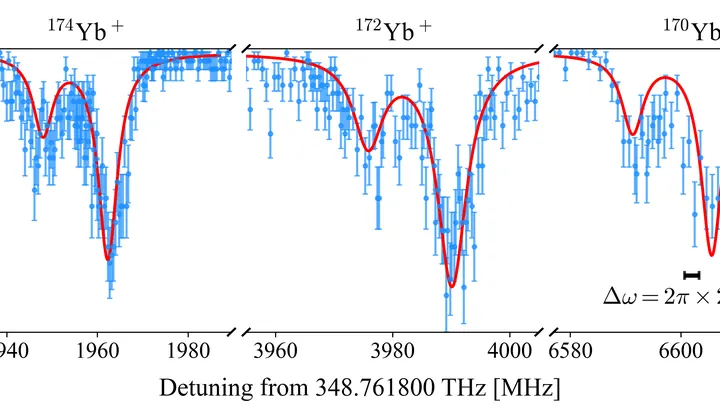
The light an atom emits or absorbs is like a fingerprint: each element has its own pattern of lines. In an ytterbium ion (an atom that has lost one electron), researchers have found three new lines that were previously unused. These lines are very narrow, like thin slits in a fence that let you see far and clearly.
Fourteen rubidium atoms lined up like beads on a string. Each atom is a tiny magnet that can point up or down. Together they follow strict rules, similar to a train schedule: everything is predictable, everything repeats. But introduce a barely noticeable change, and the schedule goes off the rails.
A regular radio receiver picks up waves with a metal antenna. Here, the antenna is a single atom with an electron boosted to a distant orbit, like a satellite in a high orbit around Earth. Such atoms are called Rydberg atoms.
A bell doesn't ring with a single note — after being struck, it sounds with several harmonics at once. An atomic nucleus vibrates in much the same way: after a collision, it can oscillate, and these oscillations show up in the emitted gamma rays.
Emptiness isn't always empty: it can hide energy, like supercooled water hides ice. Physicists call this false vacuum — a state that only needs a nudge to cascade into the true one.
Two water droplets tremble in sync — because they're connected by a straw. So it is with entangled particles: their unity may be held together by a microscopic wormhole.