Magnetic Mosaic: How Non-Repeating Patterns Trap Tiny Quantum Waves express
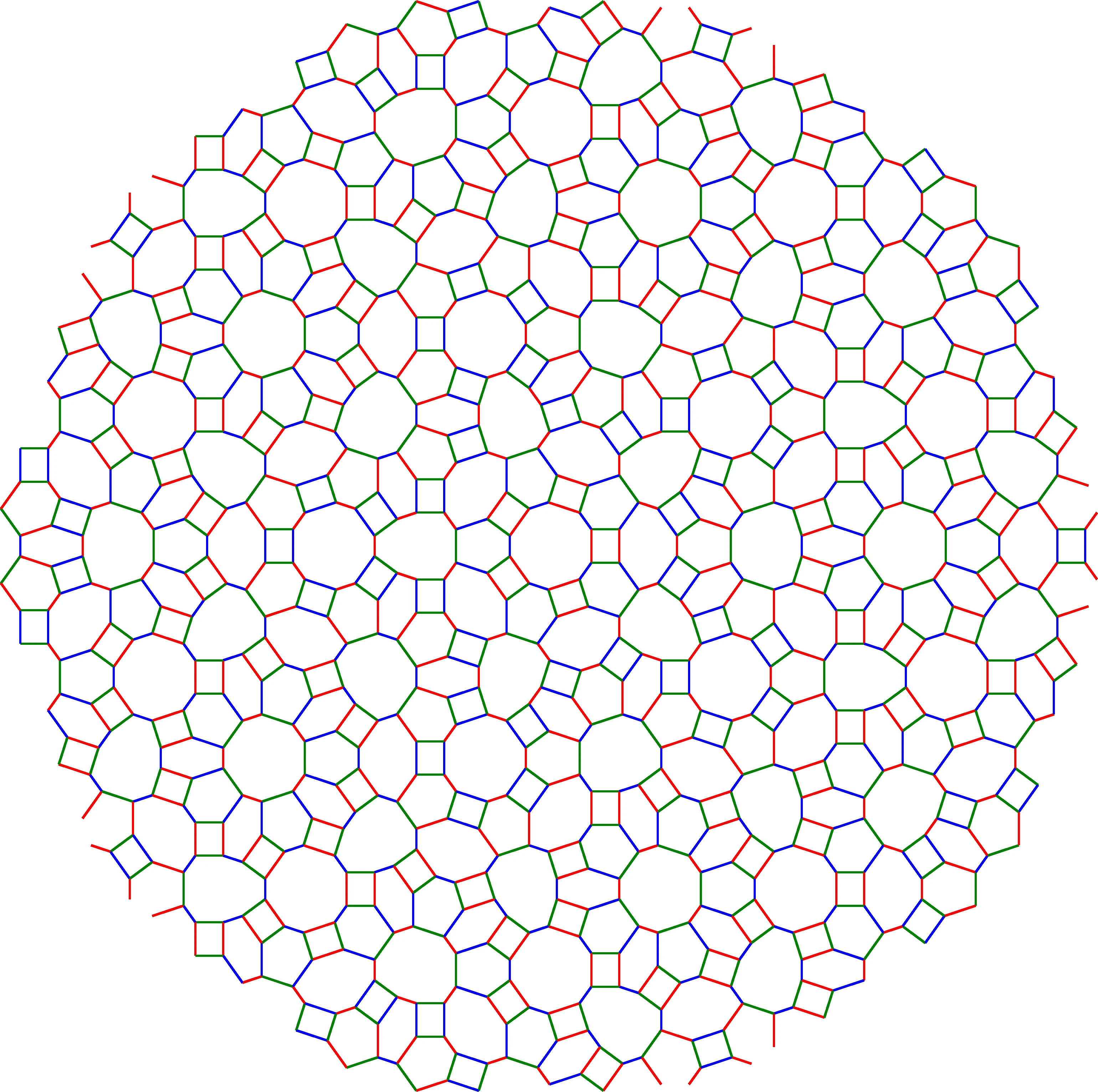
On a mosaic floor with a non-repeating pattern, magnetic arrows dance a chaotic dance, creating a quantum spin liquid with high entropy — a measure of disorder. The Alexei Kitaev model showed that in such a dance, anyons are born — particles with fractional charge, unlike ordinary particles from the Standard Model. A weak magnetic field makes the anyons move, but the mosaic pattern acts as a trap: some whirl in closed loops, others freeze forever. The energy spectrum confirms that geometry governs motion. This promises quantum computers where information is stored in immobile anyons, protected from noise. Quasicrystals themselves are not just theory: they have been found in meteorites that arrived from space long before Earth was born.
Original abstract
as written by the authors arXiv:2511.17144
An exactly solvable model of a quantum spin liquid on a quasicrystal, akin to Kitaev's honeycomb model, was introduced in Kim \textit{et al.}, \href{https://doi.org/10.1103/PhysRevB.110.214438}{\text{Phys. Rev. B} \textbf{110}, 214438 (2024)}. It was shown that in contrast to the translationally invariant models, such a spin liquid stabilizes a gapped ground state with a finite irrational flux density. In this work, we analyze the strong bond-anisotropic limit of the model and demonstrate that the aperiodic lattice geometry naturally generates a hierarchy of exponentially separated coupling constants in the resulting toric code Hamiltonian. Furthermore, a perturbative magnetic field leads to anomalous localization properties where an anyonic excitation sequentially delocalizes over subsets of sites forming equipotential contours in the quasicrystal. In addition, certain background flux configurations, together with the underlying geometry, give rise to strictly localized eigenstates that remain decoupled from the rest of the spectrum. Using numerical studies, we uncover the key mechanisms responsible for this unconventional localization behavior. Our study highlights that topologically ordered phases, in the presence of geometrical constraints can lead to highly anomalous localization properties of fractionalized charges.
Quasicrystals, discovered in 1982, were first thought impossible, but in 2011 their discoverer won the Nobel Prize. They also occur in nature: for example, in meteorites that are older than Earth.