Lattice calculation is a computational technique used in quantum physics, particularly lattice quantum chromodynamics (QCD), where continuous space-time is discretized into a grid (lattice) of points. This allows physicists to numerically simulate the behavior of quarks and gluons, which are otherwise intractable analytically due to the strong force's complexity. By placing fields on lattice sites and links, researchers can use Monte Carlo methods to evaluate path integrals, yielding predictions for particle masses, decay constants, and other observables from first principles.
History
Lattice gauge theory was introduced by Kenneth Wilson in 1974, who proposed discretizing space-time to study quark confinement. The first realistic QCD calculations emerged in the 1980s, and the field has since matured into a precision tool.
How it works
The lattice spacing acts as a natural ultraviolet cutoff, regularizing the theory. Simulations generate ensembles of gauge field configurations, weighted by the QCD action, and then compute expectation values of operators. Results are extrapolated to the continuum limit (zero lattice spacing) and infinite volume to match physical reality. Modern calculations require massive supercomputers and advanced algorithms, such as domain wall fermions or stochastic quantization, to handle fermion doubling and critical slowing down.
In practice
Lattice calculations are used to predict hadron properties (e.g., proton mass), nuclear forces, and the behavior of quark-gluon plasma, with applications in particle physics, nuclear astrophysics, and even quantum computing algorithm design.
Fun fact
Lattice QCD calculations have shown that the mass of the proton—about 938 MeV—arises almost entirely from the energy of the gluon field and quark kinetic energy, not from the intrinsic masses of quarks, which sum to only about 9 MeV.
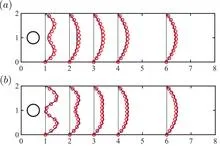
Water in a river, flowing around a stone, changes its course: some streams press against the surface, others detach and swirl downstream. A classical computer calculates such flows by dividing the fluid into millions of tiny parcels and tracking each one.
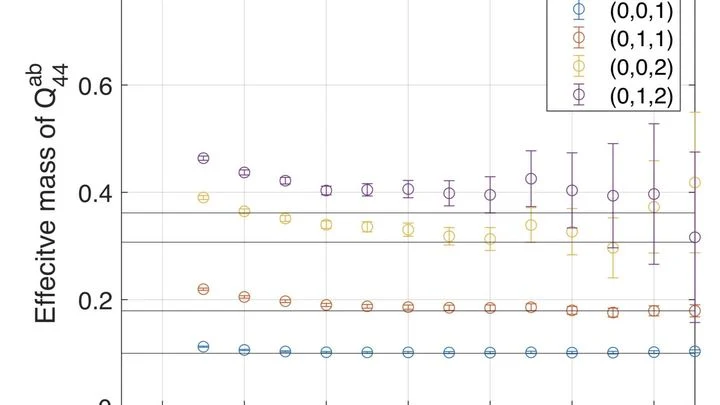
Quarks, the building blocks of protons and neutrons, usually pair up or form trios. But sometimes they assemble into larger, unstable combinations that live for mere fractions of a second. Two such particles, Bs0* and Bs1, have long been a puzzle: calculations hinted they should be bound, but the precision wasn't enough to say so with confidence.
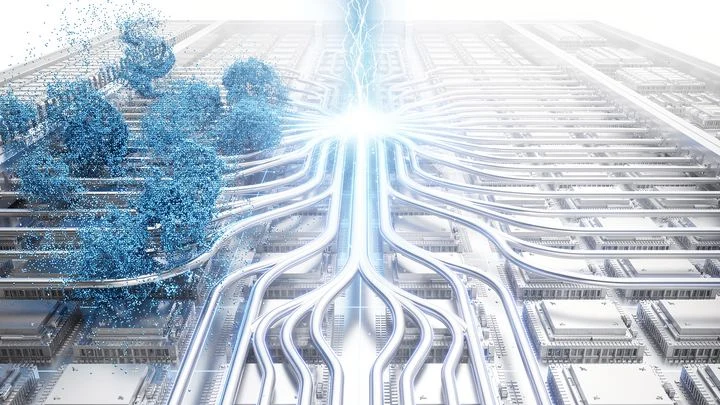
A quantum computer is usually like an assembly line: operations proceed one after another, and each error accumulates. In the new work, physicists tried a different path — an architecture where the computation grows out of the measurement process itself. They took 56 ions in a trap and wove them into a three-dimensional cloud of entangled particles.
The early universe was less like a calm pond and more like a boiling cauldron. Matter flowed, collided, and swirled against the backdrop of rapid spatial expansion. To understand how stars and galaxies emerged from this hot soup, physicists build digital simulations.
This new work is the third part in a series on lattice-based cosmological modeling. The first two focused on fields; this one deals with fluids.
For a long time, biologists studied cells by listening to just one voice in a polyphonic choir: measuring gene activity while ignoring how DNA is packed. It's like trying to grasp a conversation knowing only one language. LATTICE fixes this: the program learns five molecular 'languages' at once — from gene activity to spatial markers.
A translator who translates not words but the very structure of a conversation runs into trouble when the chat moves beyond a quiet room. In a familiar simulation on a spatial lattice, everything follows a strict script. But the moment the interlocutors find themselves in a noisy square, where sound is distorted by echoes and the crowd keeps changing direction, the script falls apart.
Electric charge is not like a number chiseled in stone. In the vacuum around any charged particle, pairs of particles and antiparticles are constantly born and annihilated, like the foam in a glass of champagne. The bubbles screen the true charge, making it appear smaller or larger depending on how close we get.
A quantum spin chain is like a string of beads, where each bead is a microscopic magnet pointing up or down. In the XXZ model, these little magnets interact differently along the three axes, and at special parameter values, roots of unity, the system awakens with a hidden memory.
A stone falls into a well, and the splash reaches your ears with a delay. Something similar happens to light as it leaves Earth: its oscillations become less frequent, the beam seems to 'tire.' This is gravitational redshift — a phenomenon Einstein spoke of a century ago.
A radio picks up a broadcast through crackle and hiss. That's roughly how modern quantum computers work: the useful signal drowns in noise. The longer the computation runs, the more the interference distorts the result.
Heavy particles, which physicists call baryons, are like tiny families of three quarks. The common baryons are protons and neutrons, which make up everything around us. But there are also exotic relatives: instead of light quarks, they harbor charm or bottom quarks — heavy and short-lived.
If you place a kaon in an electric field, it stretches slightly, like a balloon rubbed on wool. This response, the electric polarizability, shows how rigidly the particle is built inside. For the charged kaon, it has been measured for the first time, and the number is about one ten-thousandth of the volume occupied by a proton.
When light passes through a turbid medium, like a glass of milk or frosted glass, it scatters in all directions. But sometimes, instead of spreading out, it gets trapped in tiny 'pockets' inside the material. Physicists call these pockets localized modes: light falls into them as if into a trap and cannot escape.
Water boils at 100 degrees Celsius, but if you squeeze it hard enough, it behaves differently. Similarly, quarks and gluons, the building blocks of protons and neutrons, change their properties in a strong magnetic field.
When two atomic nuclei collide, the outcome depends on their energy and the angle at which the fragments fly apart. Typically, such calculations demand enormous computing power, and accuracy hits a wall due to approximations.
The helium-5 nucleus is like an overtightened string: touch it, and it falls apart into helium-4 and a neutron. Catching such a decay and measuring its rate is no easy task. Standard calculation methods stumble over mathematical noise.
The researchers took a reliable approach to describing nuclear forces and added a clever trick — analytic continuation.
A heavy stone falls into a pond, and ripples spread across the water with a distinctive pattern — from that pattern, you can infer what lies beneath the surface. Physicists study particle decays in much the same way: rare transformations in which a heavy particle suddenly becomes a lighter one, emitting light or a pair of charged particles.
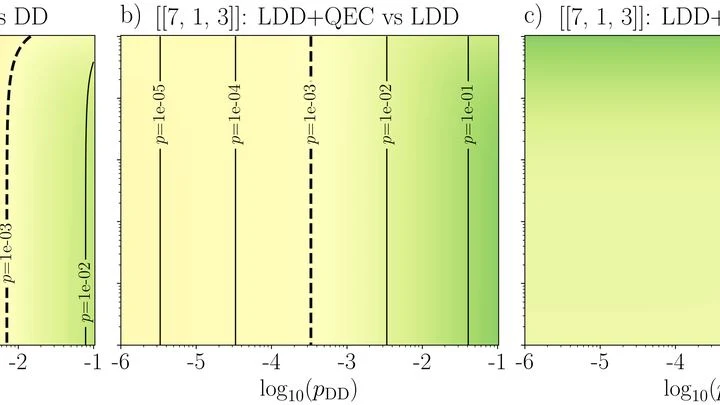
Quantum information is fragile: the slightest noise can destroy it. That's why two protection methods have been devised. The first is dynamical decoupling: rapid pulses are applied to qubits to average the noise to zero. It's like shaking a box of fragile items so they don't bump against the walls.
The proton is not a solid ball. Inside, it's a seething mix of quarks and gluons. Gluons are the particles that glue quarks together, much like wood glue binds pieces of wood. The question is: how much of the proton's "weight" comes from this glue? Physicists have calculated this on a computer by discretizing space and time into a fine grid.
A photon is like a car in a multi-story parking lot, where each floor is its frequency (color). Usually it gets stuck on one level, but scientists added an elevator — a programmable modulator that moves the photon between floors on command.
Light and matter in the tiny world obey laws that are hard to compute even on a supercomputer. Physicists build special "quantum simulators"—setups where cold atoms play the roles of particles and fields. But until now, such simulators could only depict the field in its simplest form: as if it were either present or absent.
An electron beam strikes a proton like a billiard ball hitting another ball. But between them is no empty space: the particles exchange virtual photons and Z bosons, like players passing a ball behind their backs. This exchange slightly alters the scattering trajectory, and hidden within it is a hint of new physics.
Water freezes at zero and boils at one hundred degrees. Matter made of quarks and gluons also has boundaries between states, but instead of a thermometer, the temperature here is measured in millions of electron-volts.
Neutrinos are the most elusive of all known particles. Every second, trillions of neutrinos from the Sun fly through your body, but you never notice: they barely interact with matter. To catch even one, physicists build giant detectors — pools of water or liquid argon deep underground.
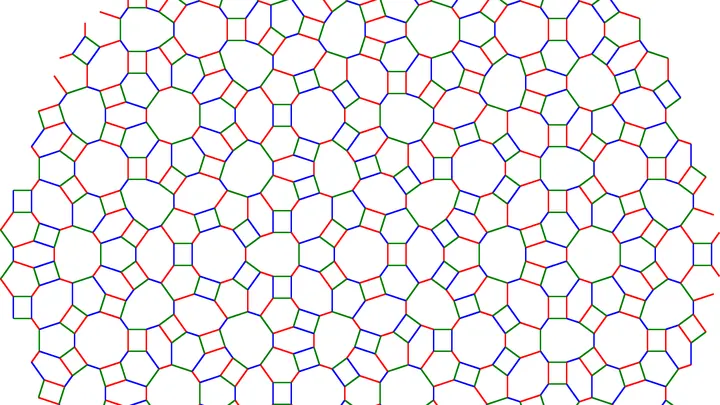
Imagine a tiled floor whose pattern never repeats, like the famous Penrose tiling. On this floor, magnetic arrows, the spins of electrons, perform a chaotic dance, giving rise to a quantum spin liquid.
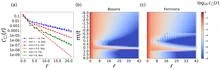
Two actors on the same stage. One is a fermion, finicky and demanding, hard to make follow the rules of a quantum simulator. The other is a boson, easygoing and undemanding, ready to take any role. The director hopes the audience won't notice the substitution.
A supercomputer simulating laser plasma is like a kitchen where hundreds of chefs are preparing a single dish. If ten people crowd around one stove while another stands empty, the work grinds to a halt. The same happens in simulations: plasma particles bunch up in certain regions of space, leaving others nearly empty.