Meteorites are solid extraterrestrial bodies that have fallen onto a planet's surface. Sizes range from millimeter-sized dust to blocks several meters across. The main source is asteroids, but fragments from the Moon and Mars are also found. By composition, they are classified as stony meteorites (including chondrites and achondrites), iron meteorites, and stony-iron meteorites. Chondrites contain chondrules—millimeter-sized spheres formed by rapid cooling of matter in the protoplanetary disk.
History
The decisive moment in the recognition of meteorites was the event of 1803: after the meteorite shower in L'Aigle (France), Jean-Baptiste Biot collected eyewitness accounts and samples, convincing the Academy of Sciences. Meteoritics has developed at the intersection of astronomy, geology, and physics. X-ray diffraction and mass spectrometry have enabled detailed study of minerals and isotopic composition. The discovery of presolar grains—microscopic dust particles that survived supernova explosions before the birth of the Sun—opened a new chapter in the study of the history of matter.
How it works
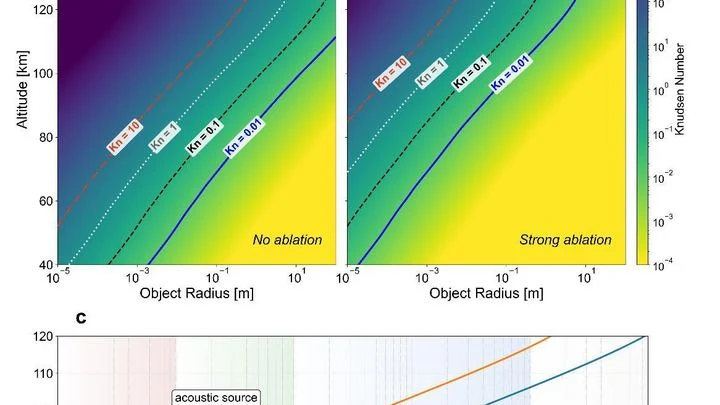
Entering the atmosphere at speeds from 11 to 72 km/s, a meteoroid undergoes strong aerodynamic heating, melting, and mass loss (ablation). The glow is caused by the shock wave and ionization of air. Equations of motion considering drag and ablation allow calculation of trajectory and final mass. The annual influx of meteoritic material is about 40,000 tons, predominantly in the form of micrometeorites. Networks of observatory cameras (e.g., the Fireball Network) record bright fireballs, enabling reconstruction of the meteoroid's orbit. Mineralogical analysis relies on X-ray diffraction and Bragg's law: nλ = 2d sinθ.
In practice
Meteorites are free samples of ancient material, allowing us to study the composition of the protoplanetary cloud without space missions and find organic molecules—the building blocks of life.
Fun fact
The Allende meteorite, which fell in Mexico in 1969, is 4.567 billion years old—older than Earth.
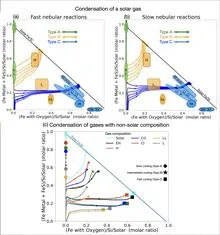
Three cabinets full of rocks. In one, metallic grains and the gray mineral enstatite; in the second, the same grains but with rusty streaks; in the third, layered clays swollen with water. All three sets were pulled from meteorites that fell to Earth: chondrites. They were born in the same gas-and-dust disk around the young Sun, yet somehow turned out so different.
Three cabinets full of rocks. In one, metallic grains and the gray mineral enstatite; in the second, the same grains but with rusty streaks; in the third, layered clays swollen with water. All three sets were pulled from meteorites that fell to Earth: chondrites. They were born in the same gas-and-dust disk around the young Sun, yet somehow turned out so different.
On the surface of the Moon and asteroids, you can find pits smaller than a pinhead but with shiny, melted rims. Such marks are left by tiny meteorites, but the exact impact speed at which melting occurs remained unclear.
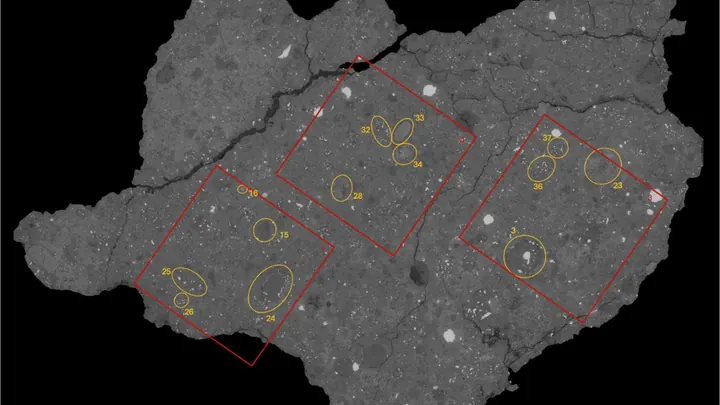
In the cold depths of space float rocks older than Earth itself. Inside some of them hide tiny glassy spheres — chondrules. They formed when a disk of gas and dust still swirled around the young Sun.
Carbonaceous meteorites Asuka 12236, Paris, and Maribo have preserved these spheres almost untouched.
A stone thrown into water quickly loses speed. A meteor entering the atmosphere should behave the same way: air slows it down, and friction burns up its material. But cameras of the Global Fireball Observatory network have captured hundreds of bright fireballs over ten years that streak across the sky with almost no deceleration.
A stone thrown into water quickly loses speed. A meteor entering the atmosphere should behave the same way: air slows it down, and friction burns up its material. But cameras of the Global Fireball Observatory network have captured hundreds of bright fireballs over ten years that streak across the sky with almost no deceleration.
In a vast hall, billiard balls are scattered about. At first they lie sparsely, each on its own. Then someone adds more, and suddenly the balls compress into dense clusters. This is a phase transition — the moment when matter abruptly changes its state.
Physicists have long described such a picture with the hard-sphere model: particles are identical balls that cannot overlap.
Remember the sensational comet 1I/‘Oumuamua — the first object to come to us from another star? Its hyperbolic trajectory left no doubt: it was a wanderer from the interstellar void. But astronomers wondered: could some of these visitors not be strangers at all, but our own, escaped from the Solar System millions of years ago?
Perth residents know: when the daytime heat becomes unbearable, relief arrives from the ocean — a fresh breeze affectionately called the Freo Doctor. The same wind, only on a global scale, decides the fate of cosmic visitors plunging into the atmosphere. A meteorite fall is a two-act spectacle.
Perth residents know: when the daytime heat becomes unbearable, relief arrives from the ocean — a fresh breeze affectionately called the Freo Doctor. The same wind, only on a global scale, decides the fate of cosmic visitors plunging into the atmosphere. A meteorite fall is a two-act spectacle.
On April 1, 2026, satellites recorded a bright fireball blazing in the sky over the South Atlantic. Photometric tracking satellites detected the entry and demise of the object at an altitude of 90.5 km. An ordinary asteroid? No. Astronomers recalculated the velocity vector into the heliocentric system — and gasped: 51.73 km/s.
Putting together the Solar System is like crafting a high-end tasting menu: the recipe isn't always set in stone — sometimes the final ingredient is added while the dish is already cooking.
The story began almost a century ago, when Edwin Hubble showed that galaxies are receding, and Fritz Zwicky and Vera Rubin later realized: to explain their motions, invisible mass is needed — dark matter.
Astronomers using the JWST (James Webb Space Telescope) have for the first time studied in detail the atmosphere of a young exoplanet, V1298 Tau c. This super-Earth, a planet more massive than Earth but less so than gas giants, is only 23 million years old.
A pebble the size of a grape enters the atmosphere almost tangentially and skims across the sky without falling. That's exactly what happened to a meteoroid weighing about 45 grams. It came in at such a shallow angle that it traveled 164 kilometers at an altitude of 92 kilometers — where the air is a million times thinner than at the surface.
A chef pours hot sugar syrup onto a cold table, and it sets into crystals. That's roughly how engineers pictured metal solidification: the liquid instantly becomes a scatter of crystalline grains. But close-up imaging revealed an extra stage wedged between liquid and solid.
Chondrules look like frozen raindrops made of stone. They're about the size of a grain of sand, but they record the history of the first few million years of the Solar System. Once, these droplets floated in the scorching gas around the young Sun, then clumped into asteroids and fell to Earth as meteorites.
An old chest of family heirlooms opens, and inside lie jewels that were thought to be as old as great-grandmother. But suddenly it turns out: the gold was remelted, the stones were recut, and this happened much later than thought. A similar story happened to the oldest particles in meteorites — calcium-aluminum inclusions, or CAIs.
The Red Planet is surrounded by the rubble of failed worlds — rocky boulders stuffed with metal. Shipping a kilogram of steel from Earth to Mars costs as much as several cars. It's far cheaper to pick up space junk right in orbit.
Light reflected from a rock carries its composition. Just split that light into colors, like a rainbow, and look carefully for missing shades. That's how hyperspectral imaging works: the camera takes hundreds of pictures of the same spot, each in a very narrow wavelength range. Minerals absorb light differently, and these 'dips' in the spectrum reveal what we're looking at.
When a baker kneads dough, the grains of flour can tell you which mill they came from. It's the same with Earth: the composition of iron in its depths preserves a memory of where the pieces that assembled the planet were born.
In its youth, Earth resembled a beehive: it grew by sticking together from countless rocky chunks. When the main construction was over, a late swarm of meteorites rained down on the young planet — the so-called late veneer. These impacts, scientists thought, brought platinum, gold, and other rare metals to Earth's upper layers.
In 2017, a stone fell from the sky in the Indian village of Mukhundpura. It was a rare carbonaceous meteorite — a chunk of ancient cosmic material that preserves traces of the birth of the solar system. Locals quickly gathered the fragments, and they ended up in a laboratory.
4 billion years ago, the young Earth was mercilessly bombarded by meteorites, leaving behind impact craters. Rains filled them with water, forming shallow ponds where lipid bubbles accumulated. These bubbles, like soap bubbles but with a double-layered lipid membrane (just like modern cells), formed spontaneously when water mixed with fat-like substances.
The young Solar System resembled a giant construction site: around the newborn Sun swirled a disk of gas and dust, and from this dust gradually assembled stones, boulders, and then planetary embryos — planetesimals. Today, their fragments fall to Earth as meteorites.
Sometimes a fiery streak crosses the night sky. It's a piece of rock from space burning up in the air, and the color of the flash can tell you what elements it contained. Astronomers pointed sensitive cameras at such flashes and, among 180 images, found two rocks that stand out from the majority of shooting stars.
An ordinary lump of coal left under the blazing sun just heats up. But if you take it into space and bring it twenty times closer to the Sun than Earth is, it won't survive for more than a few minutes. That's roughly how dark, carbon-rich asteroids behave. They are rarely found on orbits that dive deep inside Mercury's orbit.
When countless asteroids pummeled the young Earth, they tore chunks from its mantle. These fragments spiraled in a cosmic disk around the planet and, like a snowball in a blizzard, fused into the Moon.
The Moon harbors a secret that has puzzled planetary scientists for decades: its isotopic composition is almost indistinguishable from Earth's. According to the canonical giant impact model, the Moon should have inherited most of its material from the impactor Theia, a Mars-sized planet that slammed into the young Earth.