Magnetic Mosaic: How Aperiodic Patterns Trap Quantum Waves express
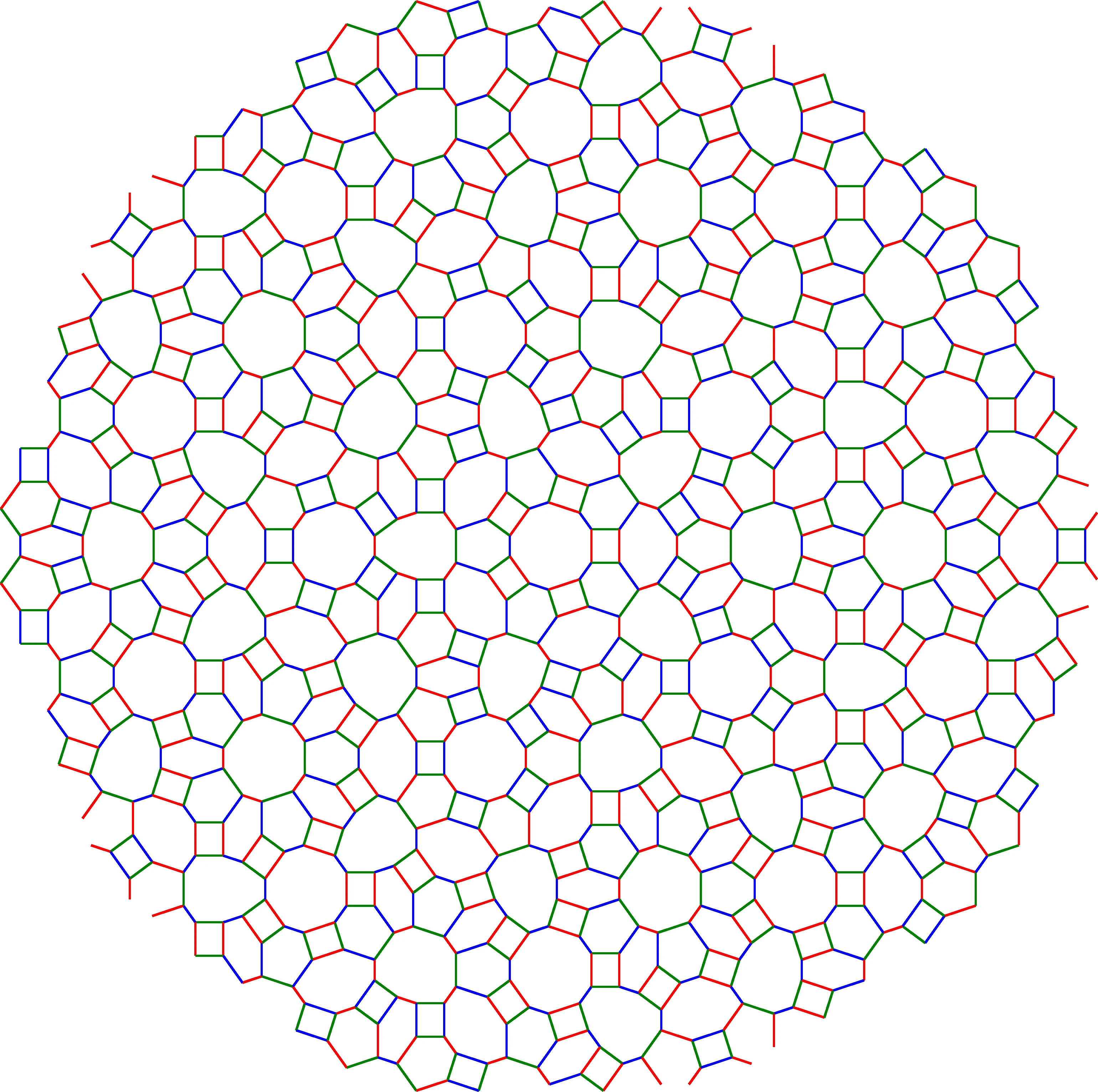
Imagine a tiled floor whose pattern never repeats, like the famous Penrose tiling. On this floor, magnetic arrows, the spins of electrons, perform a chaotic dance, giving rise to a quantum spin liquid. This is a state of matter with high entropy, a physical measure of disorder, where magnetic moments refuse to align into a strict order even at ultra-low temperatures. The model proposed by Alexei Kitaev showed that such a dance births anyons — exotic quasiparticles with fractional charge, whose behavior defies the familiar particles of the Standard Model.
A weak magnetic field makes anyons move, but the aperiodic tiling acts as an ingenious trap: some anyons loop along closed paths, while others freeze forever, caught by the geometry. Scientists figured this out by analyzing the system's energy spectrum, the distribution of allowed energy states, which confirms that geometry, indeed, dictates the motion. The dance-on-a-tiled-floor analogy simplifies the picture: in reality, it's a complex quantum-mechanical interplay where the topology of the pattern decides the fate of quasiparticles.
This discovery promises quantum computers where information is stored in stationary anyons, shielded from external noise by the system's very topology. Remarkably, quasicrystals, structures with aperiodic order, are not just a theoretical abstraction: they've been found in meteorites that arrived from space long before Earth was born, hinting at the universality of such patterns in nature.
Quasicrystals, discovered in 1982, were initially deemed impossible, but in 2011 their discoverer won the Nobel Prize. They also occur in nature: for instance, in meteorites older than Earth itself.