Climate as a Conductor: Neural Network Learns to Direct Extremes ✛
An orchestra of a thousand musicians plays in harmony as long as the conductor keeps the tempo. But the moment the score changes, the violins in one corner grow louder while the brass in another come in late. That is roughly how climate indices like El Niño reshape the behavior of extreme weather events: drought in one region and heat in another stop being independent coincidences and start occurring together.
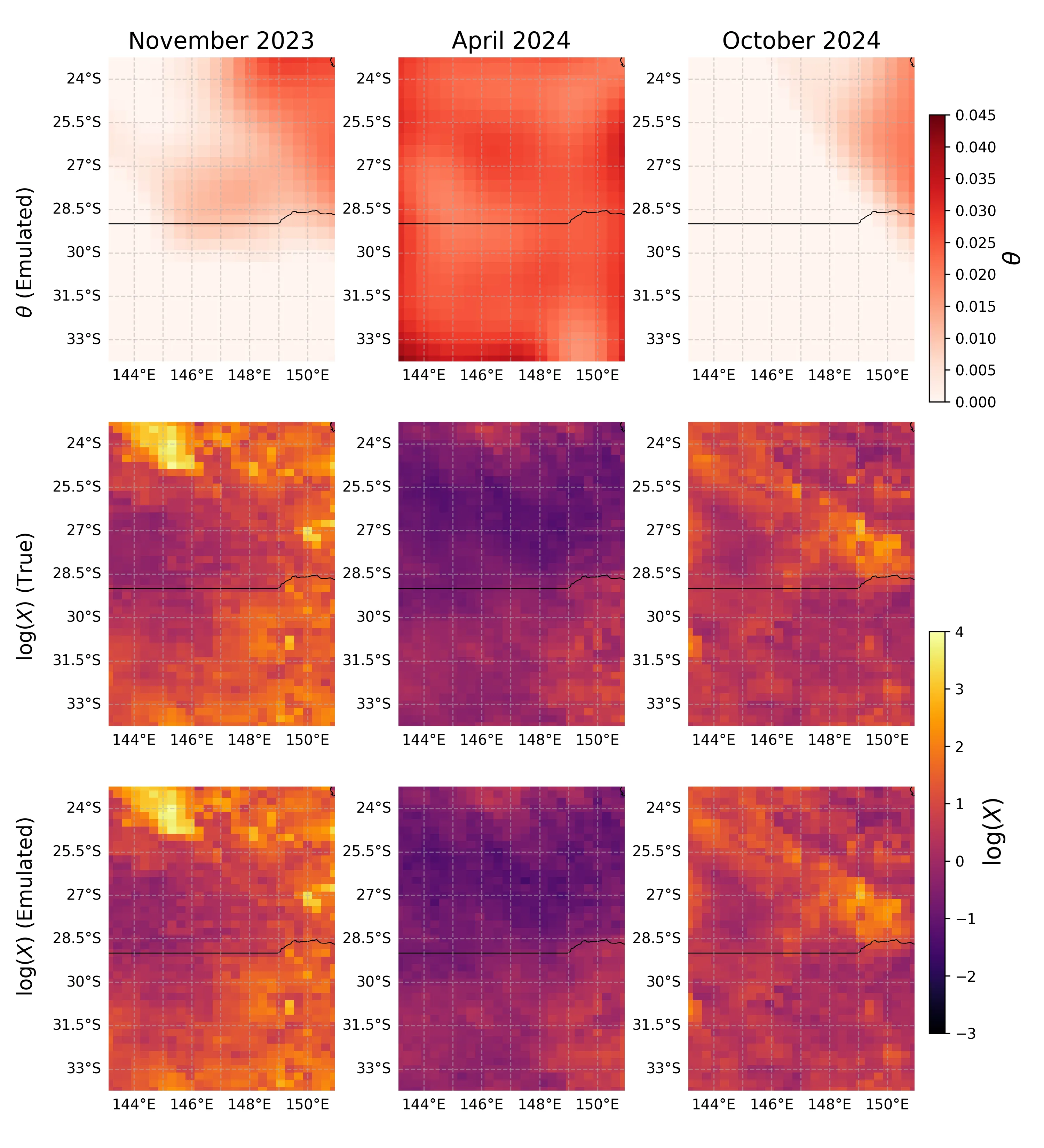
Scientists have long struggled to capture this connection. Classical models assumed that the dependence structure between locations is fixed, as if the orchestra always plays the same piece. The new work proposes a neural network that compresses a spatial field into a latent representation and then reconstructs it conditioned on the climate index. The climate index is injected into the latent space via a linear mapping and interleaved with latent variables before being fed into a convolutional decoder.
The results are striking. On synthetic data, the model reproduces the extremal dependence coefficient between pairs of locations at any distance with almost no bias. Replacing white noise with the real climate index markedly improves reconstruction quality, and learnable basis functions add a further boost. A counterfactual experiment with a flipped ENSO index shifts the distributions of the emulated extremes.
Now the conductor can do more than wave the baton; it can play alternative scores. Flip El Niño, and the orchestra of extremes will sound different, and the neural network will show exactly how. The orchestra stays the same, but the music changes, and we can finally hear it in advance.
Training the model on 127 monthly maxima of the fire weather index took about 16 minutes on a standard desktop computer without a graphics accelerator, whereas classical Bayesian methods for similar problems may require many hours or even days.
The idea of 'what if the climate were different' echoes Kim Stanley Robinson's novel 'The Ministry for the Future', where climate scenarios are used to plan disaster prevention. Only here, instead of global models, there is a fast neural network that produces plausible extreme fields in seconds under a modified El Niño index.