An autoregressive model is a simple but powerful way to predict a value in a time series by looking at its own recent past. Instead of using outside factors, it assumes that today's number is a weighted sum of yesterday's, the day before's, and so on, plus some random noise. For instance, if the temperature today is close to yesterday's, the model captures that by giving a large weight to the previous day's value. It is a workhorse for separating a smooth underlying signal from short-term fluctuations.
History
The concept was developed in the 1920s and 1930s by statisticians such as G. Udny Yule and Gilbert Walker, who applied it to sunspot numbers and atmospheric pressure, respectively.
How it works
The model is written as x_t = c + a1*x_{t-1} + a2*x_{t-2} + ... + ap*x_{t-p} + e_t, where the a's are coefficients, p is the order (how many past values to use), and e_t is random noise. The coefficients are estimated from data using methods like least squares. Once fitted, the model can be used to forecast future values or to remove the predictable part of the series, leaving the 'innovation'—the part that is genuinely new at each step.
In practice
In climate science, autoregressive models are used to model natural variability so that an anomalous trend—like global warming—can be detected against the background of year-to-year fluctuations. They also appear in econometrics, speech processing, and EEG analysis.
Fun fact
The name 'autoregressive' comes from the idea that the series is 'regressing on itself,' meaning it predicts its future from its own past, much like a person learning from their own history.
An architect reinforces the foundation but leaves a door open for remodeling: that's how living systems balance reliability against renewal. A cell copies hereditary information with a fidelity any scribe would envy, yet it can also allow changes that help it survive under new conditions.
The brain doesn't just react to the world: it's constantly guessing what will happen next. This principle is called predictive coding: neurons compare expectations with reality and update their internal picture when an error occurs. But how such a complex system could be wired into the living tissue of the cortex remained unclear.
In 1998, mathematician David Boyd noticed something strange. He was studying the Mahler measure of polynomials, a quantity that gauges the "complexity" of their roots, and found that for a family of curves, it always equals a special rational number times the derivative of an L-function.
Reconstructing a full picture from fragments is like discerning an orchestra's melody in a noisy hall. Such challenges arise in photometry, where a star's brightness is recovered from faint twinkling. Traditional methods need precise noise information, which is almost always unknown.
The cosmic microwave background is the first light that pierced the dense fog of the early universe. Its spectrum, like a frozen score of a cosmic symphony, preserves the tiniest density fluctuations from which galaxies grew.
At a weather station in Brazos County, Texas, rain is recorded on magnetic tape: every day, four years straight. Nine hundred millimeters in a good season, a hundred in a bad one. Then the tape falls silent. Drought creeps in without a sound — the slow fading of the earth's pulse. The standard SPI-3 index only catches on a month or two later, once the moisture is already gone.
Light from distant galaxies travels to us for billions of years, but along the way it gets bent and twisted by the invisible web of dark matter. This effect, predicted by Albert Einstein within general relativity, is called gravitational lensing.
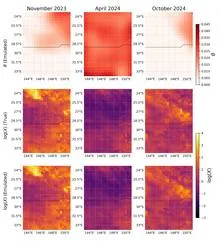
A mosaic of large colored tiles. Each tile is the average precipitation over an entire month for an area the size of a small country. For a general understanding, the picture is fine, but if you need to know whether a downpour hit a specific city yesterday, it's useless.
The Taiji detector, planned for launch into space, will pick up the trembling of space caused by collisions of enormous black holes. But its data is frequently marred by random bursts, like static crackling in a radio receiver.
The proton is not a smooth ball but a tangle of quarks and gluons in constant motion, exchanging energy. Finding out exactly how energy, pressure, and spin are distributed inside it is impossible to do directly: measurements yield only sparse, noisy points. It's like trying to guess a face from a few blurry photos taken from different angles.
An orchestra of a thousand musicians plays in harmony as long as the conductor keeps the tempo. But the moment he changes the score, the violins in one corner start playing louder, while the brass in another come in late.
Imagine a translator in a noisy hall, trying to catch a speech through the buzz of voices. The usual approach is to memorize a set of phrases and slot them into templates. But when the noise cranks up, the template falls apart.
Climate scientists have long debated where exactly the El Niño "pool" is located: the region in the equatorial Pacific that first responds to an impending weather shift. The debate isn't due to a lack of data. The ocean is measured along longitude, latitude, and depth, and each slice contains thousands of numbers. The problem is that there are too many numbers to see the pattern directly.
An orchestra without a conductor: the musicians take their seats, tune their instruments, and begin to play in harmony because each one hears the common rhythm. That is how TreeDOX works, a method that predicts chaotic time series without requiring the user to choose parameters or fine-tune anything.
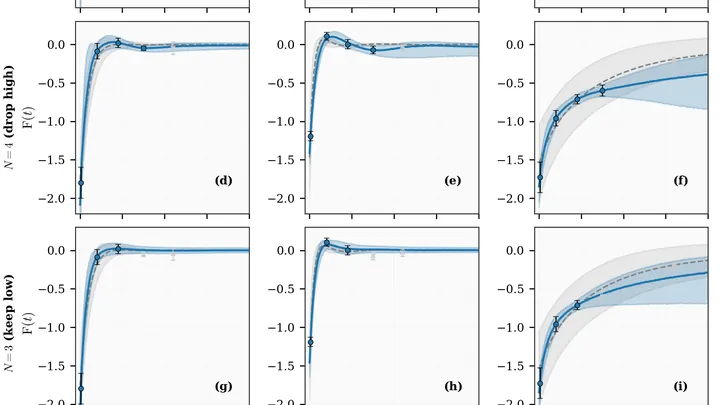
The ocean doesn't always stick to the same schedule. Sometimes the warm El Niño current strengthens, sometimes it weakens, and each regime dictates its own reaction speed to the past. These hidden regimes are like shifts in currents that remember their path with different depths.
A fisherman in Queensland notices that in some years snapper are harder to catch, even though the nets and boat are the same. The reason hides not in the catch itself but in the water temperature several months earlier, when the fry were just hatching. A warm current arrived not for the whole year but only for a few weeks, and that short episode decided the fate of an entire fish generation.
The ocean remembers its past. Heat given to the water off the coast of Norway does not vanish without a trace: it embarks on a long journey across the Atlantic, only to return decades later and alter the temperature at those same shores once again.
A translator who jumps at every rustle in the hall starts mixing up words by the end of the meeting. Their confidence in being right grows, while their accuracy drops. That is roughly how poorly calibrated probabilistic forecasts behave: the model claims a high probability for an event, but reality disagrees.
The barometer in the port of Papeete on Tahiti and the one in Darwin, Australia, are separated by 7,400 kilometers. When one shows high pressure, the other often shows low, and this difference, called the Southern Oscillation, drives rainfall from India to Brazil. Predicting it even a month ahead is a problem with a century-long history.
The ice cover of a river looks solid, but beneath it lie cracks that alter the flow. So it is with a time series: behind the smooth surface of numbers hide moments when the rules of the game change. These moments are called change points, and finding them is like tapping the ice to locate weak spots.