Statistical ML stat.ML

33 articles

Machine learning with a statistical or theoretical grounding: supervised, unsupervised, semi-supervised learning, graphical models, reinforcement learning, bandits, high dimensional inference.

articles

Finding the Puppet Masters: How Causality Saves Predictions from Computational Blow-Up
The puppet master pulls the strings, and the marionette dances. In forecasting the future from time series, the puppet masters are the few variables that truly control the system. The rest merely echo their movements, creating an illusion of complexity. The challenge is to find these puppet masters and watch only their fingers, not the whole stage.

El Niño Without a Teacher: How an Algorithm Heard Climate in Ocean Noise
A translator sits in a hall where people speak an unfamiliar language. They don't understand the words, but they hear how the tone shifts: sometimes calm and steady, sometimes excited and sharp. From intonation alone, they guess what is being discussed.
A City as a Single Organism: Water and Electricity Breathe in Unison
Every morning in six American cities, from Chicago to Minneapolis, faucets open at the same time coffee makers switch on. Water and electricity flow through pipes and wires like two connected vessels in the city's body. In the past, utilities monitored these flows separately, as if the organism had no common circulatory system.
A Month Ahead: What Machine Learning Can Do for Weather Forecasts
A farmer in Iowa looks at the calendar: plant now or wait? In a month, a heat wave might strike, or rain might set in. Forecasters throw up their hands: the two-week forecast still holds, the seasonal one is out of reach, and in between lies a gap. The atmosphere changes too quickly to remember yesterday, and the ocean is too slow to come to the rescue.
A neural network trained on 127,137 years of model climate predicts winter
A translator who learned a language from thousands of books can interpret a conversation without being distracted by noise in the hall. Similarly, a neural network trained on 127,137 years of model climate produces a winter forecast in a fraction of a second, faster and more accurately than bulky dynamical systems.
Graph Neural Networks Predict El Niño More Accurately
The warm El Niño current appears in the tropical Pacific every few years and reshuffles weather across the planet: drying fields in some places, flooding streets in others. Meteorologists have long tried to catch it early, but the ocean is too cunning: the cause hides not in a single spot but in a call-and-response between regions separated by thousands of kilometers.
The World as a Graph: Neural Network Learns to Predict El Niño
The ocean resembles a giant web, where each thread connects distant points of water. When one spot warms, winds and currents change thousands of kilometers away. The neural network in this study wove such a web for the first time on its own to predict El Niño.
A Translator That Never Loses the Meaning
A long conversation between two people can be condensed into a few key phrases that preserve the essence. That is exactly how a macrovariable works: temperature stands in for billions of moving molecules, and sea level for thousands of waves.
Taming Chaos with Physics: Predicting Extreme Events from Sparse Data
Imagine a translator who learns the grammar of a chaotic language from textbook examples and then becomes fluent in real speech, complete with accents and noise. That is how the new KDL method works: first, a neural network is trained on synthetic data generated by the Liénard equation, then it is transferred to real time series where extreme events are rare and unpredictable.
Reservoir with a Correction: How to Predict Noisy Chaos
A translator who learns to correct their own slips works more accurately. In the world of forecasting noisy processes, a new method takes on this role: a reservoir computer that adds a random correction to its prediction at each step.
Calibrating for Small Data: The GOAL Algorithm
An optician turns the frame, adjusts the focus, and a blurry spot becomes a sharp image. The new algorithm GOAL works much the same way: it rotates the data cloud, compresses redundant dimensions, and brings into focus what truly matters.
Trees Predict Chaos Without Tuning
An orchestra without a conductor: the musicians take their seats, tune their instruments, and begin to play in harmony because each one hears the common rhythm. That is how TreeDOX works, a method that predicts chaotic time series without requiring the user to choose parameters or fine-tune anything.
Climate as Conductor: Neural Network Learns to Direct Extremes
An orchestra of a thousand musicians plays in harmony as long as the conductor keeps the tempo. But the moment he changes the score, the violins in one corner start playing louder, while the brass in another come in late.
Machine Learning2026-01-111 minarXiv:2601.06788express
Why neural networks are like black holes: a lesson from 'bald' models
Fine-tuning a neural network is like trying to alter a black hole without touching its event horizon: you change only a tiny fraction of parameters. Researchers looked inside and saw stunning patterns — strong links between pieces of the model, akin to quantum entanglement.
q-bio.GN2026-01-142 minarXiv:2601.09758express
How to Tell a Technical Glitch from a Real Disease
Genetic diagnostics is like comparing two photos taken with different cameras. If one camera slightly shifts the colors, the image will show "defects" that don't exist in reality.
stat.ME2026-01-302 minarXiv:2601.22481
Breaking Points: How a Restorer Cleans Data
Old weather records hold surprises: the thermometer suddenly jumps by half a degree, not because of the weather, but because the station switched instruments. Such abrupt shifts in data are called changepoints, and separating them from genuine climate signals is a challenge statisticians grapple with.
Machine Learning2026-02-011 minarXiv:2602.01045express
Overlapping Features Speed Up Learning
A neural network can be compared to a dormitory where each resident gets their own room. Usually, each feature in the data occupies a separate neuron, and learning proceeds sequentially: first one feature, then another. This is slow and depends on which data you happen to get. But if you allow several features to share a room, overlap them, the picture changes.
Distilling the Ocean: How to Compress Thousands of El Niño Models into Twelve Pure Drops
Thousands of models simmer in a single cauldron, and the steam rises thick and impenetrable. Each whispers something about the future of El Niño, but in the general din you cannot tell who is right and who is just boiling over.
Applied Statistics2026-03-031 minarXiv:2603.02616express
How to Peek Inside the Heart Without a Pricey Ultrasound
An electrocardiogram is like a recording of an engine's hum: an experienced mechanic can hear when something's off. A heart ultrasound shows the engine itself from the inside, but the machine is pricey and specialists are scarce.
Windows into the Same Mechanism: How Thousands of Neighbors Reveal Hidden Links
Seven snapshots of the sky after the eruption of Mount Pinatubo. Each snapshot is a map of concentrations for dozens of substances. The question is simple: which substance turns into which? But how do you infer a causal chain from seven frames when you have more variables than time points? M-CaStLe looks at the map differently.
General Relativity2026-05-042 minarXiv:2605.02453express
How to Hear a Crack in the Fabric of the Universe
The symphony plays, but a barely perceptible wrong note has crept into the score. This is roughly how physicists search for deviations from general relativity in the 'sounds' of the universe — gravitational waves from merging black holes.
Machine Learning2026-05-082 minarXiv:2605.07878express
Why Some Questions Work and Others Don't
You're trying a dish at a restaurant, but you haven't seen the menu. You ask the waiter questions — too salty? what spices?—and from the answers you try to guess what kind of chef prepared it.
physics.data-an2026-05-171 minarXiv:2605.17518express
How chemical logic rescues spectra from noise
A spectrum is like a photograph of a material's inner workings, taken with light. When a beam passes through or reflects off a sample, molecules leave characteristic dark bands, peaks, on that photograph. But if the image is overexposed or veiled in gray, making out details becomes nearly impossible.
stat.ME2026-06-242 minarXiv:2606.26061express
A New Way to See the Hidden in Data Chaos
A lab robot counts molecules, and gets it wrong. One tube shows 0, another 12, a third 3, though in reality they all hold roughly the same amount. Such 'raw' numbers are common in biology: DNA sequencing, counting species in a water sample, gene activity. There's plenty of data, but it's sparse and more scattered than simple randomness would predict.
math.PR2026-06-303 minarXiv:2607.00149
Genes Speak Different Languages — A Neural Network Found a Common One
60 mice, 1,980 samples, 234 lung cancer patients. Behind each number lie thousands of genes. Their activity is measured to understand the disease. But the data aren’t uniform: for one patient, you assess a protein level (a continuous number), make a diagnosis (yes/no), and determine the tumor subtype (a category).
Machine Learning2026-07-131 minarXiv:2607.11091express
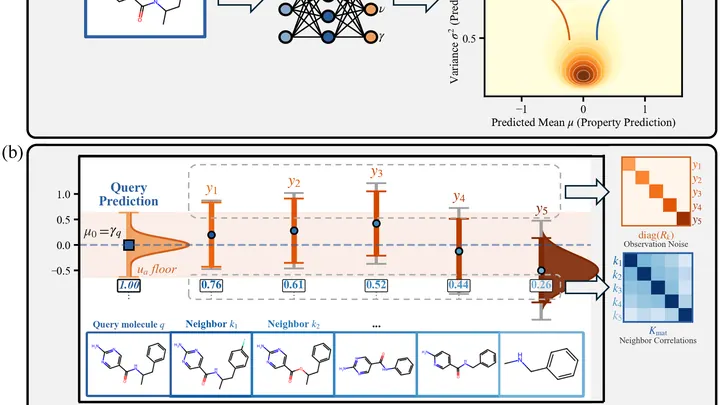
Neighbor molecules improve prediction accuracy
Predicting the properties of a new molecule is like guessing the flavor of an unfamiliar dish. The program works like an experienced chef: it “tastes” similar molecules whose properties are already known, and based on their “flavor,” it refines its guess.
math.OC2026-07-131 minarXiv:2607.11344express
Taming Chaos: How Algorithms Predict the Future
Complex machinery, from drones to surgical robots, sometimes behaves like a wild mustang: full of disorder and whims, where the slightest touch triggers a storm. Instead of rote memorization of formulas, the new method observes the system like a horse breaker.
Machine Learning2026-07-142 minarXiv:2607.12417express
A Neural Network That Perceives Phase: From Hearing to Quantum Computing
A sound signal is conveniently represented as a complex number: its modulus (amplitude) reflects loudness, while its argument (phase) indicates the wave's position in time: its instantaneous shift.
Machine Learning2026-07-151 minarXiv:2607.13891express
Radar Without Learning: How PiVoT Turns Noise into Order
A regular radar is like a microphone in a buzzing crowd: individual sounds blend into mush. PiVoT works like a conductor who instantly recognizes each instrument in the tuning chaos. Instead of shuffling through hypotheses, the algorithm tightens a loop around the most likely targets — cars, cyclists, pedestrians.
The Brain as a Predictor: A New Look at Neural Circuits
The brain doesn't just react to the world: it's constantly guessing what will happen next. This principle is called predictive coding: neurons compare expectations with reality and update their internal picture when an error occurs. But how such a complex system could be wired into the living tissue of the cortex remained unclear.
Statistical ML2026-08-012 minarXiv:2608.00675express
Round Trip: How a Neural Network Checks Itself Without Hints
A neural network predicts the future of a system — say, how plasma will swirl in a magnetic field or how a face in a video will change. Errors are inevitable, and the further it looks ahead, the more they accumulate. Checking against the correct answer during operation is impossible: it simply doesn't exist.
Statistical ML2026-08-171 minarXiv:2608.16506express
How to See Shape When Data Are Unevenly Sampled
Two photographers shoot the same mountain. One takes a hundred shots from the summit and only a couple from the base; the other does the opposite. If you try to align their images, the algorithm might decide that the summit in one photo matches the summit in the other simply because there are many similar points there, not because it's the same spot. Sampling density throws it off.