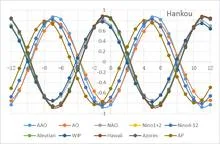
Teleconnections are often described using indices, which are numbers that summarize the state of a particular pattern. For instance, the Southern Oscillation Index (SOI) measures the pressure difference between Tahiti and Darwin, Australia, and is used to track the ENSO state. These indices are derived from historical data and are used to monitor and predict climateanomalies. Teleconnections are also a key tool in climate research, helping to attribute regional climate changes to remote drivers and to understand the mechanisms behind them.
History
The concept of teleconnections dates back to the late 19th and early 20th centuries, when meteorologists noticed correlations between weather in different parts of the world. Sir Gilbert Walker, in the 1920s, was among the first to systematically study these relationships, identifying the Southern Oscillation and other pressure seesaws. The term 'teleconnection' itself was coined later, in the 1930s, by the Swedish meteorologist Carl-Gustaf Rossby, who also explained the underlying wave dynamics.
How it works
The ocean also plays a role, as it can store and release heat over long timescales, providing a memory that extends the influence of an initial anomaly. For example, an El Niño event warms the tropical Pacific, which then affects the atmosphere for many months. The atmosphere, in turn, can influence the ocean through wind-driven changes in currents and upwelling, creating feedbacks that can either amplify or dampen the teleconnection. The result is a complex, coupled system where the statistical link between distant regions is a manifestation of these physical processes.
In practice
Teleconnections are used in operational seasonal forecasting, where indices like the SOI or NAO are input to statistical and dynamical models to predict temperature and precipitation anomalies months ahead.
Fun fact
The 2010 Russian heat wave and the 2010–11 Queensland floods in Australia were both linked to a strong La Niña event, demonstrating how a single teleconnection can produce opposite extremes in different parts of the world.
In an oven, as temperature rises, molecules move faster and disorder increases. With language models like ChatGPT, it's the opposite. When developers increase the 'temperature' parameter, the model gets access to a wider choice of words, but its long texts suddenly start looping.
A team of researchers tested 11 different AIs by generating 12,000 text continuations.
A family tree becomes a tangle if you account for adopted children and remarriages. Evolution often resembles such a tangle: although the Standard Model, the traditional view of divergent evolution where species branch like a tree, paints a neat tree of species, in reality genes travel not only by inheritance but also directly between unrelated organisms — a process…
Decades of radio astronomy have listened to space, hoping to catch narrowband radio transmissions — the technogenic 'voice' of distant exoplanets. But our own technological evolution reveals a paradox: loud analog signals, like 1960s TV broadcasts, are just a brief squawk of a newborn civilization.
A student who has spent years solving problems from other people's textbooks suddenly receives three notebooks with real ocean observations. There are few problems, but they have already seen hundreds of similar ones, and now a couple of examples suffice to catch the new teacher's style.
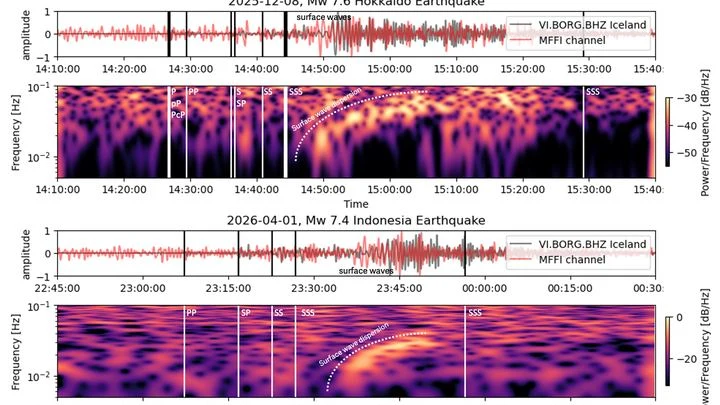
The planet-spanning web of undersea internet cables acts like a giant ear. The glass thread inside responds to water movements: currents, tides, and distant earthquakes bend the cable. Light traveling along the thread takes slightly longer: this delay is measured on shore against a reference. That’s how the speed of light reveals itself.
A tuning fork produces a pure tone, but if you strike it too hard, it starts to rattle, and a musician might mistake that rattle for complexity in the sound.
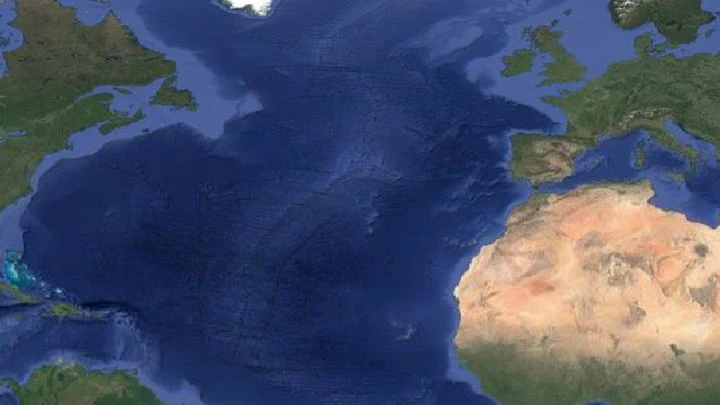
In the Atlantic, a giant invisible conveyor operates: warm surface waters flow north, cool, sink, and return south. This circulation, AMOC, carries heat, making Europe noticeably milder than Canada at the same latitudes. But the conveyor isn't eternal: if diluted by fresh water from melting Greenland ice, the engine stalls.
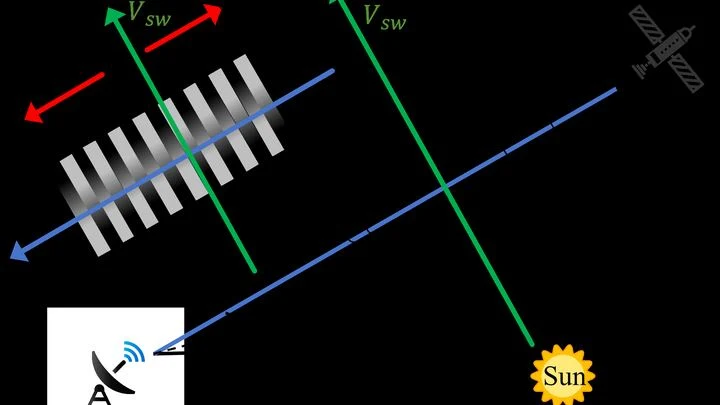
A radio signal travels from Mars to Earth, but on the way it has to push through the invisible "wind" of charged particles blowing from the Sun. This wind, like ripples on water, slightly distorts radio waves.
A comet hurtling through space is a mountain of ice and dust that carries itself across the Solar System. If you mount small engines on such a mountain, it becomes a ship with its own fuel: gas from the interior can be vented through nozzles to change course.
Thousands of kilometers of fiber-optic cables lie on the ocean floor. They carry internet traffic, but the cables themselves sense the slightest vibrations in the water and the seabed. If you listen closely to such a cable, you can hear a blue whale singing or the ground trembling thousands of kilometers away.
Long before stars appeared, the universe was filled with cold hydrogen. This gas can 'sing'—emitting radio waves with a wavelength of 21 centimeters. When the first stars and galaxies ignited, their ultraviolet light began to strip electrons from hydrogen atoms, turning neutral gas into ionized gas.
The bronze plates of a gamelan do not sound according to a single tuning standard: each orchestra on Java keeps its own tuning, and two neighboring ensembles may play the same melody in slightly different intervals.
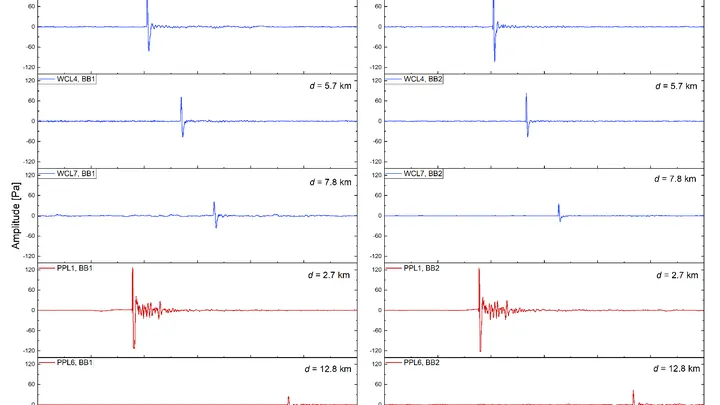
The same explosion can sound different: it all depends on which way the wind is blowing. In 2024, researchers set off charges equivalent to ten tons of TNT twice and recorded the sound with a network of 31 microphones spread over a radius of 23 kilometers. The source was identical, but the acoustic pictures turned out to be quite different.
A translator who jumps at every rustle in the hall turns a one-hour meeting into two. It's the same in epidemic control: contact tracing teams try to reconstruct the chain of infections, but something always slips through. Someone forgets who they met, someone doesn't answer the phone, someone never even comes to the attention of health workers.
The Pacific Ocean breathes slowly and deeply. Every few years, its warm surface waters shift eastward toward the coast of South America, and then Peru gets drenched while Australia goes up in flames. A year or two later, the water retreats, and the picture flips. This breathing is called El Niño, and until now its rhythm could only be guessed a couple of steps ahead.
A warm ocean off the coast of Peru can make winter in Moscow unusually mild. Climate scientists call these invisible threads that link weather in distant corners of the planet teleconnections. For a long time, they were thought of as something like permanent wiring: the signal sources may pulse, but the wires themselves lie still.
An orchestra of a thousand musicians plays in harmony as long as the conductor keeps the tempo. But the moment he changes the score, the violins in one corner start playing louder, while the brass in another come in late.
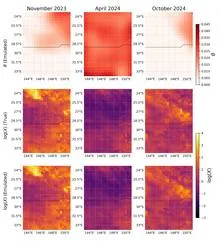
Imagine an interpreter in a negotiation room who hears the tropics whisper and repeats it too loudly. That is how the neural-network climate model DLESyM behaves when forced with real Pacific sea surface temperatures. The ocean whispers "El Niño," and the atmosphere shouts back as if being shaken by the shoulders.
Every few hours, narrow beams of radio waves leave the Mojave Desert, near Madrid, and near Canberra, heading into the sky. This is NASA's Deep Space Network: three antenna complexes that keep in touch with spacecraft across the solar system.
In 2015, downpours in Chennai turned streets into rivers overnight. The city was caught unprepared: seasonal models offered only a vague warning. Yet the monsoon is not a whim of the sky; it is the pulse of a vast machine linking oceans and continents.
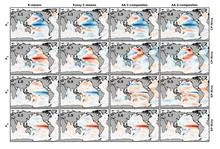
An artist painting the ocean does not limit themselves to two colors: warm and cold. Likewise, climatologists studying El Niño increasingly speak of a whole palette of shades. El Niño is a warm current off the coast of Peru that, every few years, alters weather across the planet. Its counterpart, La Niña, brings cold.
Climate is like an orchestra without a conductor: each musician hears the others with a delay, and the score changes mid-concert. The ocean, atmosphere, ice, and land continuously exchange energy, and the slightest hiccup in one instrument can escalate into a shift of the entire melody.
An orchestra without a conductor plays a complex piece. The listener hears the overall music but wants to understand who leads the melody and who merely echoes it in unison.
Every year, the same drama unfolds over West Africa: from June to September, the sky fills with moisture and releases rains that determine the harvests of millet, sorghum, and maize. This rainy season is driven by the West African monsoon, a giant atmospheric pump that pulls moist air from the ocean deep into the continent.
In the tropical Pacific Ocean lives a giant pendulum: warm water swings from Australia to South America and back, and each swing changes weather across the entire planet. This pendulum is called El Niño–Southern Oscillation, and its behavior resembles a capricious conductor: sometimes it waves the baton sharply, sometimes slowly, and sometimes it freezes, confusing forecasters.
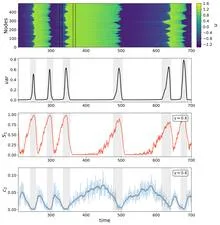
A fisherman pulls on his net and listens to it ring. Each strand quivers in its own way, but before a strong tug, all the strands begin to vibrate in unison. So it is with complex systems: before a sharp state jump, the individual parts suddenly start to oscillate in concert, and that synchrony betrays the coming jump.
A fisherman in Queensland notices that in some years snapper are harder to catch, even though the nets and boat are the same. The reason hides not in the catch itself but in the water temperature several months earlier, when the fry were just hatching. A warm current arrived not for the whole year but only for a few weeks, and that short episode decided the fate of an entire fish generation.
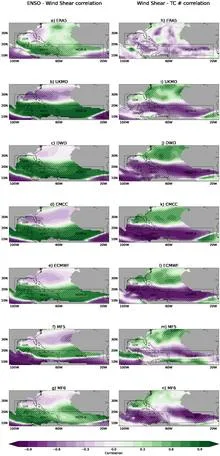
Over the warm waters of the Atlantic, air begins to swirl like water spiraling down a drain. That is a future hurricane, and its fate depends on what happens thousands of kilometers away in the Pacific Ocean. When the El Niño current warms up there, storms in the Atlantic become fewer. The models that forecast hurricane season know about this link.
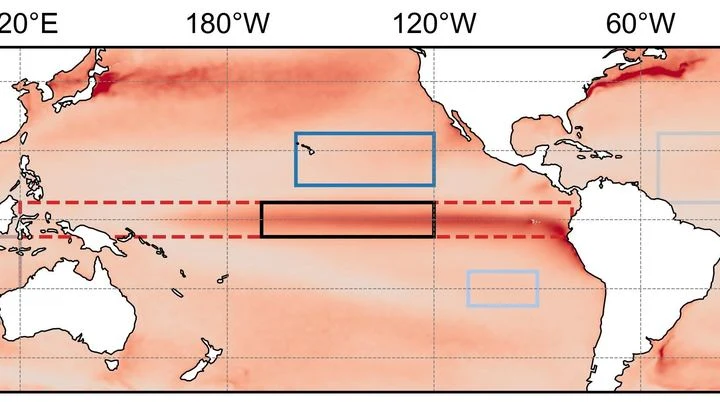
The orchestra plays a symphony, and you listen only to the first violin. That is roughly how river discharge forecasts have worked for decades: the entire El Niño signal is reduced to a single number calculated from a small rectangle in the Pacific Ocean. Yet the ocean is a vast ensemble, where heat flows from one region to another, and its full score contains far more information than a single note.
In 1960, a meteorologist at a station in Peru records water temperature, while a farmer in India watches the sky waiting for the monsoon. There is no direct link between these two events, but months later one will echo in the other.
Every summer, the same scene unfolds over India: clouds driven from the ocean by the wind release their rain, and how that rain falls on the fields determines the harvest for more than a billion people. Meteorologists have long tried to reduce this mosaic to a single number, the all-India rainfall index, which averages millimeters across the country.
Two people are talking at once, and by the loudness of their voices you can't tell who is answering whom. That's how climatologists have for decades searched for a link between warm water off the coast of Peru and droughts in Australia: they compared how synchronously ocean temperature and rainfall change in different parts of the planet.
In 1982, a warm current off the coast of Peru grew so large that it altered weather across the entire planet. That year, India saw drought, Australia wildfires, and California torrential rains. The world learned that ocean and sky are linked by invisible threads: an event in one hemisphere echoes as rainfall in another.
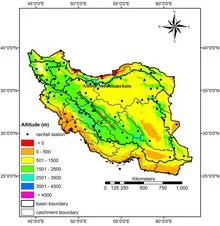
In 2019, northern and southwestern Iran received 50% more rainfall than usual, and rivers overflowed their banks. A year earlier, in 2018, rainfall was 53% below normal, and fields cracked under drought. Such swings are not random; they are responses to three distant oceanic pulses that set the rhythm for Iran's rains.
Winning the lottery changes the winner's life, but for the statistics of all players it means almost nothing: the probability of winning is negligible, and the average winnings per ticket remain tiny.
On a playground, two swings stand side by side. One child pumps on their own, while the other barely moves until the first gives a push with their foot. Something similar happens in the tropical Pacific and Indian Oceans, except instead of children, there are warm and cold masses of water.
It takes eight years for a wave to circle Antarctica. It carries warmth and cold in turn, and sea ice advances and retreats with its crests. Previously, researchers caught this wave using different methods and saw either a propagating signal or a frozen dipole. Now it's clear: the dipole is just a snapshot of the wave when it stretches between two oceans.
The dance between two partners, the ocean and the sky, has been going on for thousands of years. El Niño warms the Pacific, and usually at the same time seasonal rains over India weaken. But in recent decades, the rhythm seems off: rains don't always respond to the warm current.
Picture a web stretched across every corner of the Earth: each strand is a coincidence of temperature fluctuations at two points. In ordinary years, the web is neatly divided into regional clusters, but when El Niño arrives, the strands break and reweave, linking distant continents.
For a century, climatologists have measured the ocean's pulse with a barometer. Indices like El Niño or the North Atlantic Oscillation are built on atmospheric pressure differences between two points, and then we wonder why rivers don't obey.