Light in a Pipe Without Polarization Loss express
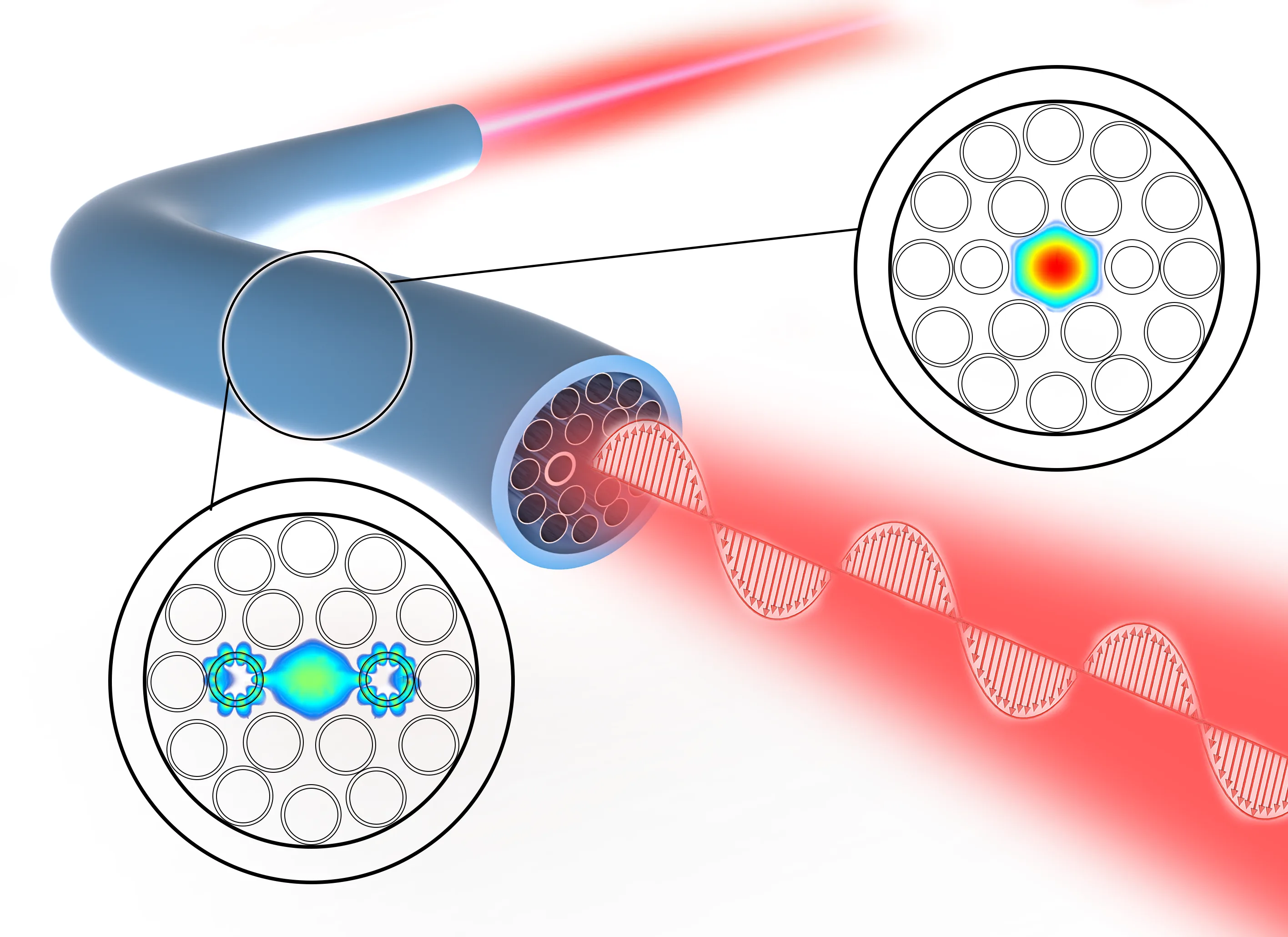
Light traveling through an optical fiber is like a crowd in a narrow corridor: each photon takes its own path, and if the paths get mixed up, you end up with mush at the exit. In ordinary hollow fibers, thin glass tubes where light travels through air rather than glass, the two polarizations (directions of oscillation of the light wave) travel together in a jumble. Any vibration, heating, or bending of the fiber changes their ratio, and the signal degrades.
The new design solves this problem. The fiber with a double ring of walls forces one polarization to "fall through" into the cladding and die out there, while the other continues on its way undisturbed. It's as if the corridor had side doors that let half the crowd slip away, while the rest keep going straight. As a result, after ten meters of fiber, the light that emerges contains less than one hundredth of the unwanted polarization: it is attenuated by more than a factor of one hundred. Meanwhile, the useful light loses only about one and a half percent per meter.
This opens the door to gyroscopes that sense rotation through shifts in the light wave, to quantum networks where polarization carries information, and to laser experiments where beam purity is critical. For the first time, all of this has been packed into a single piece of glass, with no extra components.
Original abstract
as written by the authors arXiv:2601.00684
Achieving robust single-polarization guidance in hollow-core fibers has remained a longstanding challenge, limiting their integration into precision photonic systems. Here, we report the first experimental realization of a low-loss, polarization filtering antiresonant hollow-core fiber (AR-HCF). Conventional AR-HCFs inherently support degenerate orthogonal polarization modes, making them vulnerable to polarization drift under environmental perturbations. Our dual-ring fiber design introduces polarization-selective resonant coupling to lossy cladding modes, enabling strong polarization filtering without compromising transmission efficiency. The fiber achieves a polarization extinction ratio exceeding 21 dB and a propagation loss as low as 0.15 dB m^-1 over a 10 m fiber length. The design is scalable across wavelength bands and maintains polarization discrimination under mechanical bending, making it highly suitable for applications in fiber-based gyroscopes, quantum optics, and polarization-sensitive nonlinear interactions. This work represents a significant step toward monolithic, polarization-selective hollow-core fiber systems.
An ordinary window lets through light of any polarization, while polarized sunglasses block half — roughly what the new fiber does, but thinner than a human hair.