A gyroscope is a device that measures or maintains orientation and angular velocity, based on the principles of angular momentum. A classic mechanical gyroscope consists of a spinning rotor mounted on gimbals, which allows it to rotate freely in any direction. Because of the conservation of angular momentum, the spinning rotor resists changes to its axis of rotation, making it a stable reference for orientation. Modern gyroscopes, however, often use optical or quantum effects rather than mechanical spinning, but they serve the same fundamental purpose.
History
The gyroscope was invented by French physicist Léon Foucault in 1852, who named it from Greek words meaning 'to see the turn'. He used it to demonstrate the Earth's rotation, as the device's axis would remain fixed while the Earth rotated beneath it.
How it works
In a mechanical gyroscope, the spinning rotor has a large angular momentum. According to Newton's first law, an object in motion tends to stay in motion, so the rotor's axis of rotation will remain fixed in space unless an external torque is applied. When the gyroscope is tilted, the gimbals allow the rotor to maintain its original orientation, and sensors measure the angle of the gimbals relative to the device's housing. Optical gyroscopes, like ring laser gyroscopes, use the Sagnac effect, where two beams of light travel in opposite directions around a closed loop; rotation causes a slight difference in their travel time, which can be measured to determine the rotation rate.
In practice
Gyroscopes are essential in inertial navigation systems for aircraft, ships, and spacecraft, providing orientation data without external references. They are also used in smartphones for screen rotation and in stabilization systems for cameras and drones.
Fun fact
The gyroscopic effect is what keeps a spinning top upright, and it also explains why a bicycle is easier to balance at higher speeds, as the wheels act as gyroscopes that resist tilting.
Light knocks electrons out of a crystal, and they fly toward the detector like arrows toward a target. From their trajectories, physicists reconstruct how electrons behaved inside the material: with what energy and in which direction they moved. But switch on a magnetic field, and the trajectories bend. The arrows start to curve, the target turns into a warped mirror, and the picture blurs.
An interpreter gets distracted by every rustle in the hall, and a one-hour meeting stretches into two. The same happens with a capacitive gyroscope: to hear the nanometer-scale displacement of its proof mass, it needs perfectly tuned gaps between the plates. The smaller the sensor, the harder it is to maintain that precision.
Imagine a string stretched between two tuning pegs. The slightest touch makes it vibrate, and from the pitch you can guess exactly how it was plucked. Physicists at the University of Arizona have stretched a similar string — not on a musical instrument, but on a silicon membrane just a hundred nanometers thick.
At the very heart of the Milky Way, stars whirl around an invisible supermassive black hole. One of them, S301, completes an orbit in just 8.7 years. Its path is a highly squashed ellipse: sometimes it grazes the black hole, sometimes it shoots far away. At closest approach, the distance to the black hole is tiny by cosmic standards.
A tiny magnetized sphere floats in a vacuum, held by invisible fields. It starts to spin around the axis of the magnetic field, just like a top that's been given a gentle nudge. That's precession. But when the sphere becomes really small, quantum laws come into play.
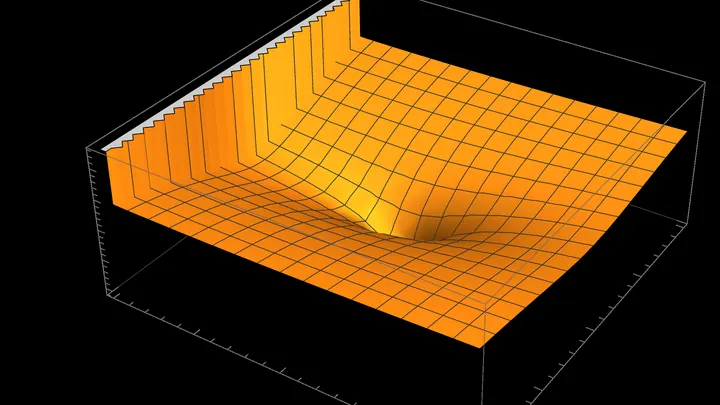
Spacetime can be imagined as a tightly stretched fabric. A massive body dents it, guiding light. Rotation twists the fabric into a spiral. Such a gravitational funnel can entangle a passing photon with the very source of rotation — say, a tiny mirror. Quantum entanglement springs up: an invisible thread binding their fates.
A photographer shoots a runner with a long exposure and gets a blurry silhouette. That's roughly how a standard MRI scanner "sees" moving organs: the heart contracts, the lungs breathe, and the image smears. To avoid this, patients are asked to freeze and hold their breath. But for a child or someone short of breath, that's nearly impossible.
The method called GRASP tackles the problem differently.
Two beams of light race around a closed loop, heading toward each other. Since the speed of light is constant, when the ring turns, one beam has to catch up with a moving finish line, while the other meets it sooner. Their meeting creates a pattern, and from that pattern we can tell how fast the whole system is spinning.
A hot spoon in a cup of tea — heat runs along the metal from the hot end to the cold one. Textbooks describe this process as atoms jiggling and passing on their jolts to each other. But atoms don't just jiggle: they also spin, like tiny tops. Until now, physicists had no common language to describe both motions at once.
The authors of the work built such a language.
Think of a stack of paper: when the sheets lie perfectly aligned, light passes through them uniformly. But turn one sheet by a few degrees, and the picture changes. Something similar happens with layers in certain materials: rotate them relative to each other, and their properties change — sometimes dramatically.
Spectroscopy isn't the key here, or rather, it's not the method used.
The compass needle trembles when a truck rumbles by. Similarly, in a tiny gyroscope, a device that senses rotation, any noise drowns out the useful signal. For a long time, engineers couldn't shrink a gyroscope down to fingernail size without sacrificing accuracy.
The solution came in a two-loop architecture.
You can make a light beam look like a flower with several petals. If you send such a beam through a cloud of cold rubidium atoms and switch on a magnetic field, the petals start to rotate. The angle of rotation is directly linked to the field's strength.
If you look at a map of distant galaxies, it is not perfectly uniform: on one side of the sky there are slightly more, on the other — slightly fewer. This lopsidedness has been noticed in several sky surveys, and it does not look like a random fluke. Usually, it is explained by the fact that our Galaxy itself is flying somewhere, making distant objects appear shifted.
A sugar solution can twist light — many have seen this in polarization experiments. Surprisingly, a similar trick appears in the fabric of the cosmos itself.
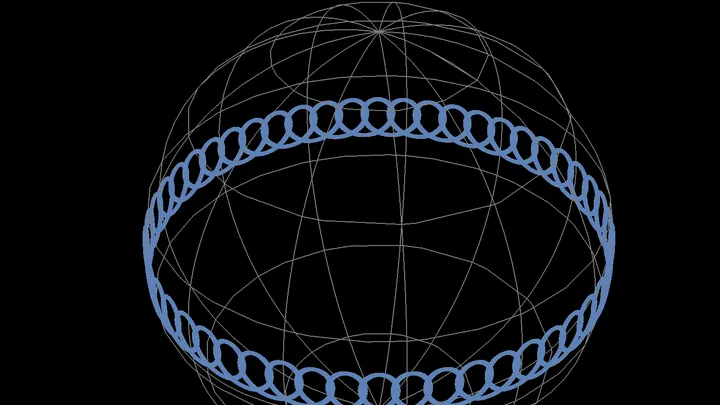
Vortons are invisible cosmic hoops, closed loops of curved spacetime. Thinner than an atom but heavier than stars, these Big Bang relics spin like giant carousels, churning everything around them. Einstein's equations describe how particles dance near such a hoop: paths twist into spirals or dart chaotically.
Sound waves on a chip usually spread in all directions, like whispers echoing around a dome. In a gyroscope, this creates noise that obscures rotation. But a new design forces sound into a one-way flow. By tapping the sound path at several points with precise timing, backward-traveling waves cancel out, while forward waves reinforce.