The concept of a quantum internet was proposed by H.-J. Kimble in 2008, building on earlier work in quantum cryptography and teleportation. Experimental demonstrations of small-scale networks have been growing since the 2010s, with multi-node testbeds in several countries.
How it works
Quantum networks rely on transmitting quantum states, typically encoded in photons, over optical fibers or free space. A key challenge is loss: photons get absorbed, limiting direct transmission to tens of kilometers. To extend distances, quantum repeaters use entanglement swapping and purification: they create entanglement over short segments, then connect them via Bell measurements, effectively teleporting quantum states. Nodes contain quantum memories (like diamond NV centers or cold atom clouds) to store entanglement until the next segment is ready. The network architecture includes quantum switches and routers that direct photons without measuring them, preserving quantum information.
In 2024, researchers demonstrated a quantum network with three nodes in a city, where entanglement was maintained over a total distance of more than 20 kilometers, a step toward a practical urban quantum internet.
Quantum communication is like sending a secret letter that tears apart at any attempt to peek. So far, such a letter can only be sent along one road, and that's slow. Scientists have figured out how to send 16 couriers along 16 parallel roads, different frequencies of light, and verified that the letters arrive intact.
The transmitter sends only a rough sketch of the message — like an artist drawing contours without details. At the receiving end, the AI, like an experienced restorer, reconstructs the full picture, cleaning it of interference. This is how LiTCom technology works, changing the game in future 6G networks.
Training a large neural network across hundreds of compute nodes is like making soup as a team: each 'chef' tastes the dish and tells the others what to adjust.
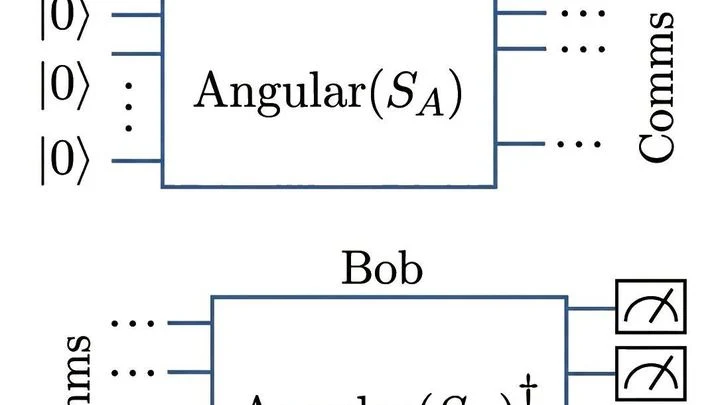
Quantum computers in the cloud are like a post office: you send a letter, and someone else reads the address and the contents. In ordinary computing, the server sees your data and algorithm. Blind quantum computing is an unopenable envelope: the server does the work but doesn't know what it's doing.
Three people sit in three corners of a room. Each receives a sealed envelope from an invisible courier, but the couriers do not coordinate and have never met. The people open the envelopes and see a note with one word: "yes" or "no." They choose nothing themselves: they just read.
DNA is a long carbon necklace made of four types of beads. Biologists often need to compare two strands to find differences. Normally this requires a lengthy brute-force search. Researchers came up with a clever trick: encode each bead as an arrow that rotates based on its neighbors. The idea came from language models, where words also 'know' context.
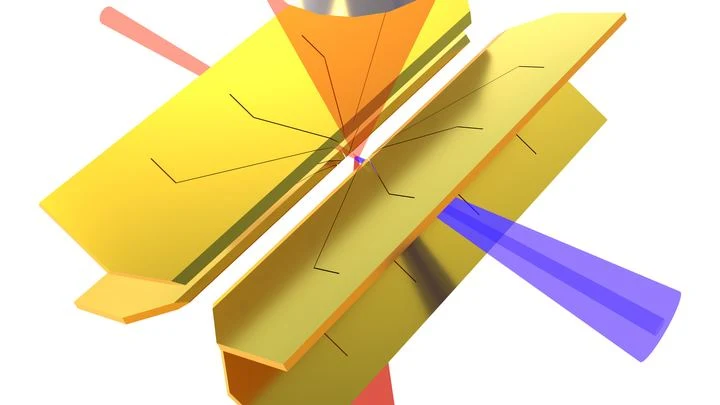
A quantum computer in the lab resembles an orchestra: lasers play the role of bows, and ions are the strings. To play the desired melody, powerful radio signals are sent to the lasers: they set the rhythm and pitch. But part of this "music" escapes the stage.
Imagine two synthetic diamonds, each acting as a high-precision tuning fork. Inside the crystal lattice of each diamond sits a carbon-13 atom: this is a quantum bit, or qubit, the minimal unit of quantum information.
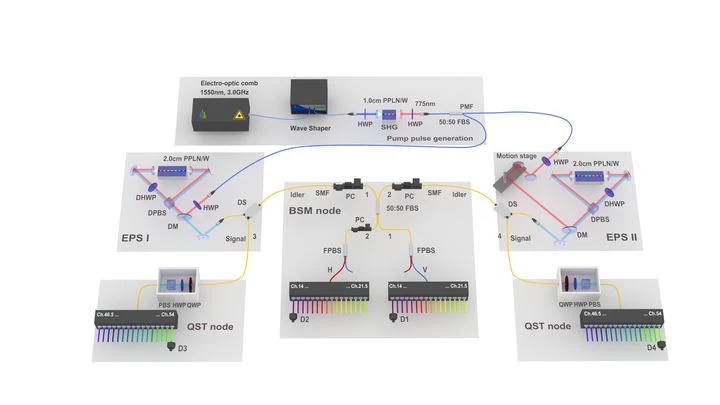
The quantum network works like a series of turnstiles that open only for a pair of perfectly synchronized photons. The central node tells them which turnstile to go to, but cannot forge the synchronization. 200 users can communicate with each other over distances up to 200 km — about the size of a large city.
Regular quantum communication is like a postal service that sends letters strictly one at a time. If the route is long, you have to wait an indecently long time for a reply. Physicists sped up the process by dispatching ten 'postal trucks' — light pulses — into a single optical fiber, but in different time windows.
On an ordinary optical table, amid lasers and mirrors, a cloud of a hundred strontium-87 atoms begins to live by the laws of curved spacetime. Half a second later, its quantum interference fades: gravitational time dilation destroys the superposition.
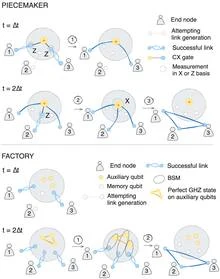
Assembling a puzzle as pieces arrive, rather than waiting for the complete set, is the philosophy behind a new protocol for distributing quantum entanglement. In quantum networks, where nodes exchange Bell pairs, the traditional approach resembles a patient assembler who waits until all pieces are on the table before starting.
Two dilution cryostats, each the size of a barrel, stand at opposite ends of the laboratory. Inside are superconducting circuits cooled to 50 millikelvin, a hundred times colder than interstellar space. Between them runs an ordinary optical fiber, a kilometer of glass thread carrying light.
Inside a cryostat cooled to tens of millikelvins live superconducting qubits. There aren't many of them: tens, at most hundreds. Crosstalk and thermal noise prevent packing more. But cracking RSA-2048 requires anywhere from ten thousand to ten million physical qubits.