Scientist

Anton Zeilinger

1945–present · quantum information, quantum optics
Austrian physicist, pioneer of quantum information and quantum optics. He designed and carried out key experiments on quantum teleportation, multi-particle entanglement, and Bell inequality tests with all local loopholes closed. Winner of the Nobel Prize in 2022.

Biography

Born in Ried (Austria). He earned his doctorate at the University of Vienna. Professor at the University of Innsbruck and the University of Vienna. President of the Austrian Academy of Sciences. He led the group that achieved the first quantum teleportation of an independent qubit and entanglement distribution between the Canary Islands.

Key discoveries

💡 In one experiment, his team teleported photon states between the islands of La Palma and Tenerife over a distance of 143 km.
"He asserted that quantum mechanics teaches that reality does not exist until it is measured."
Concepts
quantum entanglementquantum informationquantum measurementquantum optics
Laws
Bell's theorem
Scientists
Charles TownesAlain AspectErwin SchrödingerDavid DeutschShuji NakamuraJohn Stewart BellNiels BohrAlbert A. Michelson

Related articles

Sunspots and the Paraná's Floods
The Paraná River behaves like a seismograph that records not the shaking of the ground but the pulse of the Sun. A century of daily water-level measurements at the gauging station in the city of Corrientes, 900 kilometers from the river's mouth, shows that when the Sun has many sunspots, the river floods more. This connection is neither accidental nor weak.
A Telegraph Through a Hidden Tunnel in Time
Two couriers leave the same city in opposite directions. An hour later, each opens an envelope: one contains a slip marked “plus,” the other “minus.” How did they know who would get which?
Earth Took Off Its Sunglasses: Why 2023 Was Anomalously Hot
In the summer of 2023, thermometers around the world registered numbers that even the boldest forecasts had not anticipated. The planet's average temperature rose to 1.48°C above pre-industrial levels, a jump of 0.17°C that broke the previous record as if the climate had suddenly shifted gears.
A Beacon Near Our Nearest Sun: First Glimpse of a Planet around Alpha Centauri A
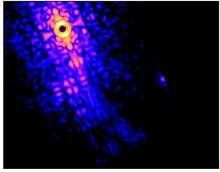
In August 2024, the MIRI coronagraph on the James Webb Space Telescope stared at Alpha Centauri A, the nearest Sun-like star to our Sun. At 1.5 arcseconds from the star, a point source, S1, blinked into view. Flux: 3.5 mJy, contrast: 5.5×10⁻⁵. Four to six sigma. A lighthouse flashing in the fog.
Ionic Liquids on Rocky Exoplanets: Life Without Water
Water is the gold standard for life. We search for its traces on Mars, in icy moons, and in the atmospheres of distant planets. But what if life doesn't need water? On a warm rocky exoplanet with a thin atmosphere, water would evaporate within hours.
Galaxies2025-08-272 minarXiv:2508.19643
An Invisible Stone in the Stellar Pond
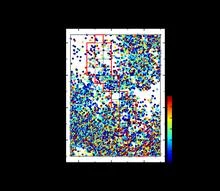
Someone has thrown an invisible stone into the stellar pond of the Milky Way. The ripples spread not through water but through the motion of stars: in a region 200 by 50 parsecs across, their average vertical velocity is 7 km/s lower than that of their neighbors. The deviation is statistically significant at the 6σ level, so chance cannot explain it.
Quantum Conductor: Entangled Photons Take the Concert Stage
In September 2024, the concert hall in Linz had more than just an orchestra on stage. Next to the musicians, a setup was generating pairs of entangled photons: a laser with a wavelength of 405 nm passed through a nonlinear crystal and split into two photons at 810 nm, which flew off to two measurement stations, Alice and Bob.
A Thermos with a Loose Lid: Super-Hot Super-Earth Has a Thick Atmosphere
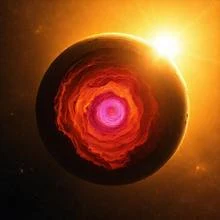
The super-hot super-Earth TOI-561 b completes an orbit around its star in just 10.7 hours. It is a scorched rocky sphere, so close to its star that its dayside should heat up to 2950 K, a temperature at which many minerals melt.
Falling into a McVittie Black Hole: A Plunge into an Expanding Waterfall
A waterfall doesn't ask if you're ready to jump. Its flow accelerates, and at some point even light can't escape back. A McVittie black hole is such a waterfall, but not in an ordinary river; it's in an expanding universe: the water here is space itself, which continuously stretches, carrying galaxies apart from each other.
Fluid Dynamics2025-11-071 minarXiv:2511.05351express
How a Whirlpool in a Cup Becomes a Black Hole Bomb
When liquid is swirled in a cup, a vortex with an empty center forms. In this empty core, waves find a trap: bouncing off the walls, they siphon energy from the vortex and grow like a flame along a fuse — each wave stronger than the last, until a surge breaks loose. Astrophysicists have described the same chain reaction around black holes.
Cosmology2025-11-251 minarXiv:2511.19802express
The Frozen Dance of Dark Matter
Dark matter is the invisible scaffold of the cosmos, its existence betrayed by whirls of galaxies to Fritz Zwicky and Vera Rubin. What it is made of remained a mystery for half a century. A new hypothesis paints an unusual picture.
HEP Phenomenology2025-11-261 minarXiv:2511.21826express
Dark Stars: The Explosion That Changes the Universe
The universe exists in a state of false vacuum, like water behind a dam. Behind it lies the true vacuum — an abyss with different laws. Normally, water can only seep through the pores in a thin trickle (a quantum effect), barely changing the level.
HEP Phenomenology2025-12-161 minarXiv:2512.14821express
Quantum Sensors Will Hear the Hum of Dark Matter
Dark matter makes up 85% of the matter in the Universe, yet remains invisible. It only reveals itself through gravity. We can catch it by its cosmic 'hum' — a faint vibration that permeates space. A single detector is powerless here: the signal is too quiet. Physicists turn many sensors into a quantum ensemble.
High Energy2026-01-012 minarXiv:2601.00394express
A Black Hole's Shadow Betrays Its Spin
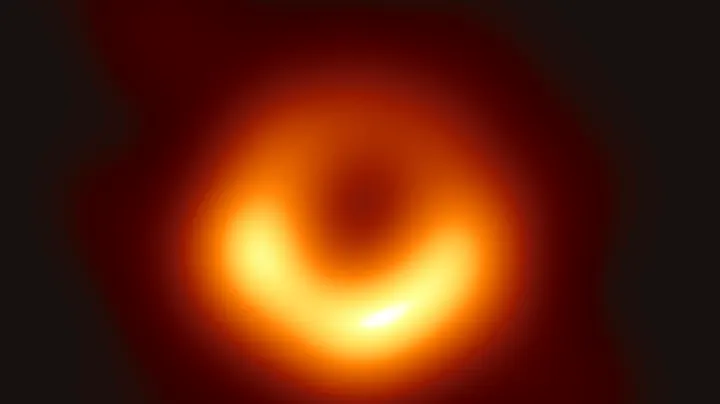
In 2019, astronomers unveiled the first-ever image of a black hole's shadow — a dark void encircled by a lopsided orange ring. This is the supermassive black hole at the heart of galaxy M87, 55 million light-years away. The ring isn't just glowing: one side is noticeably brighter than the other, like a campfire burning unevenly, with flames leaping higher on one side.
HEP Experiment2026-01-022 minarXiv:2601.00597express
How to Hear Dark Matter in the Whisper of Atoms
In a dark room, there is a tank of liquid argon. Sometimes an invisible particle flies through it, strikes an atomic nucleus, and a faint light flashes in the liquid. From this flash, physicists try to figure out what kind of guest has arrived.
Pressure Instead of a Syringe: A New Way to Shield Cells from the Cold
The usual way to freeze a living cell is like trying to put a spacesuit on it: you first need to get a protective substance inside, but while it's crossing the membrane, the cell can burst from salt imbalances or get poisoned by the chemicals.
Fluid Dynamics2026-01-021 minarXiv:2601.00724express
How a Trickle Becomes an Ice Ridge
A thin stream of water flows down a cold inclined board and, before your eyes, turns into an ice ridge. At first, the water paves itself a straight icy path, as if reinforcing its own banks. Then the trickle starts to meander, and the ice quickly spreads sideways. Finally, the ridge stops growing outward and begins to thicken, smoothing out irregularities.
HEP Phenomenology2026-01-031 minarXiv:2601.01043express
Molecular Magnets Catch Dark Matter
Dark matter is invisible, but according to calculations, it holds galaxies together. Catching its particles is like hearing a whisper in a noisy room. You need a material that responds loudly and noticeably to the slightest nudge. Molecular magnets could be such a material — substances where each molecule acts as an independent tiny magnet.
Cosmology2026-01-051 minarXiv:2601.02458express
Bubbles in a Boiling Universe: How Dark Matter and Gravitational Waves Were Born
In the first moments after the Big Bang, space boiled. A superheated substance permeating the world gave rise to giant bubbles of a new phase – much like a liquid produces vapor. Collisions of these bubbles accelerated particles to energies unimaginable in Earthly accelerators.
HEP Phenomenology2026-01-051 minarXiv:2601.02474express
Hunting Dark Matter with Qubits
Dark matter is an invisible substance, five times more abundant in the universe than ordinary matter. Its particles barely touch atoms, but occasionally they can nudge an electron, like a string brushed by the wind.
Instrumentation2026-01-051 minarXiv:2601.02576express
One membrane – two mysteries of the Universe
Imagine a membrane stretched like the skin of a drum. It picks up two signals at once: gravitational waves — the trembling of space itself — and elusive particles of dark matter. The membrane is placed between mirrors, and light presses on it like a finger on a string, keeping it under constant tension.
Nuclear Experiment2026-01-082 minarXiv:2601.05139express
A Hot Quark Soup
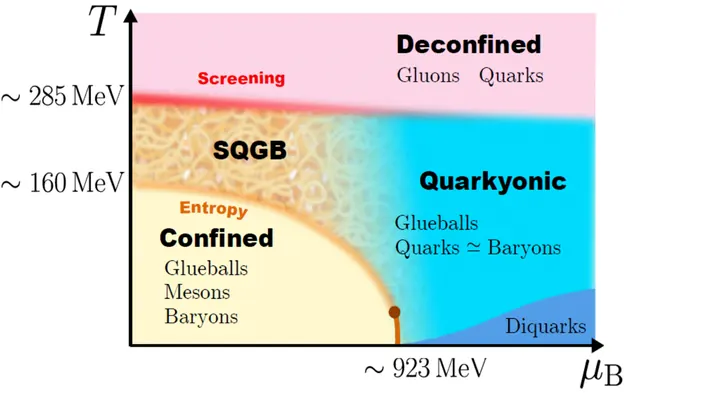
Water in a kettle heats to 100 degrees, and stops being water, turning into steam. Something similar happens to atomic nuclei when they are smashed together at enormous speeds in the Large Hadron Collider.
HEP Theory2026-01-091 minarXiv:2601.05931express
How Dark Matter Was Born from the Geometry of the Universe
In the first moments, the Universe went through a brief but turbulent period — inflation, when it expanded at a colossal speed. This idea was proposed by Alan Guth. At the same time, particles of ordinary matter were born.
Exoplanets2026-01-121 minarXiv:2601.07471express
A Cosmic Furnace: How the Sun Vaporizes Dark Asteroids
An ordinary lump of coal left under the blazing sun just heats up. But if you take it into space and bring it twenty times closer to the Sun than Earth is, it won't survive for more than a few minutes. That's roughly how dark, carbon-rich asteroids behave. They are rarely found on orbits that dive deep inside Mercury's orbit.
HEP Phenomenology2026-01-121 minarXiv:2601.07921express
Dark Matter and Its Taste Preferences
The cosmos is filled with invisible dark matter, which betrays itself only through gravity. Its existence was suspected by Fritz Zwicky and confirmed by Vera Rubin.
Exoplanets2026-01-131 minarXiv:2601.08390express
Quantum Physics2026-01-131 minarXiv:2601.09020express
Salt in the Cell Changes the Rules of the Game
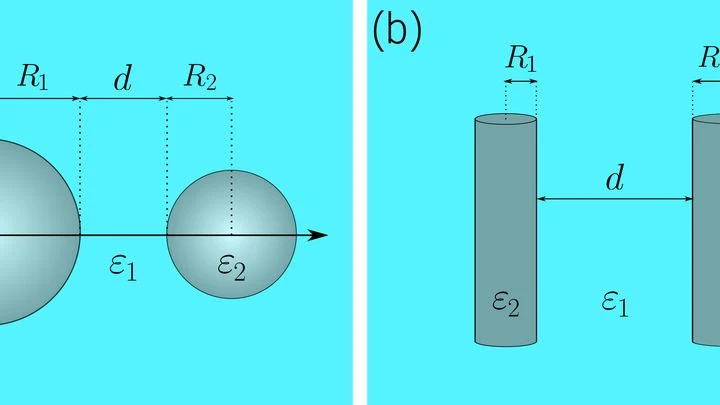
In a glass of salty water, even if it sits perfectly still, something is always happening. Tiny salt particles, ions, float and collide, sending ripples through the water. These ripples are invisible, but they create a force that attracts or repels nearby objects. Previously, it was thought that this force only acts over very short distances, as if it quickly fades out.
Quantum Physics2026-01-161 minarXiv:2601.11753express
Hunting Light Dark Matter with a Silicon Detector
Dark matter is the invisible substance that holds galaxies together, yet it has so far escaped direct detection. The BULLKID-DM detector is designed to catch candidate particles with a mass around 1 GeV (roughly that of a proton) and an extremely weak interaction with ordinary matter — a…
Lead from an Ancient Shipwreck Hunts Dark Matter
Ancient lead that lay on the seafloor for two thousand years has become the heart of a detector searching for the most elusive substance in the universe. From it, researchers grew a transparent lead tungstate crystal weighing 13 grams and cooled it to near absolute zero.
Salt, Water, and Invisible Pairs
Salt in a glass of water is a crowd of charged particles. When there's plenty of water, each particle floats on its own, wrapped in a thick fur coat of water molecules. But as you keep adding salt, the water runs out for everyone, and the particles start seeking each other out. First, they stick together in pairs, then in larger clumps.
Materials2026-01-241 minarXiv:2601.17444express
Nickel Flower Catches Sugar
Conventional blood sugar sensors rely on enzymes — proteins that recognize glucose. But enzymes are finicky: they spoil from heat, moisture, and time, like cut flowers wilting without water. Here, instead of enzymes, a non-living material does the job: nickel oxide, grown as tiny flowers on a sheet of graphite paper.
Stellar2026-01-301 minarXiv:2601.23046express
Solar Flare: Two Peaks, One Magnetic Ribbon
On October 1, 2024, a class X7.1 flare erupted on the Sun — one of the most powerful. Two spacecraft, HXI and STIX, watched it from different angles, like two eyes, and together with a computer model helped reconstruct the three-dimensional picture.
Exoplanets2026-02-021 minarXiv:2602.02392express
Why Earth is Two-Thirds Ocean?
Earth is like dough mixed to a precise recipe: two parts water to one part land. Too much water, and the planet becomes a vast ocean where intelligence has nothing to grasp onto. Too much land, and water retreats deep, leaving a desert. Scientists put this culinary analogy to the test with statistics.
HEP Phenomenology2026-02-021 minarXiv:2602.02694express
A Hydrogen Trap for Dark Matter
Dark matter is invisible, but you can catch it on the rebound. Hydrogen embedded in a carbon film acts like a billiard ball: when a dark matter particle hits it, the proton flies out. That ejection is the signal you're looking for.
Stellar2026-02-022 minarXiv:2602.02870express
Stars Measured by Light Speckles
Light from a streetlamp passing through blinds flickers: the stripes shift, and brightness rises and falls. From that rhythm, you can guess how wide the lamp is. The new method for measuring stars works similarly: instead of capturing a sharp image, astronomers monitor the "twinkling" of light collected by two or more telescopes simultaneously.
Exoplanets2026-02-051 minarXiv:2602.05168express
Surprise Planet Around a Young Star
Astronomers caught the young planet AU Mic b in the act of hiding behind its star. The Spitzer telescope tracked its infrared glow: as the planet slipped behind, the system's total light dimmed slightly. The dip was just 171 parts per million, like a single drop of ink in ten buckets of water.
HEP Experiment2026-02-052 minarXiv:2602.05455express
How Current in a Wire Explains Hydrogen Catalysis
Hydrogen is the lightest fuel, and its conversion into electricity on a metal surface resembles a game of ping-pong: hydrogen atoms alternately attach to and detach from the electrode. But the score in this game depends on solution acidity in ways that were unexpected. Classical formulas predict a smooth change, while experiments show jumps and kinks.
Stellar2026-02-091 minarXiv:2602.08814express
Flare Temperatures Shift: A New Look at Stellar Energy
When a bright spot flares up on a star, astronomers want to know how much energy was released into space. They used to picture a flare as a growing campfire: the area of the fire increases, but the heat remains the same. That made calculations simpler, but reality turned out to be different.
HEP Experiment2026-02-102 minarXiv:2602.09421express
Heavy Dark Matter: Traces in Liquid Argon
A bullet that doesn't just pierce one target but leaves marks in several layers of armor. That's roughly how superheavy dark matter behaves, and it's what the DarkSide-50 detector was built to catch for the first time. The usual suspects for dark matter (weakly interacting massive particles, or WIMPs) pass through matter almost unnoticed, occasionally bumping into a nucleus.