Carbon fiber is a material consisting of extremely thin fibers, about 5-10 micrometers in diameter, composed mostly of carbon atoms. These fibers are known for their exceptional strength-to-weight ratio, being roughly five times stronger than steel while being about one-third the weight. The material is anisotropic, meaning its mechanical properties differ depending on the direction of the applied force: it is extremely stiff and strong along the fiber axis but much weaker perpendicular to it.
History
Carbon fiber was first developed in the late 1950s at the Royal Aircraft Establishment in the UK, with the first high-performance version created by Roger Bacon in 1958. Commercial production began in the late 1960s.
How it works
Carbon fibers are produced by heating precursor materials (usually polyacrylonitrile) in a controlled atmosphere, which drives off non-carbon atoms and leaves a highly orderedgraphite-like structure. The fibers are then woven into fabrics or aligned in a single direction and embedded in a polymer resin to form a composite material. The anisotropy arises because the carbon atoms form strong covalent bonds along the fiber length, while only weak van der Waals forces act between adjacent fibers.
In practice
Carbon fiber composites are used extensively in aerospace structures, high-performance sports equipment (bicycles, tennis rackets), automotive components, and increasingly in wind turbine blades and medical imaging equipment where low weight and high stiffness are critical.
Fun fact
The first carbon fiber bicycle frame was introduced in 1986 by the Kestrel company, and it weighed just 1.4 kilograms — less than half the weight of a typical steel frame of the time.
A slice of eucalyptus a tenth of a millimeter thick is placed under a polarized light microscope, and the wood suddenly blooms: blue, yellow, and pink bands twist into spirals, forming rings and swirls. This is not paint but the play of light: the cellulose fibers that make up cell walls transmit light differently depending on their orientation.
Deep beneath our feet, in the scorching mantle, iron leads a double life. It can be divalent or trivalent, like a coin that lands heads or tails. Which side dominates determines how much oxygen stays in the planet's rocky shell and how much sinks into the core.
In murky mud, between two electrodes, long chains of bacteria line up: each one as thin as a microscopic cable. Every such filament conducts current over a full centimeter, a true marathon for a microbe.
A crystal is like a row of soldiers on a parade ground: every atom is in its place, and electrons march through it in neat waves. An amorphous material is like a crowd at a train station, where there is no order, just a jostling throng. In such a crowd, an electron usually gets stuck quickly, like a person trying to push through a dense mass of people.
In late 2019, the sky over Australia turned red with smoke. The fires burned so intensely that the heat lifted air to the altitude where airplanes fly — into the stratosphere. There, tens of kilometers up, the smoke didn't just disperse. It swirled into a massive air vortex, like a giant funnel. Scientists named this vortex Kubor, after the sky spirit from Australian Aboriginal mythology.
A thin film is like a taut sheet: the thinner it is, the harder it is to push through. Scientists have noticed that films made of very different materials (graphene, graphene oxide, polymers) resist projectile penetration surprisingly well under high-speed impact. And the thinner the film, the more energy it absorbs per unit mass.
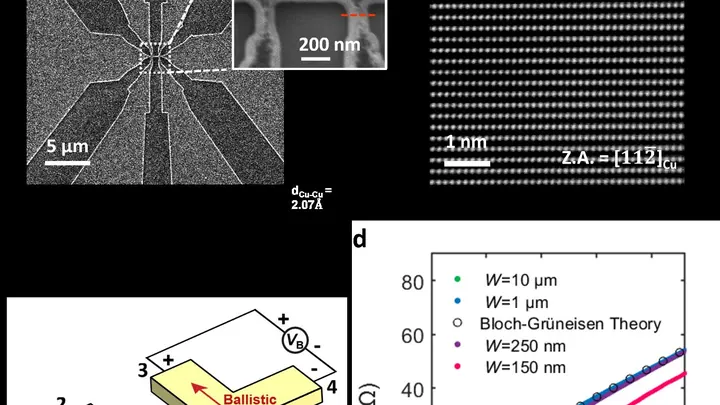
An electron in a metal is usually like a person in rush hour: it constantly bumps into others and loses its way. But if you remove the obstacles, it can fly in a straight line, like a car on an empty night highway. This kind of motion is called ballistic — from the word "ballista," an ancient catapult that hurled a stone without interference.
In a thin layer of a crystal, electrons behave differently than in an ordinary piece of metal. They are cramped, collide with each other more often, and feel the shape of the lattice more strongly. Usually, such states are created artificially by stacking layers of different materials. But sometimes nature does it all by itself.
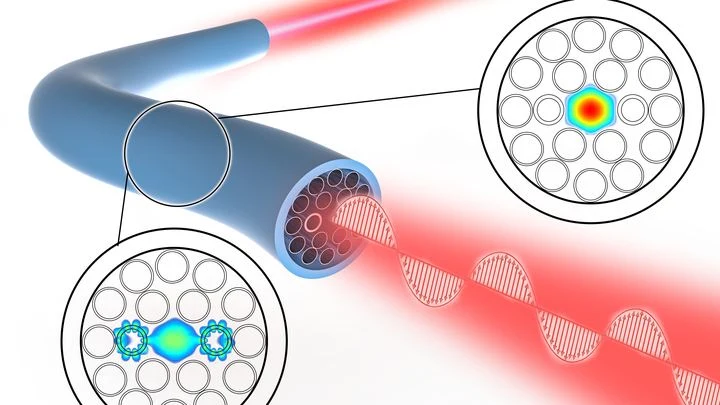
Light traveling through an optical fiber is like a crowd in a narrow corridor: each photon takes its own path, and if the paths get mixed up, you end up with mush at the exit.
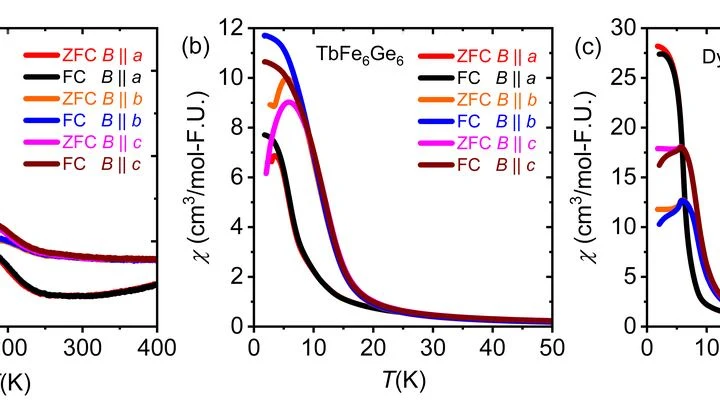
Imagine a stack of pancakes where each pancake is magnetized, but the magnetization directions in adjacent pancakes are opposite. That's exactly how this new magnetic material is arranged: in each atomic layer, all magnetic moments — the atom's 'arrows'—point in one direction, while the next layer is magnetized in the opposite direction.
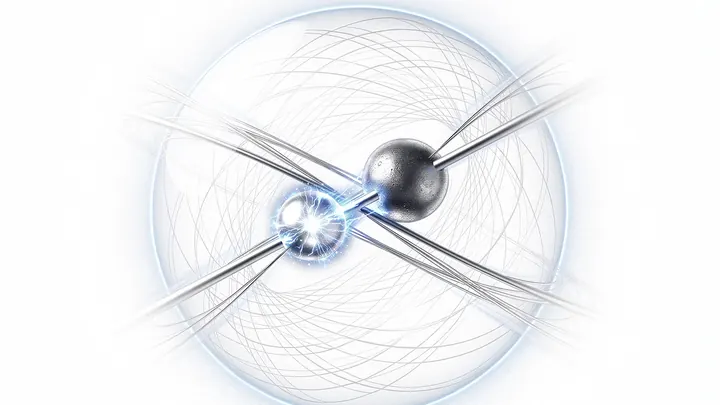
In the stream of cosmic rays, particles flying toward us from the depths of the Galaxy, titanium is rare. Its nuclei are almost indistinguishable from iron: both are heavy, and both leave similar tracks in detectors.