Attenuation is the gradual loss of intensity that a wave or signal suffers as it propagates through a medium. In physics, attenuation is a universal phenomenon: light dims as it passes through fog, X-rays weaken as they penetrate tissue, and sound fades with distance. The effect is quantified by the attenuation coefficient, which describes how quickly the amplitude or power decreases per unit distance. Understanding attenuation is crucial for designing communication systems, medical imaging, and acoustic engineering.
History
The quantitative study of attenuation dates back to the 18th century, with Pierre Bouguer and later Johann Heinrich Lambert and August Beer formalizing the exponential law of absorption.
How it works
Attenuation arises from two main mechanisms: absorption and scattering. Absorption converts the wave's energy into heat or other forms within the medium, while scattering redirects the wave's energy into different directions, reducing the intensity along the original path. The combined effect is often modeled by the Beer-Lambert law, which states that the transmitted intensity decreases exponentially with the product of the attenuation coefficient and the path length.
In practice
Attenuation is exploited in CT imaging to map tissue density, in fiber-optic communications to determine repeater spacing, and in seismology to infer the properties of Earth's interior.
Fun fact
In the ocean, sound attenuation is so low that whales can communicate across entire ocean basins, whereas light is absorbed within a few hundred meters.
A laser beam passes through a glass cell filled with cesium vapor. The atoms in the vapor dart around chaotically, like a crowd at a train station: each one enters the beam, spends a moment there, and flies back out. Their internal state, something like the orientation of a tiny magnet, changes under the influence of light. If all atoms were identical and stationary, the signal would be steady.
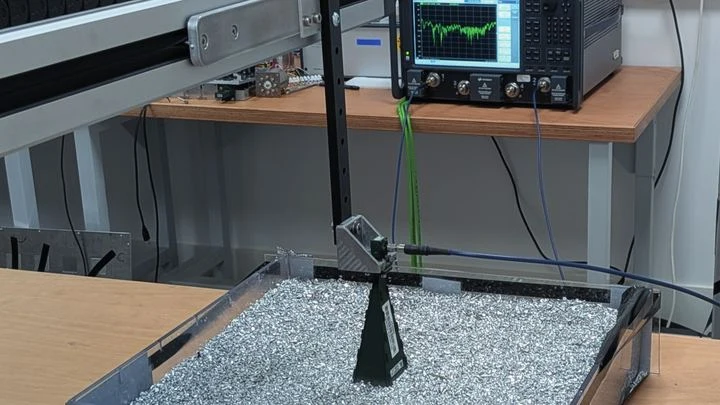
Physicists have achieved three-dimensional Anderson localization of electromagnetic waves — a phenomenon where waves become permanently entangled in a random labyrinth of metal particles and cease to propagate.
Gravitational wave detectors are microphones listening to the trembling of space. But their own noise drowns out weak signals. To hear more, physicists add special "squeezed" light to the instrument: it reduces quantum noise, like noise cancellation in headphones.
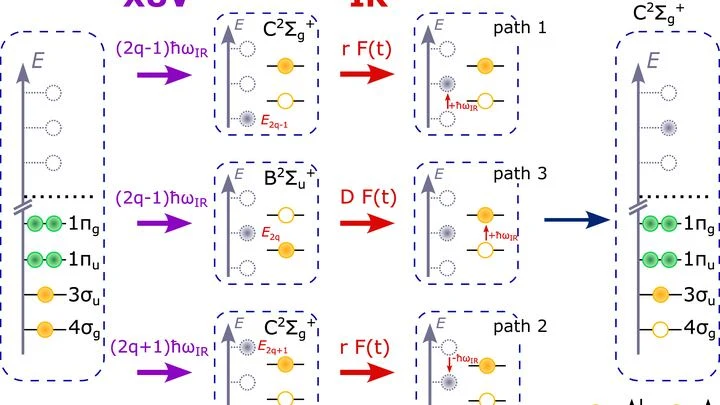
A high-speed camera capable of capturing the motion of electrons is an attosecond interferometer. It sends two laser pulses at a substance with a tiny delay. The first, ultraviolet, acts like a flash, knocking an electron out of the molecule. The second, infrared, like an invisible hand, gently nudges or slows this electron in flight.
Each vowel sound is a distinct shape of the mouth, tongue, and throat. When you say 'ah,' 'ee,' or 'oo,' not only does the air inside your head change, but so does the way radio waves pass through it. Researchers peered into this process using MRI scans taken right during speech and built a precise computer model of the head — from bones to soft tissues.