How to Pry Open a Crystal and Catch Quantum Ripples express
The NbSe2 crystal is like a stack of paper: layers lie tightly packed, and their properties blend together. Chemists found a way to pry this stack apart by nearly double — inserting long organic molecules between the layers like spacers. Now each layer behaves as if it were all alone, just one atom thick.
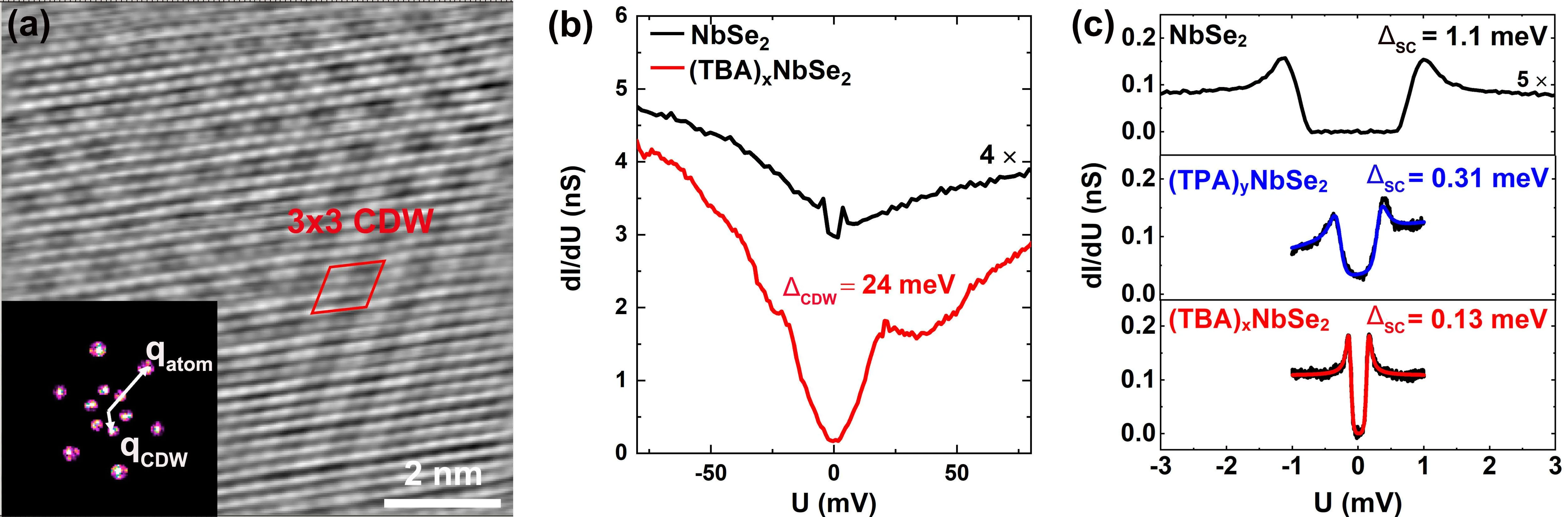
In a single layer of NbSe2, a charge density wave emerges — electrons line up in a rhythmic pattern, like a crowd at a stadium doing the wave. In the pried-apart crystal, this wave becomes noticeably stronger and persists at higher temperatures — around 130 K (minus 143°C). At the same time, superconductivity, where current flows without resistance, nearly disappears.
The cause lies in the electronic isolation of the layers and the extra electrons brought in by the organic molecules. Together, these two effects switch the material from a superconducting state to a charge-density-wave state. Previously, this was only seen in tiny exfoliated flakes, but now it's observed in a bulk crystal that can be produced in large quantities.
The method is like making a sandwich: between slices of bread (NbSe2) you put the filling (organic molecules), and the dish changes flavor. By prying layers apart with different molecules, you can tune the quantum properties of the material for specific applications — from ultra-sensitive sensors to new memory elements.
The organic molecules inserted between NbSe2 layers act as adjustable spacers: the longer the molecule, the greater the interlayer distance and the more pronounced the changes in the crystal's properties.
In Arthur C. Clarke's novel "Childhood's End," aliens alter material properties at the atomic level to control weather and gravity — here, scientists are doing something similar, but with quantum states.