Intercalation is the reversible insertion of atoms, ions, or molecules into the layered structure of a host material without destroying its overall framework. The host material typically has a lamellar or layered crystal structure, with strong covalent bonds within each layer and weaker van der Waals forces between layers. Intercalation alters the host's electronic, optical, and mechanical properties, often dramatically, making it a key process in materials science and chemistry.
History
The concept of intercalation dates back to the 19th century with studies of graphite compounds, but the term was popularized in the mid-20th century. The modern understanding was advanced by researchers like M. Stanley Whittingham, who in the 1970s demonstrated reversible lithium intercalation in titanium disulfide, a breakthrough that led to the development of lithium-ion batteries and earned him a share of the 2019 Nobel Prize in Chemistry.
How it works
The process relies on the ability of guest species to diffuse into the gaps between layers, called van der Waals gaps. This diffusion is often driven by an applied electric field, a concentration gradient, or chemical potential. The intercalated species can be neutral atoms or charged ions, and their insertion changes the interlayer spacing and the electronic structure of the host. The process is often reversible: by removing the guest species, the host can return to its original state, which is why intercalation is exploited in rechargeable batteries.
In practice
Intercalation is the fundamental mechanism in lithium-ion batteries, where lithium ions are intercalated into graphite anodes and metal oxide cathodes during charging and discharging. It is also used in supercapacitors, electrochromic windows, and in the synthesis of new materials with tailored properties.
Fun fact
Intercalation is also a natural process: graphite in the Earth's crust can intercalate potassium, and the resulting compound can spontaneously ignite in air, which is why natural graphite deposits sometimes show signs of burning.
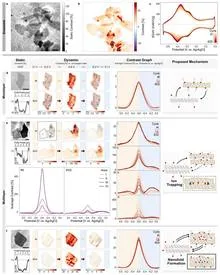
A stack of pages that has been flipped through many times remembers it: some sheets lie flat, others stick up, and creases remain here and there. Layered materials behave much the same way when ions enter them.
Two mica plates, smooth as mirrors, slowly approach each other in a calcium solution. At a distance of fifty nanometers, an invisible barrier suddenly appears between them: as if someone had stretched a web of molecules between the walls. This web prevents the plates from touching, even though by all calculations they should glide freely toward each other.
A deck of cards in which each card is slightly rotated cannot lie flat: the backs and faces will never align. But if the cards are flexible, they will start to adjust, shifting by fractions of a millimeter to find the perfect match. Something similar happens inside crystals when two thick layers of MoS2 or MoS2 with WS2 are stacked with a twist of 1–2 degrees.
Three voices merging into a single chord. In the physics of quantum materials, this image takes on a literal meaning: three layers of graphene, separated by thin spacers, force electrons and holes from different layers to move as a single fluid.
The laser beam in an optical tweezer is not just a spot of light but a force bag. A particle caught in it usually rolls toward the brightest point, like a ball into a dimple.
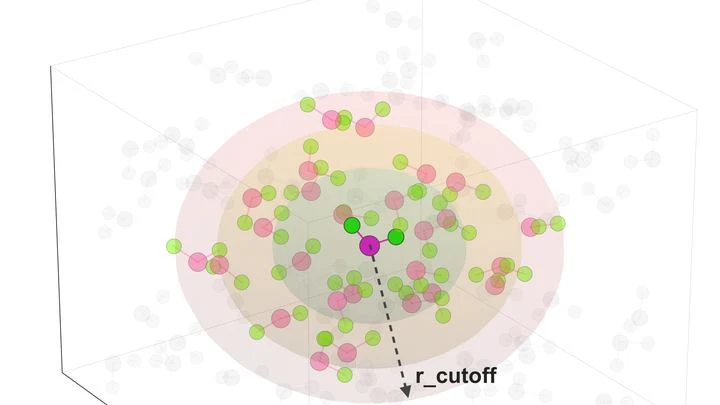
A fusion reactor is like a super-hot furnace where plasma reaches millions of degrees. The walls are made of tungsten, the most refractory metal there is. But even tungsten needs protection: fast particles from the plasma bombard the surface and knock atoms loose. These ejected atoms enter the plasma and cool it down, like a spoonful of cold milk in hot tea.
Ordinary ice at very low temperatures and high pressures does not melt but transforms into another solid — equally shapeless (amorphous) but much denser. For a long time, no one could understand exactly what happens at the moment when low-density ice begins to become dense.
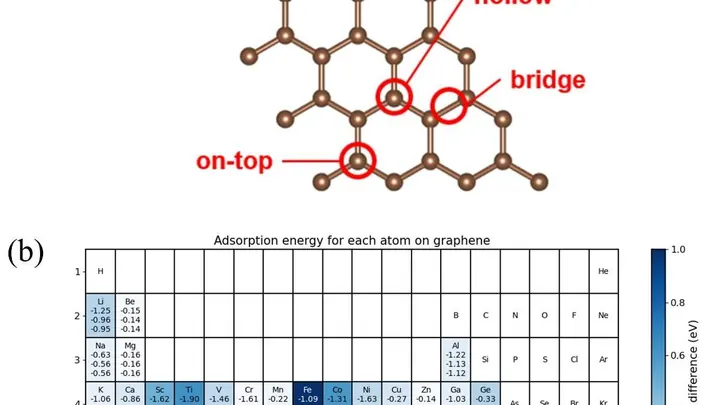
Two sheets of graphene — carbon film one atom thick — without a twist resemble a harbor clogged with shoals: lithium ions either run aground or rush past without stopping. But a 9.43° twist lays out a perfect fairway. The ion ships dock securely to carbon 'piers' and immediately cast off without losing speed.
A magnet that stacks up like a pile of pancakes: that's how the material CrSBr is structured. At low temperatures, each layer is magnetized, but neighboring layers point in opposite directions, and their magnetic fields cancel each other out. This order is called antiferromagnetic, and it's fragile: just a slight warming demagnetizes the layers.
Three charged ytterbium atoms are arranged in a triangle inside an electromagnetic trap. Normally, they all communicate with each other, like three people at a table constantly exchanging remarks. But if one of them steps into the next room, the conversation continues between the remaining two.
Molten metal is like an overcrowded hall where everyone is waiting for a signal to start dancing. Crystallization is that very moment when chaos turns into order. But to start the dance, you need a first step: the appearance of tiny crystal nuclei. Usually, this requires the metal to be cooled a lot. It turns out that a simple shake can replace some of that cooling.
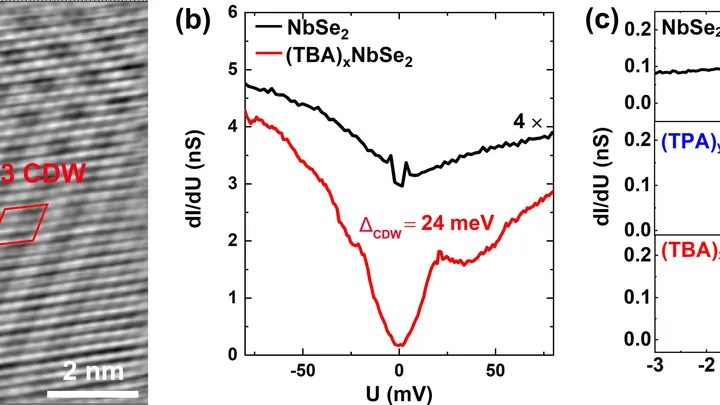
The NbSe2 crystal is like a stack of paper: layers lie tightly packed, and their properties blend together. Chemists found a way to pry this stack apart by nearly double — inserting long organic molecules between the layers like spacers. Now each layer behaves as if it were all alone, just one atom thick.
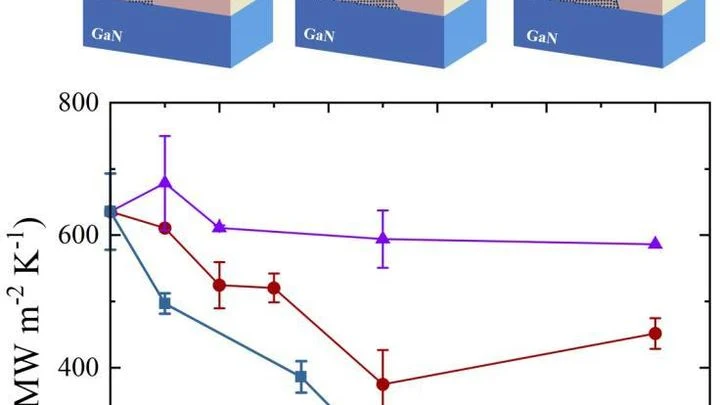
Inside a high-power transistor, heat escapes through junctions between different crystals, like water through narrow locks. For aluminum and gallium nitrides, key materials in power electronics, that lock is often a thin layer of their alloy. It is added deliberately or forms on its own during crystal growth.
Pour a handful of dry sand: it will spread into a neat cone. Now grab a box of star-shaped pasta: the pile will stand almost vertical. Why? It's all about particle shape.
Physicists built cylindrical piles from particles of different geometries — from smooth spheres to 'polypods' with several arms, like a sea star.
Six barium ions lined up in a flat hexagon inside a Paul trap, a device that holds charged particles with oscillating electric fields. But a slight change in the shape of the trapping potential made the crystal rearrange: one ion moved to the center, and the other five formed a ring around it.