Electron pairs are two electrons that become bound together by an attractive interaction, even though electrons normally repel each other. In superconductivity, these pairs, known as Cooper pairs, act as a single quantum entity with integer spin, making them bosons. This allows them to condense into a single quantum state, enabling lossless electrical current flow.
History
The concept of electron pairs in superconductivity was proposed by Leon Cooper in 1956, and it became a cornerstone of the BCS theory (Bardeen, Cooper, and Schrieffer) developed in 1957.
How it works
The attraction that binds electrons into pairs typically arises from interactions with the crystal lattice (phonons) or other collective excitations. In conventional superconductors, an electron moving through the lattice attracts positive ions, creating a slight positive charge imbalance that attracts a second electron. This pairing is weak, so the pairs are loosely bound and extend over many lattice spacings. Once formed, the pairs condense into a macroscopic quantum state, and scattering events that would normally cause resistance cannot break the pairs without a large energy input, so current flows without resistance.
In a superconductor, the electron pairs have a size (coherence length) that can be thousands of times larger than the distance between individual electrons, meaning they overlap heavily and act collectively.
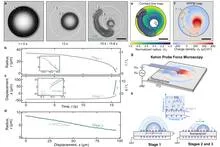
A water droplet on a fluoropolymer film initially behaves as expected: it sits and evaporates. But once it shrinks to a quarter of its initial size, it suddenly takes off and, within fractions of a second, covers a distance several times its own radius. Then it crawls slowly but persistently, leaving behind an invisible trail of electric charges. That trail is what drives the motion.
An empty dance floor where people occasionally appear. Each moves on their own, chaotically, with no connection to the others. But when the right music starts and the hall cools down a bit, the dancers suddenly begin to form long chains and move in unison. That's roughly how electrons behave in a dilute three-dimensional gas.
A lone erbium atom sits on a silver substrate, and its spin, the electron's internal rotation, stores quantum information. Previously, flipping this spin required a magnetic pulse: a blunt tool that disturbs neighbors and works slowly. Now physicists from Germany and Korea have shown that a single electric voltage suffices.
An extra electron in a molecule is like a passenger barely hanging onto the step of a departing train. Such a 'passenger' turns the particle into an anion — a negative ion. Studying it is tough: the bond is weak, the electron cloud is diffuse, and any jolt can knock the electron off.
A quantum spin liquid is a state of matter in which the magnetic moments of atoms behave like a fluid: they constantly fluctuate and never settle into a rigid order, even at extremely low temperatures. One of the most famous theoretical models of such a liquid was proposed by Alexei Kitaev.
Hidden within thin layers of tantalum selenide (TaSe₂) is a property that defies conventional physics. When guest atoms were added between the layers of this material, the structure lost its center of symmetry, and inside, superconductivity with armor emerged.
In superconductors, electrons pair up and flow without resistance. Usually, these pairs are distributed uniformly, like water in a calm lake. But sometimes ripples appear in the material — pairs bunch up and thin out with a certain period. This state is called superconductivity with pair-density waves.
In the city of elementary particles, there is a house right on the edge — X(3872). It sits exactly on the line separating it from decaying into two lighter structures: a D meson and an anti-D meson. Give it a nudge, and it would fall apart. But the house stands.
Physicists have long debated what holds it together.
Two sheets of tungsten diselenide (not carbon, but a compound of tungsten and selenium) are rotated relative to each other by a tiny angle, about 5 degrees. This creates a moiré pattern: an enlarged periodic lattice where electrons behave very differently than in a regular crystal.
Light hits an organic molecule, and inside, a pair of twin excitations is born. They're called triplet pairs. In single pentacene molecules, such pairs have long been known to share their energy with neighbors: this is the basis of singlet fission, which boosts the efficiency of solar cells.
Superconductivity is often pictured as a frozen dance of electrons: they pair up and move without resistance, like figure skaters on perfect ice. But in high-temperature superconductors, that ice turns out to be not so smooth.
Boson stars are gravitational atoms. Only instead of electric charge, gravity itself serves as the nucleus, holding a cloud of scalar field in quantized clumps.
A sheet of paper with square grid, one with diamond grid, and one with honeycomb — three different universes for an ant. Change the sheet, and the rules of movement change. That's roughly how electrons experience the crystal lattice: geometry dictates whether they become little magnets, superconductors, or something else. In ordinary materials, the lattice is as rigid as if engraved.
Run a current through a spring of organic molecules, and the electrons that come out are almost all spinning the same way. This trick is called chiral spin selectivity, and it has long puzzled physicists. In light atoms, spin (the particle's intrinsic rotation) is too weakly coupled to charge motion to achieve nearly perfect sorting.
Many black holes are surrounded by magnetic fields. As it spins, the black hole drags curved spacetime along with it, like a machine's flywheel, and sets the cosmic factory in motion.
In a boron nitride crystal, the perfect atomic lattice is sometimes disrupted: an atom is missing here, or replaced by a foreign one there. Under a powerful microscope, these tiny imperfections appear as traps for electrons: they capture particles and start to emit light, and they also respond to magnetic fields.
Energy transfer in photosynthesis is like a children's slide: it bends under the weight of one, reshaping the path for the next. That's what happens in a leaf: an excited molecule instantly reshapes the 'landscape' of its neighbors.
Physicists reproduce this effect using ions suspended in a vacuum trap.
Two electrically charged spheres attract each other with a certain force. If you replace their charges with magnetic poles, a spring scale shows exactly the same force. Black holes, it turns out, behave the same way — except instead of springs, the fabric of spacetime itself does the work.
A bridge made of two rows of planks bends under the feet of pedestrians, and each step gets a boost from the elastic motion of the deck. A similar principle underlies superconductivity: electrons glide without resistance because the atomic lattice itself adapts to them. In nickel-based materials, this picture has long been elusive.
The dance floor is packed: everyone moves on their own, no one holds hands. Suddenly the music gets louder and more rhythmic — neighbors start grabbing each other, forming pairs that spin in sync. That's roughly what the experiment looked like in the lab, where a cloud of lithium atoms, cooled to near absolute zero, was made to suddenly strengthen its mutual attraction.
Usually, isotopes are separated by exploiting the difference in nuclear weight. That difference is tiny, like sorting grains of sand that differ by one hundredth of a millimeter. The new method ignores weight and instead looks at the nucleus's rotation: its spin.
The laser hits the molecules twice with a short pause in between.
According to the Standard Model, the vacuum is not emptiness but an ocean of virtual ghost particles. An ultra-strong electromagnetic field, like a storm, yanks electron-positron pairs into reality.
A cold cloud of atoms is like a swarm of fireflies drawn to one another. The attraction between atoms tries to pack them into a single dense ball. But quantum jitter, the unavoidable motion of particles, keeps the ball from collapsing. When the attraction is strong, the cloud breaks into separate clumps.
Two superconducting banks are connected by a bridge of magnetic material. Inside the bridge lies a domain wall: a narrow boundary where the magnetization rotates, like a column of soldiers changing their marching direction.
In a dark room, an infrared laser flashes, and a speck of black K3C60 powder conducts electricity without resistance for a split second. The light strikes at 10 terahertz — a thousand times faster than a microwave oven. The effect is a hundred times stronger than at other frequencies. Why this particular frequency?
Two particles flying apart in opposite directions behave as a single whole: measuring one instantly determines the state of the other. Such quantum entanglement has long been known for light particles, but now it has been observed for the first time in heavy Z bosons — the carriers of the weak force.
Atoms settled along a chain of traps, like a line of coastal forts. Nearby, a quantum sea: a Bose-Einstein condensate (a substance with zero resistance, where particles move as a single wave).
A quantum dot the size of a virus, squeezed between mirrors, gives birth to two photons in a short flash of light. These photons fly out as a pair, and their polarizations, the directions of wave oscillation, are linked such that knowing one instantly tells you the other.
In a superconductor crystal, electrons sometimes arrange themselves into charge waves, like ripples on water, but made of the particles themselves. Some waves stretch far, while others live only over short stretches. Scientists took the material YBa$$_2$$Cu$$_3$$O$$_{6.67}$$ and hit it with short X-ray pulses to observe both types of waves.
A laser strikes a strontium atom, and two electrons fly out at once. Previously, it was thought that in such double ionization each electron acts on its own: one is knocked out first, the second later, randomly.
An ion quantum computer is like a chandelier with a dozen pendants: pull one, and they all start swinging. Each ion is a qubit, but when there are many, their collective vibrations crowd the stage. Any operation on one pair disturbs the neighbors, and the computation goes awry.
When two different materials are pressed together and then pulled apart, a spark jumps between them. Anyone who has pulled off a wool sweater in the dark or gotten a shock from a doorknob knows the feeling. For a long time, it was thought that charges simply hop from one surface to another due to differences in material properties.
Hidden inside a zinc oxide crystal is a quantum duo: a tin atom and a lithium atom sitting side by side. Their bond is so tight that the electron captured by this pair seems to live on the tin, while the lithium merely plays along. This complex was long sought after, but only now has it been deliberately created and identified by its characteristic glow.
In two mirrored rooms, set at right angles, lives a cloud of atoms. Each atom is like a singer in a choir: on its own, it may stay silent, but when neighbors start to sing, it joins in. Here, the conductor's role is played by geometry itself: one room helps the atoms emit light together, while the other gently nudges them toward that — not directly, but through a clever detour.
Sunlight hits a rooftop, and electrons are born in a thin film. They must reach the wires before they cool down and lose their energy. In tin sulfide, a cheap and accessible material for batteries, this sprint and cooldown has now been captured with unprecedented sharpness: frames follow every billionth of a billionth of a second.
Light in semiconductors is born from pairs of charges, an electron and a hole, that attract each other like a magnet to a fridge. Such a pair is called an exciton. If you add one more charge to the pair, you get a trion — a trio of three particles.
An ordinary superconductor is like a squad of soldiers marching in pairs: electrons pair up, and their spins (internal 'tops') point in opposite directions. A magnetic field easily flips such pairs, destroying superconductivity.
In UTe₂, things are different.