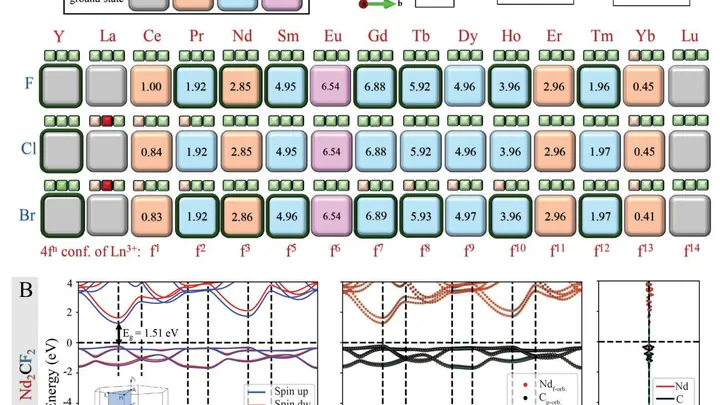
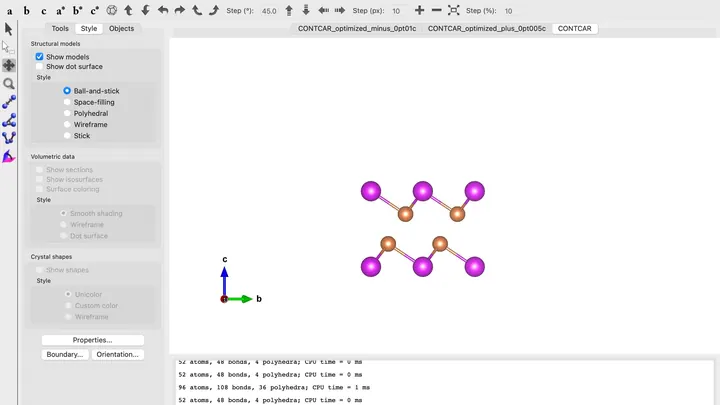
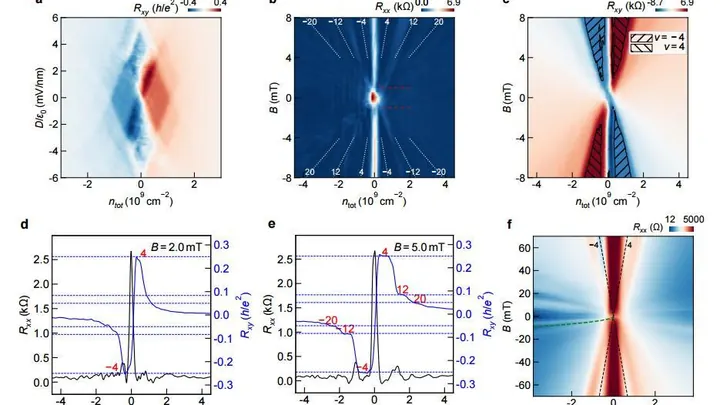
Two-dimensional materials are crystals just one atom thick, such as graphene (carbon) or transition metal dichalcogenides. At this scale, electrons are confined to a plane, leading to exotic properties absent in bulk materials—like extraordinary strength, high electrical conductivity, and tunable optical behavior. These materials are a playground for fundamental physics, revealing quantum effects that are otherwise hidden.
History
Graphene was first isolated in 2004 by Andre Geim and Konstantin Novoselov, who won the Nobel Prize in Physics in 2010. Earlier theoretical work by Wallace in 1947 had predicted its unique electronic structure.
How it works
The confinement of electrons in one dimension alters their energy dispersion, often producing linear (massless) or parabolic (massive) bands that differ from 3D materials. Stacking different 2D layers with slight twists creates moiré patterns, which can engineer new electronic band structures, including flat bands that host correlated states like superconductivity.
In practice
Two-dimensional materials are used in flexible electronics, high-speed transistors, and as sensitive sensors; they are also promising for quantum computing qubits and energy storage.
Fun fact
A single layer of graphene is so thin that it is transparent, yet it is impermeable to helium atoms—the smallest gas atoms—making it an ultimate barrier.
In chemistry's storeroom, records of substances no one thought were special gathered dust. It turns out that among them hide 2D materials — thin as a sheet of paper, but strong and with unexpected properties. Scientists ran a computer search through databases, and it pulled out 38 candidates that had not been recognized as 2D before.
In a pot of boiling water, steam bubbles appear and disappear — a similar struggle takes place in two-dimensional materials. Here, electrons both create magnetism and try to extinguish it.
The book is open to the middle. Current runs along the spine, while the pages remain cool. That's roughly how a two-dimensional topological insulator works — a material where electricity flows only along the edges, while the interior stays still.
Imagine a skyscraper assembled not from individual bricks but from entire studio apartments. That's exactly how the Au₆Te₁₂Se₈ crystal is built: its nodes are not atoms but superatomic clusters of gold and chalcogens that behave as single quantum objects.
A crystal is like a row of soldiers on a parade ground: every atom is in its place, and electrons march through it in neat waves. An amorphous material is like a crowd at a train station, where there is no order, just a jostling throng. In such a crowd, an electron usually gets stuck quickly, like a person trying to push through a dense mass of people.
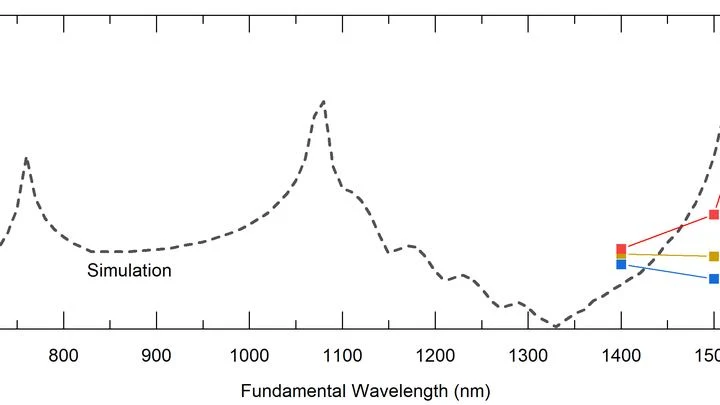
An ordinary piece of semiconductor weakly changes the color of light passing through it. For decades, physicists worked around this limitation by placing the crystal in clever surroundings, but the material itself remained the same.
Now researchers have assembled a "sandwich" of alternating thin layers of gallium arsenide and aluminum gallium arsenide.
Graphene is a carbon sheet just one atom thick, a fantastic conductor. But its surface is crinkly, like a wrinkled tablecloth that hasn't been ironed. Scientists built a 'sandwich': two of these sheets pressed together with a non-conductive spacer in between. They iron out each other's folds, like two halves of a sandwich making the surface perfectly even.
A crystal one atom thick is like a sheet of paper you can write on with electricity. Such a material promises to become the foundation for tiny, fast microchips. But before putting it into production, you need to know exactly what it's made of. And that's where the usual formula falls apart.
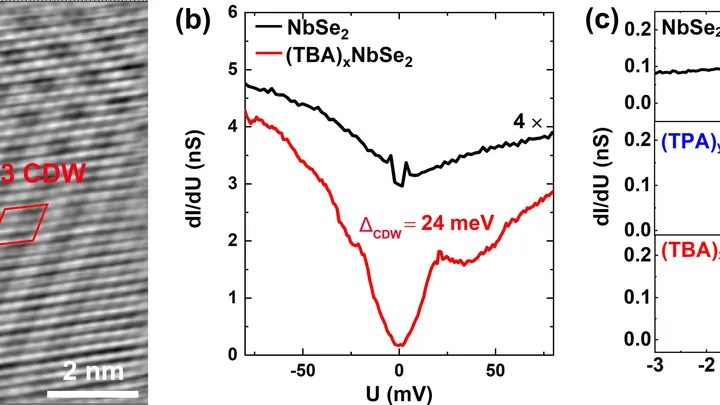
The NbSe2 crystal is like a stack of paper: layers lie tightly packed, and their properties blend together. Chemists found a way to pry this stack apart by nearly double — inserting long organic molecules between the layers like spacers. Now each layer behaves as if it were all alone, just one atom thick.
A thin sheet of carbon, resembling an intricate mesh of triangles, hexagons, and octagons, lies on a substrate. By itself, it is not superconducting: electrons move through it haphazardly, bumping into atoms. But stretch the sheet evenly, like canvas on a frame, and the picture changes.
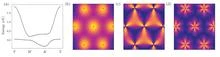
Electronic charge is a tumbleweed that moves camp depending on energy. In tungsten selenide (WSe₂) crystals, this is seen with utmost clarity: at a bias of −1.4 V, near the K point of the Brillouin zone, the maxima of tunneling current sit in the centers of hexagons, where there are no atoms.