An ultra-sensitive sensor is a device engineered to detect extraordinarily weak signals or minute changes in a physical quantity, often approaching the fundamental limits imposed by quantum mechanics. These sensors go far beyond ordinary detectors, enabling measurements of phenomena that would otherwise be lost in noise, such as the tiny vibrations of atoms, individual photons of X-ray light, or the presence of a few molecules in a sample. Their development is a frontier of metrology, pushing the boundaries of what can be observed and measured in physics, chemistry, and biology.
History
The concept of ultra-sensitivedetection has evolved over the 20th and 21st centuries, with milestones including the development of the SQUID (Superconducting QUantum Interference Device) in the 1960s and the advent of laser interferometry for gravitational wave detection. However, the specific techniques and devices described in the provided titles are recent innovations, and no single inventor can be credited for the entire field.
How it works
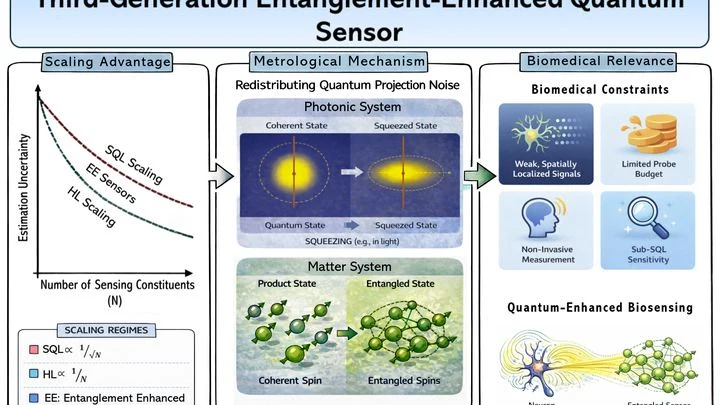
Many ultra-sensitive sensors exploit quantum effects to enhance their response. For example, some use quantum squeezing to reduce noise in one measurement variable at the expense of another, allowing a signal to be extracted from a quieter background. Others rely on the extreme sensitivity of certain quantum states, such as the spin of a nitrogen-vacancy center in diamond, to external fields, enabling detection of tiny magnetic or electric changes. The key is often to isolate the sensor from environmental disturbances and to use carefully designed measurement protocols that maximize the signal-to-noise ratio.
In practice
Ultra-sensitive sensors are used in diverse fields, from medical diagnostics (e.g., detecting biomarkers in breath or blood) to fundamental physics (e.g., measuring gravitational waves or searching for dark matter). They also find applications in navigation (quantum gyroscopes), materials science (imaging inside batteries), and security (detecting trace amounts of substances).
Fun fact
Some ultra-sensitive sensors based on quantum squeezing can measure signals so precisely that they surpass the standard quantum limit, a boundary once thought to be absolute.
A billiard ball hangs in midair. Tiny peas shoot at it from a blowgun. Each hit is barely perceptible, but if the ball is very light and barely trembles from heat, you can make out individual nudges. That's essentially the setup: a glass sphere the size of a bacterium levitates in a vacuum while a narrow beam of xenon atoms flies at it.
A magnet weighing just a few grains of sand hovers in midair with no support. It doesn't touch the walls, doesn't rub against bearings — it just hangs in a magnetic trap like a speck of dust in a sunbeam. Researchers have turned this tiny object into an ultra-sensitive compass: the device detects changes in the magnetic field of 23 femtotesla.
If a smell seeps into a room through a slightly open door, you could stand in the middle and sniff. But the most accurate way to catch the moment the smell arrives is to stand right at the threshold. A cell behaves much the same way when it needs to measure the concentration of a substance around it.
Light waves are never perfectly smooth — they are constantly jittered by quantum ripples. These almost invisible nudges were studied by Nobel laureate Roy Glauber, who laid the foundations of quantum optics. Now physicists have learned to freeze these ripples.
A laser beam in a multi-kilometer tunnel trembles as a gravitational wave passes, but the tremor is barely perceptible, on the scale of fractions of a proton's diameter. To hear this cosmic whisper, physicists squeeze every last bit of performance out of light.
In the pitch darkness of a vacuum chamber, a tiny magnet floats. It touches no walls and loses almost no energy — an ideal sentinel, ready to catch the faintest nudge. Such a sentinel is exactly what you need for axion hunting. These particles are prime suspects in the case of the Universe's hidden mass, which we call dark matter.
Imagine a library where instead of books, you have every conceivable combination of a few dozen quantum particles. The number of combinations grows like a snowball: add one particle, and the volume doubles. For fifty particles, there are more shelves than atoms in the visible universe.
In 1948, engineer Claude Shannon laid the foundations of information theory. The Nyquist–Shannon theorem gave the first answer: to avoid losing a signal, you need at least twice as many measurements as the fastest feature in the signal. In 2006, the method of compressed sensing relaxed this requirement.
Four tiny puddles, and in them ripple droplets of a superfluid. These droplets are atoms cooled to near absolute zero and paired up like little magnets. When the whole setup rotates, the fluid flows between the puddles. Simply counting how many droplets end up in each reveals the angle and angular velocity.
A pendulum swings with such precision that, had it been counting seconds since the Big Bang, it would have drifted by only half a second by today. That is the stability of the new portable ultraviolet laser — the heart of aluminum atomic clocks.
A modern hospital sensor is like a sensitive microphone in a noisy hall. It picks up a weak signal from the heart or brain, but along with it comes the hum of machines, footsteps, the breathing of neighbors. Separating the desired sound from the interference is a science in itself.
A detector that hunts for rare particles is like an ear trying to catch a whisper in a noisy room. The quieter the signal, the harder it is to tell apart from random noise. In the NUCLEUS experiment, such detectors, cryogenic calorimeters, are cooled to near absolute zero so they can pick up even a faint pulse of heat from a single particle.
A quantum magnetometer based on hydrogen nuclei works like noise-canceling headphones. It alternately "listens" to the field in two different ways: the noise is the same for both, but the desired signal is different. By subtracting one from the other, the device extracts the signal, reducing interference by more than 1000 times.
In a lab, you measure a very weak signal — say, a tiny change in a magnetic field. The instrument trembles from passing cars, from the experimenter's breathing, from wires heating up. This technical noise can't be fully eliminated, and it sets a limit on precision. An ordinary sensor works like a scale that sways with any draft.
Radio waves that oscillate less than once per second pass through the earth and water with almost no loss. Such signals are used to communicate with submarines and to search for minerals. But a conventional antenna for them would need to be hundreds of meters long, and its sensitivity leaves much to be desired.
A fridge magnet attracts a paperclip: we can feel that field with our hands. Now shrink that field by a billion times. Atoms inside our bodies emit such weak signals, and they are very hard to catch.
Scientists built the sensor from special molecules that themselves behave like tiny magnets.
Even Einstein predicted gravitational waves — a trembling of the very fabric of spacetime. Today they are captured by gigantic installations like LIGO, created thanks to Rainer Weiss and Kip Thorne.
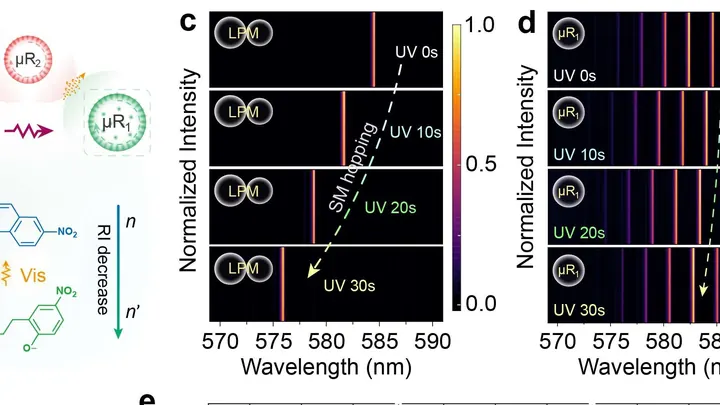
Two liquid droplets hanging side by side begin to sing in unison. One droplet is like a string tuned to a certain pitch, and together they form a laser that shines with a single, pure color. That's how a new type of sensor, a liquid photonic molecule, works.
The secret is that the droplets are slightly different in size.
Ultra-precise scales that catch the slightest changes in gravity work like a keen ear: they hear even the whisper of distant underground voids or the tremors of the Earth's crust. But such instruments have a hidden enemy: their own internal clocks. Time inside the sensor also jitters, and this jitter smears the picture.
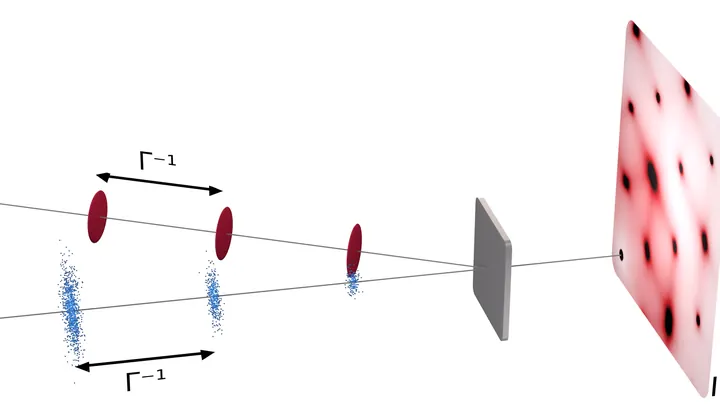
A camera that captures not light but a stream of electrons reflected off a crystal is a hybrid pixel detector. It can count every electron that hits it, generating almost no noise of its own. In normal mode, when the electron beam flows continuously, the detector works perfectly.
An X-ray photon hits the detector like a pebble dropping into still water. The water is a thin film of aluminum and manganese, cooled to near absolute zero. The impact sends a heat wave rippling across the film, and by measuring its height, you can tell how much energy the photon carried.
An X-ray beam strikes a piece of superconductor, and the material warms up ever so slightly. That heating, by billionths of a degree, is the only trace the light leaves behind. The new detector catches exactly that, like a sensitive thermometer pressed against cold metal.
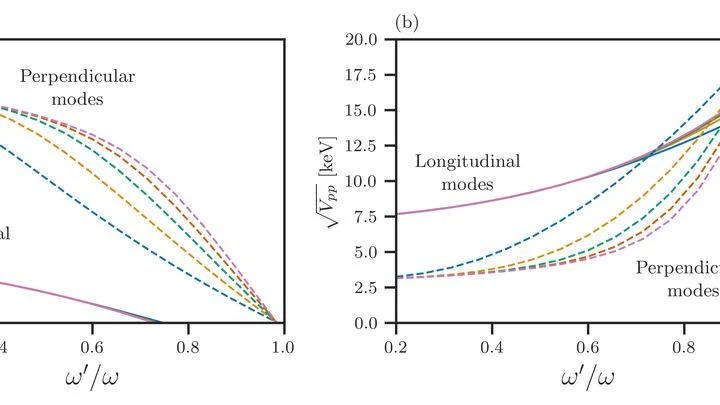
A speck of glass floats in a laser beam. Air molecules, photons, even Earth's gravity give it little pushes, and by watching its jitter, you can tell what pushed it. But every measurement has a limit: the particle's own noise hides weak signals. Quantum mechanics sets that limit, but it can be bypassed.
Light in a microscope doesn't arrive as a steady stream but like buckshot from a bag: sometimes more photons, sometimes fewer. This random scatter is the shot noise. It sets a limit: faint signals from tiny objects get lost in the ripple.
Scientists have found a way to calm this buckshot.
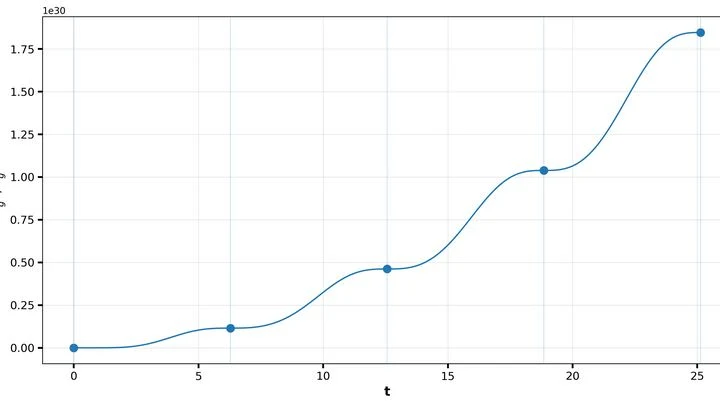
A particle trapped in a light field behaves like a ball on a spring: give it a nudge and it starts to oscillate. If you suddenly stiffen the spring, the ball freezes for an instant at the very bottom, where its position is known most precisely. That's exactly the moment physicists exploited to turn a nanoparticle into an ultrasensitive accelerometer.
A regular radio receiver picks up waves with a metal antenna. Here, the antenna is a single atom with an electron boosted to a distant orbit, like a satellite in a high orbit around Earth. Such atoms are called Rydberg atoms.
An ordinary sensor is like a scale that always shakes a little on its own. Even in total silence and at zero temperature, every particle jitters — this is quantum jitter, and it limits the precision of any measurement.
Detecting a faint signal against a noise background is like trying to hear a distant bell in a storm. Ordinary amplification only makes the din more deafening. Quantum error correction solves the problem in an unexpected way.
A chain of atoms on a light-guiding chip behaves like a row of pendulums on a shared support: swinging in opposite directions, they barely transfer energy to the air and freeze for a long time.
Building ultrasensitive sensors for light measurements and spectroscopy starts with tiny chambers where light ricochets like an echo in a canyon. Previously, engineers chased the quality factor — the duration of this echo: the longer it rings, the more noticeable the slightest changes.
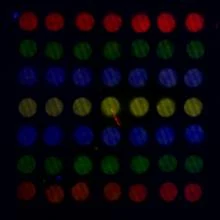
On a two-by-two-millimeter diamond plate, an entire orchestra of forty-nine violins fits. Each string is tuned to its own note, its own DNA fragment. When the right melody enters the hall, the string responds, and the conductor hears a clean sound. That conductor is a quantum sensor hidden within the diamond itself.
Detecting a single quantum emitter is like tuning a piano on a factory floor full of screaming machines: the pure tone drowns in noise. But the tuner doesn’t try to outshout the racket — he picks up a tuning fork and listens for beatings. That’s how even a barely audible echo becomes clear.
Picking up an ultraweak microwave signal is like trying to hear a whisper in a storm. Rydberg atoms, inflated to the size of bacteria, promise to become perfect antennas. But there's a fatal catch: during optical readout, up to 98% of messenger photons vanish without a trace in the detector.
Among the fundamental symmetries of nature, mirror parity holds a special place. The Standard Model already knows one violation of it, in the weak interaction, but hypothetical long-range forces that don't conserve left and right could reveal a lot about dark matter.
A quantum battery is not a box of electrolyte but a handful of atoms or superconducting loops, with energy stored in excited states. It can be charged in fractions of a second using collective quantum effects.