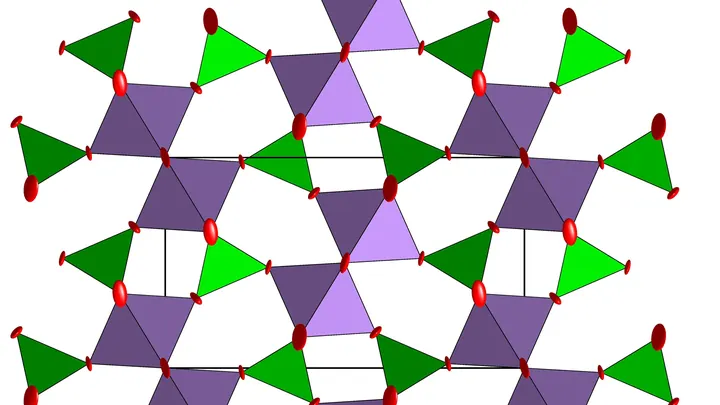
Charge densitywaves are periodic modulations of electron density in certain crystalline materials, where the electrons organize into a standing wave pattern rather than being uniformly distributed. This phenomenon occurs in low-dimensionalmetals, such as layered compounds, and represents a collective quantum state of electrons. Charge density waves are often accompanied by a periodic distortion of the crystal lattice, and they can persist even when the material undergoes an order-disorder transition, making them a rich subject for studying quantum many-body physics.
History
Charge densitywaves were theoretically predicted by Rudolf Peierls in the 1930s, who showed that a one-dimensionalmetal is unstable against lattice distortion. The first experimental observations were made in the 1970s in layered transition-metal dichalcogenides like niobium diselenide.
How it works
In a charge densitywave, the electron gas becomes unstable against a periodic modulation of its density, typically due to strong electron-phonon coupling or Fermi surface nesting. The electrons and the lattice distort together, creating a new ground state with a lower energy. This state has an energy gap at the Fermi level, turning the material into a semiconductor or insulator. The wave can be pinned by impurities or move under an applied electric field, leading to nonlinear transport phenomena.
In practice
Charge densitywaves are studied for potential applications in high-frequency oscillators, memory devices, and as model systems for understanding superconductivity and other quantum phenomena.
Fun fact
In some materials, charge densitywaves can move through the crystal like a 'sliding' state, carrying current without dissipation, similar to superconductivity but at higher temperatures.
If you push water in a narrow channel too fast, a steep wave forms and breaks into foam. In the world of ultracold atoms, cooled to near absolute zero, quantum laws prevent such a wave from breaking. Physicists took a cloud of rubidium atoms stretched into a thin thread and sharply compressed it from one end with a movable wall of light.
A thin silver thread nearly as long as a hair's width, and inside it, pristine quantum laws hold sway. Physicists built a conductor where electrons can only move forward or backward, like on a perfectly straight single-lane road with no shoulders. On such a road, any pothole or pebble would normally destroy the fragile quantum state.
In superconductors, electrons pair up and flow without resistance. Usually, these pairs are distributed uniformly, like water in a calm lake. But sometimes ripples appear in the material — pairs bunch up and thin out with a certain period. This state is called superconductivity with pair-density waves.
Plasma is not just hot gas; it's an entire orchestra of charged particles, each group playing its own part. Heavy ions (atoms that have lost electrons) set the slow rhythm, while light electrons dart around ten thousand times faster.
Imagine a skyscraper assembled not from individual bricks but from entire studio apartments. That's exactly how the Au₆Te₁₂Se₈ crystal is built: its nodes are not atoms but superatomic clusters of gold and chalcogens that behave as single quantum objects.
Physicists have achieved three-dimensional Anderson localization of electromagnetic waves — a phenomenon where waves become permanently entangled in a random labyrinth of metal particles and cease to propagate.
In diamond quantum devices, there's a tiny defect — the nitrogen-vacancy center (a nitrogen atom plus a vacancy where a carbon atom should be). It acts as a switch that spontaneously flips back and forth: it can carry an extra electron or not, and this determines whether it emits light or not.
A thin layer of oil on the surface of water breaks into separate droplets at the slightest disturbance. Something similar happens in the pulsar wind — a stream of particles ejected by a rapidly rotating neutron star. This stream also contains plasma layers, which can break apart into clumps — magnetic islands.
In an ordinary crystal, atoms stand in neat rows like soldiers on a parade ground. Any deviation from this formation is usually considered harmful: disorder scatters waves and quickly dampens collective motions of particles.
An ordinary crystal is like an apartment building: electrons move through shared hallways and staircases, influencing each other through the walls. Now, imagine removing all the walls, leaving just a single line of apartments. How would the residents behave?
Hydrogen has nothing to do with it, but the collective behavior of electrons takes center stage.
In the crystal HfTe5, electrons behave almost like light: their mass is so small that they obey the laws of relativity. If you place such a crystal in a strong magnetic field, the electrons start to circle in tiny orbits. Their energy then changes not smoothly but in steps, like floors in a building.
In the woven basket pattern, where the strands interlace into triangles, some electrons get stuck in place, like coins wedged in the gaps of the weave. Other electrons roam freely across the whole basket, like light filling a room. Physicists have long sought the moment when these two types of electrons start to influence each other, and now it has been found in the material CsCr6Sb6.
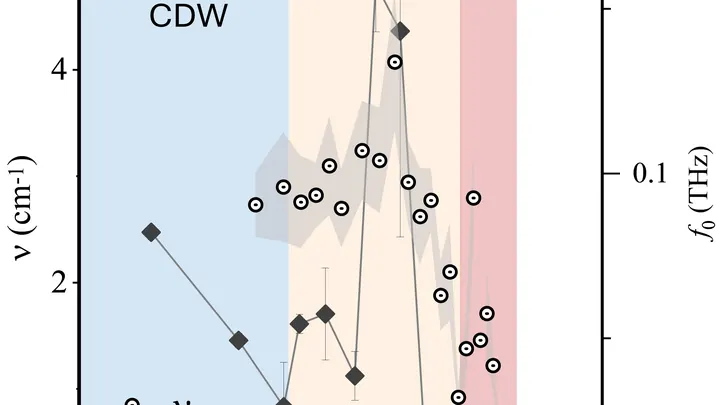
In a superconductor crystal, electrons sometimes arrange themselves into charge waves, like ripples on water, but made of the particles themselves. Some waves stretch far, while others live only over short stretches. Scientists took the material YBa$$_2$$Cu$$_3$$O$$_{6.67}$$ and hit it with short X-ray pulses to observe both types of waves.
A cooled layered crystal resembles a stack of thin sheets, with electrons wandering between them. At around 17 K, tiny regions appear where electrons line up into a wave, like ripples on water frozen in place. These regions are called charge puddles, and they were previously thought to be static.
Ahead of the bow shock that Earth creates in the solar wind, giant bubbles of rarefied gas sometimes appear. Inside them, particle density drops by factors, and electric fields start to tremble like a plucked string.
Ordinary tiles form a repeating pattern. But atoms can do more: under certain conditions, they themselves lay out a complex mosaic where the pattern never repeats, like on antique tile panels.
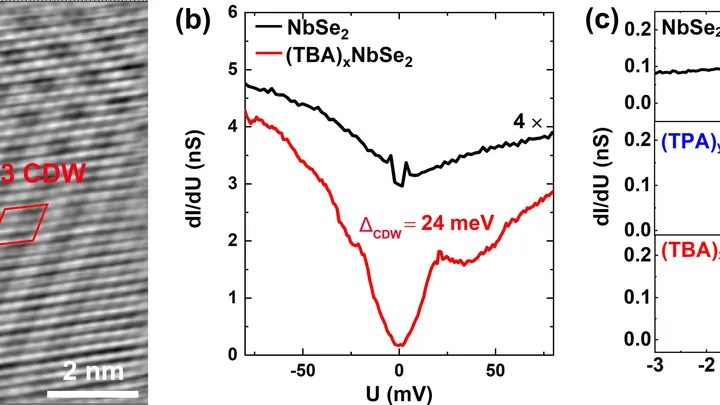
The NbSe2 crystal is like a stack of paper: layers lie tightly packed, and their properties blend together. Chemists found a way to pry this stack apart by nearly double — inserting long organic molecules between the layers like spacers. Now each layer behaves as if it were all alone, just one atom thick.
In the tungsten bronze family, one material was considered the quiet one. When cooled, its siblings rearrange their electrons into wave-like patterns, but it did not, or so it was thought until recently.
Now it turns out that this material also undergoes rearrangement.
According to the laws of the microworld, an electron obeying the Dirac equation trembles even at complete rest. This is Zitterbewegung — an oscillation with an amplitude of trillionths of a millimeter, like a spinning top on an invisible axis.