The kelvin (symbol: K) is the SI base unit of thermodynamic temperature. It is defined by fixing the numerical value of the Boltzmann constant, which relates the average kinetic energy of particles in a gas to temperature. The kelvin scale is an absolute scale: its zero point, 0 K, is absolute zero, the temperature at which particles have the minimum possible thermal motion. Unlike Celsius or Fahrenheit, the kelvin scale does not use degrees; one kelvin is a unit of temperature difference, equal in magnitude to one degree Celsius.
History
The kelvin scale was proposed by William Thomson, later Lord Kelvin, in 1848, based on the concept of an absolute zerotemperature. The unit was named in his honor in 1967, and its definition was revised in 2019 to be based on the Boltzmann constant rather than on the triple point of water.
How it works
Temperature in kelvins is defined through the Boltzmann constant, k_B, which has an exact value of 1.380649 × 10^-23 joules per kelvin. This means that the average thermal energy of a particle at temperature T is approximately k_B T. In practice, temperatures are measured using calibrated thermometers, such as platinum resistance thermometers or thermocouples, which are traceable to primary standards based on the properties of gases, radiation, or quantum effects.
In practice
Kelvin is used universally in scientific research, from cryogenics (temperatures below 1 K) to plasma physics (millions of kelvins). It is also essential in engineering, for example in the design of heat exchangers and in the calibration of industrial temperature sensors.
Fun fact
The temperature of the cosmic microwave background radiation, the afterglow of the Big Bang, is 2.72548 ± 0.00057 K, one of the most precisely measured temperatures in the universe.
Systems:SIThe SI base unit of thermodynamic temperature, defined by setting the Boltzmann constant to exactly 1.380649 × 10^-23 J/K.
Imagine a soundproof room where you tune a tuning fork: the faintest rustle throws off the tuning. In the world of ultra-precise atomic measurements, that rustle is the magnetic field. It imperceptibly shifts transition frequencies, and to get a reliable standard, physicists had to carefully calibrate the field.
Drop a pebble into a pond, and ripples spread across the water. In much the same way, any body, even the tiniest, perturbs the gravitational field around it. In empty, cold space, these perturbations, like ripples on a calm surface, make two nearby objects always repel each other.
The river splits in two. One branch is wide and fast, with water flowing smoothly, but as temperature rises, the flow slows: eddies and waves appear. The second branch is narrow, with rapids, where water leaps from rock to rock. This flow, on the contrary, becomes more lively with warming.
Heat is all around us: from a car's exhaust pipe to the casing of a running laptop. Thermoelectric materials could turn that waste heat into electricity.
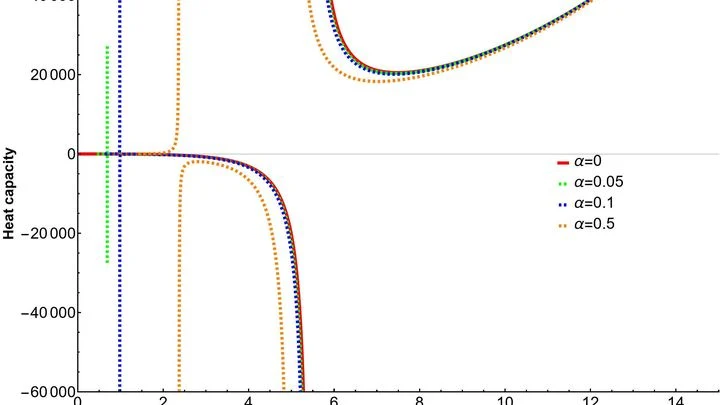
An ordinary black hole is like a stove that heats up more as its mass shrinks. A tiny hole should glow at unimaginable temperatures and evaporate in an instant. But that scenario ignores quantum corrections — what happens when the very fabric of spacetime begins to tremble.
Every quantum system (whether an atom, a crystal, or the entire Universe) has its own set of allowed energies, like the steps of a ladder. The hotter the system, the more readily particles climb to higher rungs.
A light ray skims along the horizon of a black hole: that invisible boundary from which nothing can escape. The closer the ray gets to the horizon, the slower its own 'time' stretches — a special measure of path called the affine parameter.
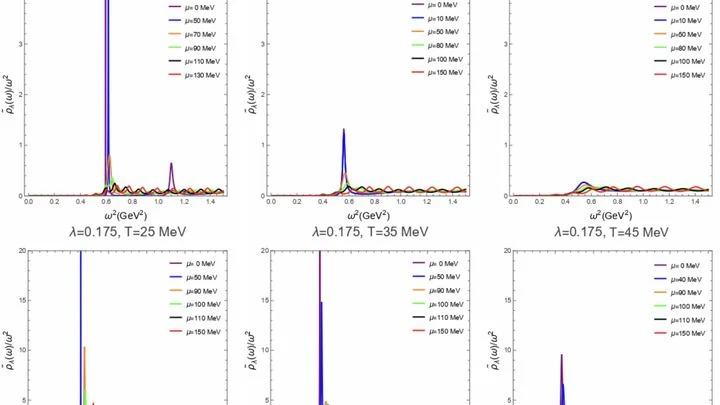
An ice cube in hot tea melts strictly at zero degrees. But what if the ice is made of subatomic particles and the tea is scorching nuclear matter? The authors studied the rho meson, a particle made of a quark and an antiquark that lives for just 4×10⁻²⁴ seconds, and searched for its 'melting temperature'.
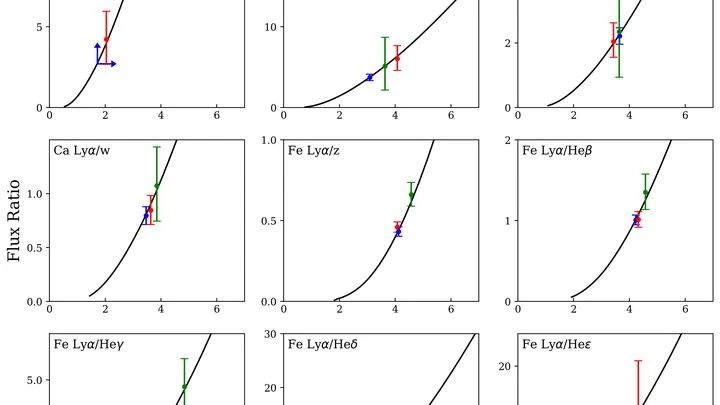
If you stick two identical thermometers into a pot of hot water, they'll both read the same, and we relax, thinking the temperature is measured correctly. But in a rarefied gas heated to millions of degrees, this trick stops working.
A giant cauldron of simmering soup stretches across millions of light-years. This is the atmosphere of the Perseus galaxy cluster — a cloud of scorching gas held together by gravity. Until recently, astronomers thought that in the center of this cauldron, the gas was calmly cooling, ready to condense into new stars.
An aluminum pot on the stove melts at 660 degrees Celsius — everyone knows that. But what happens if you heat aluminum a hundred times hotter? The liquid starts to boil, and here's the puzzle: at what exact temperature does that happen?
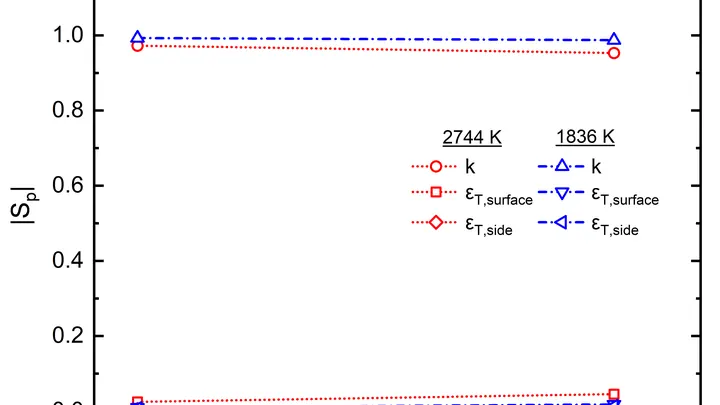
A red-hot piece of metal in a furnace is like a frying pan on the stove: the hotter it gets, the faster heat travels to your hand if you touch it. But at temperatures where the metal is close to melting, measuring that speed is very tricky: sensors don't make good contact, heat escapes into the air, and the glowing sample confuses the instruments.
This new method sidesteps those obstacles.
A hot chain of atoms lined up in a row behaves like a tiny black hole. Such a chain is a series of particles, each resembling a tiny magnet. At normal temperatures, the little magnets flip randomly, but when cooled, they align in a uniform order. Physicists have discovered that when heated, this simple system reproduces the strange properties of black holes.
A liquid that flows without friction is superfluid helium-4, a strange state of matter at temperatures below two kelvins. In a large volume, the transition to superfluidity occurs at the lambda-point temperature, but in narrow channels everything changes.
In the 19th century, James Clerk Maxwell imagined a tiny demon. It knows the speed of every gas molecule and opens a door: fast ones to the left, slow ones to the right. This creates a temperature difference without expending energy, seemingly violating the laws of physics.
In a container the size of a coin, light behaves like water: it gathers into a single quantum fluid. When energy is added, whirlpools, quantum vortices, spin up on their own. Each vortex is like a tiny whirlpool that cannot simply disappear.
Physicists illuminated this fluid with a laser and took snapshots.
In a quiet lab, a device the size of a microwave oven sits on a table. Inside, a coil glides smoothly up and down while a computer reads electrical signals. This is the tabletop Kibble balance — a machine that links mass to quantum constants.
Previously, such balances occupied a whole room and required a team of engineers.