Niobium nitride (NbN) is a chemical compound of niobium and nitrogen that becomes a superconductor at temperatures below about 16 K (−257 °C). Unlike many conventional superconductors, it can be deposited as thin films just a few nanometers thick while retaining its superconducting properties, which makes it uniquely suited for ultra-sensitive detectors and quantum devices. In the context of the listed articles, NbN appears as a key material in acoustic and optical devices, such as superconducting nanowire single-photon detectors and kinetic inductance detectors, where its sharp superconducting transition and fast response are exploited.
History
Niobium nitride's superconductivity was discovered in 1941 by German physicist Justus Mühlensiep and colleagues, who found a transition temperature around 15 K. Its use in thin-film devices developed much later, from the 1980s onward, as fabrication techniques improved.
How it works
In NbN, electrons form Cooper pairs below the critical temperature, allowing lossless current flow. When a single photon or phonon strikes a thin NbN wire, it breaks Cooper pairs locally, creating a small non-superconducting hotspot that momentarily increases resistance. This resistance change is amplified into a measurable electrical pulse, enabling detection of individual particles or quanta. The material's high critical temperature relative to other superconductors and its ability to form very thin, uniform films make it practical for such applications.
In practice
NbN is widely used in superconducting nanowire single-photon detectors for quantum optics, quantum key distribution, and astronomical observations, as well as in hot-electron bolometers for terahertz detection.
Fun fact
Niobium nitride's superconducting transition temperature is more than twice that of elemental niobium (9.2 K), despite niobium being the main constituent.
Picture a fireplace poker shoved into a blast furnace. Ordinary steel would soften and sag within minutes. Nickel-based superalloys, which make up turbine blades in jet engines, work up to 1300 °C, but beyond that they give in too. Now look at this new niobium-based alloy: at 1500 °C it retains strength comparable to cold aluminum.
The secret lies in its internal architecture.
A tiny diamond, invisible to the naked eye, sits on a chip and senses heat like no ordinary thermometer can. Hidden inside it are two defects: places where a carbon atom is replaced by a nitrogen atom, with a vacancy nearby.
A tiny black hole flies through a hydrogen cloud and stretches atoms like taffy. That is what a superconductor looks like when it traps a persistent current: a material in which electricity flows without losses turns into a miniature permanent magnet.
The neutron is a particle that usually sits in the atomic nucleus and doesn't disappear. But some theories suggest that occasionally it might transform into its invisible twin — a particle that ordinary detectors can't catch.
A metal made of five different atoms is like a soup with bits of carrot, peas, potato, onion, and meat floating in it. Each bit is its own element: chromium, vanadium, titanium, niobium, and tantalum. Such an alloy is called high-entropy: there is no single order, and the atoms are mixed almost randomly.
A plastic film as thin as a hair, and inside it — platinum dots smaller than a millionth of a millimeter. These dots sit at the boundary between two transistor layers and catch electric charge like a sponge catches water. As charge accumulates, the transistor changes its resistance, and remembers that state.
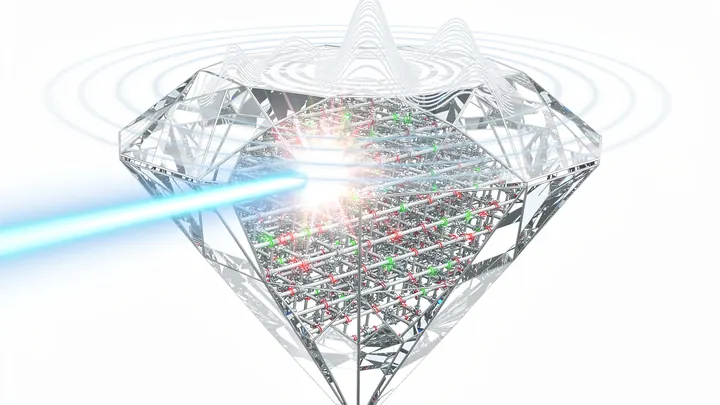
Inside a diamond anvil cell, squeezing a sample with a force millions of times greater than atmospheric pressure, a thin film of lanthanum meets hydrogen. The hydrogen comes from ammonia borane — a powder that, when heated, releases its hydrogen like a sponge releasing water.
An ordinary wire heats up when current flows through it — some energy is wasted. A superconductor lacks this flaw: electricity flows through it without loss, like water through a perfectly smooth pipe. The trouble is that most superconductors require either very low temperatures or colossal pressures, like those found in the depths of planets.
A bridge where pedestrians and cyclists flow together without getting in each other's way. That's roughly how hybrid systems of superconductors and semiconductors work: the former carry current without loss, the latter control that current.
In the cold Taurus cloud, where stars are born, telescopes have detected molecules with the smell of bitter almonds — aromatic nitriles. On Earth, you can find them in peach pits, but in space they hang in icy dust. What happens to them under the harsh ultraviolet light of young stars? Chemists recreated this process in the lab.
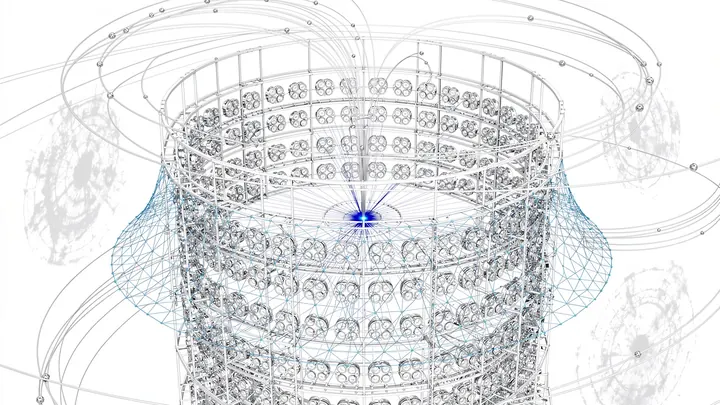
The universe is constantly sending us signals, but many are too faint to notice. Relic neutrinos, particles left over from the Big Bang, pass through Earth by the billions every second, yet catching even one is a feat on the edge of possibility. We need a detector that can sense energy a thousand times smaller than what it takes to move a speck of dust.
At the heart of a dying star, as its core collapses into a neutron sphere, an invisible storm is born. Trillions of neutrinos, particles that barely interact with matter, race through the scorching plasma. There are so many of them that they begin to influence each other, changing their 'flavors' (electron, muon, tau) like chameleons.
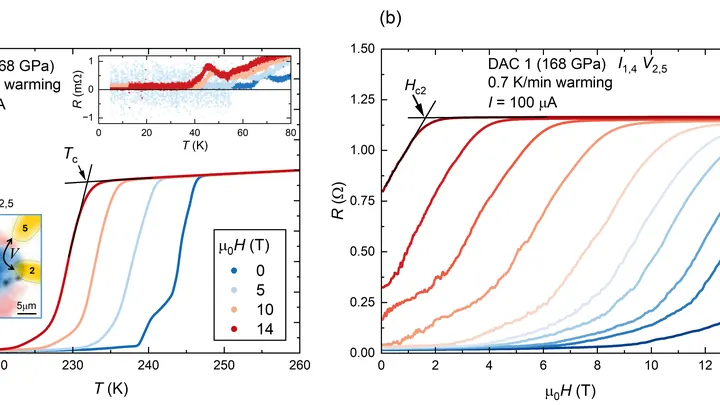
A film sliver thinner than a human hair was placed between diamond anvils and squeezed. The pressure climbed — a hundred thousand atmospheres, half a million, a million… Yet the material kept conducting electricity without resistance.
A ceramic plate as thin as a soap film, and through it flows current with zero resistance. That's the superconductivity achieved in nickelates, relatives of the famous cuprate superconductors. Previously, this required enormous pressure, comparable to that at the ocean floor.
Lossless current is the dream of energy technology. Some materials become superconductors, but usually only at extreme cold. Recently, in the family of nickelates, compounds based on nickel, candidates were found that work at higher temperatures.
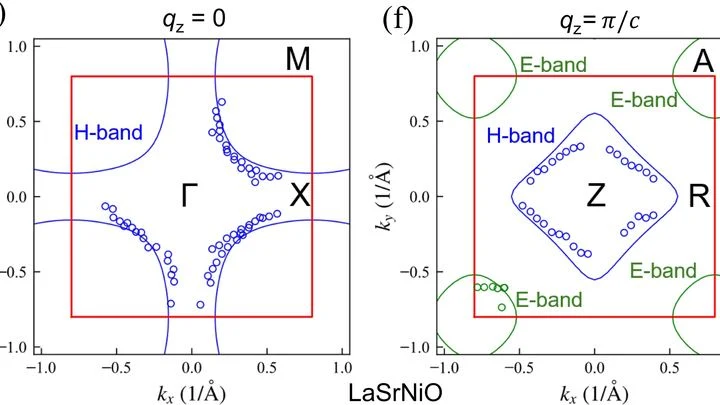
A layered cake where each tier conducts electricity differently: that's the structure of the crystal La3Ni2O7, a compound of nickel, lanthanum, and oxygen. Current flows differently along the layers than across them.
A piece of metal is cooled to minus two hundred degrees, and electric current begins to flow through it without the slightest friction, like water in a pipe flowing without touching the walls. This behavior is called superconductivity.
In the first seconds after the Big Bang, the Universe left us not only light but also something far more elusive — the relic neutrino background. This echo of creation permeates every cubic centimeter, yet we barely notice it.
In the depths of a diamond crystal, studded with NV centers, a symphony slumbers. Each defect is like a tuning fork, ready to respond to a passing acoustic wave. But alone, their voices are barely audible: the spin-phonon coupling is weaker than a whisper. A maestro is needed, one who can turn timid vibrations into a resounding choir.
The nickelate family consists of layered crystals, like a stack of pancakes: nickel and oxygen layers alternate with lanthanum spacers. Two years ago, superconductivity was discovered in them — the ability to conduct electricity without resistance when cooled.
A well-coordinated orchestra of electrons in a superconductor is easily thrown off rhythm. Thermal jolts destroy the fragile order, and resistance returns. For decades, scientists have sought ways to strengthen this ensemble — mostly by changing the material's composition or compressing it to unimaginable pressures.
A potter uses a sharp stylus to trace a pattern on a still-damp clay tile. One wrong move, and the line blurs, the tile cracks. Physicists work with films of the high-temperature superconductor YBCO (a compound of yttrium, barium, copper, and oxygen) in much the same way.
In murky mud, between two electrodes, long chains of bacteria line up: each one as thin as a microscopic cable. Every such filament conducts current over a full centimeter, a true marathon for a microbe.
Electrons in a conductor are like a chaotic crowd: colliding, they lose energy, and resistance arises. In a superconductor, however, they move in unison, like partners in a well-coordinated dance, without touching each other. This state has reduced энтропией — meaning disorder.
Such behavior is rare for gold and copper.
Imagine a sandwich where the bread is made of copper oxide layers and the filling is a thin layer of strontium ions. That's the infinite-layer cuprate, the simplest version of superconducting ceramics, conceived nearly 40 years ago.
Deep underground in Japan, a huge tank of ultrapure water waits for rare visitors — neutrinos arriving from distant stellar explosions. Such guests are few and far between: over years of observation, Super-Kamiokande registers only a handful of events.
Two burned-out stars, each about the size of Earth but heavier than the Sun, spiral ever closer until one crashes into the other. The impact triggers a thermonuclear explosion, giving birth to a type Ia supernova. Such flashes serve as cosmic beacons for measuring distances across the universe. Yet the details of their origin remain hotly debated.
The atomic nucleus is a natural spring of colossal power. When the protons and neutrons inside it rearrange, it enters a special long-lived state — a nuclear isomer. It stores energy like a spring compressed to its limit.
A packed stadium: fans mill about chaotically, creating jostling and resistance. That's how electrons behave in an ordinary conductor. In superconductivity, they pair up and move in sync, like spectators holding hands and calmly leaving the stands, without losing energy.
The dance floor is full of couples waltzing. Usually, partners move in opposite directions: one steps forward, the other backward, to keep the overall rhythm.
The La3Ni2O7 crystal resembles a layered pie, where the filling of nickel and oxygen atoms alternates with lanthanum layers. At ambient pressure, it does not conduct without resistance, but squeeze it or grow it as a thin film, and high-temperature superconductivity emerges.
A layered cake of atomic planes of nickel and oxygen: that's how bilayer nickelates are built. Two such planes are separated by a spacer layer. If an oxygen atom sits in that spacer, it acts as a bridge: it links the layers and triggers a state in which electrons move without resistance.
Light from a distant star seeps through a planet's gaseous envelope, and astronomers try to guess what that envelope is made of. That's how we study the atmospheres of worlds we can never touch. When a planet passes in front of its sun's disk, its gaseous veil briefly intercepts some of the rays.
Light leaves a trace even when there is almost none of it. A single photon, a tiny bundle of energy, strikes a silicon wafer and knocks out a handful of electrons. The trouble is that the handful is too small to notice. You need an amplifier.
Usually, the signal is amplified by applying a voltage to metal contacts on the detector's surface.
In 1987, astronomers saw a supernova flare up in a neighboring galaxy — the Large Magellanic Cloud. It was a rare gift: the explosion was close enough to catch not just light but also neutrinos, those nearly undetectable particles that pass straight through Earth.
A film of aluminum nitride, as thin as a soap bubble, hangs above a mirror with a micrometer-sized air gap between them. When invisible infrared light with a wavelength of about 15 micrometers hits it, the film starts to vibrate in sync with the light, like a string that responds only to its own note.
In cold clouds between the stars, dust grains are coated with ice, like windows covered with frost in winter. On this icy crust, chemical reactions take place that do not occur in gas. One such reaction is the encounter between a carbon atom and a nitrogen molecule.
An ordinary kitchen knife made of niobium would suddenly start conducting electricity with zero loss at −258 °C. That's how superconductivity works, and you can "switch it on" right at the metal's surface by blasting it with a laser in a nitrogen atmosphere.