Bridges Over the Microchip express
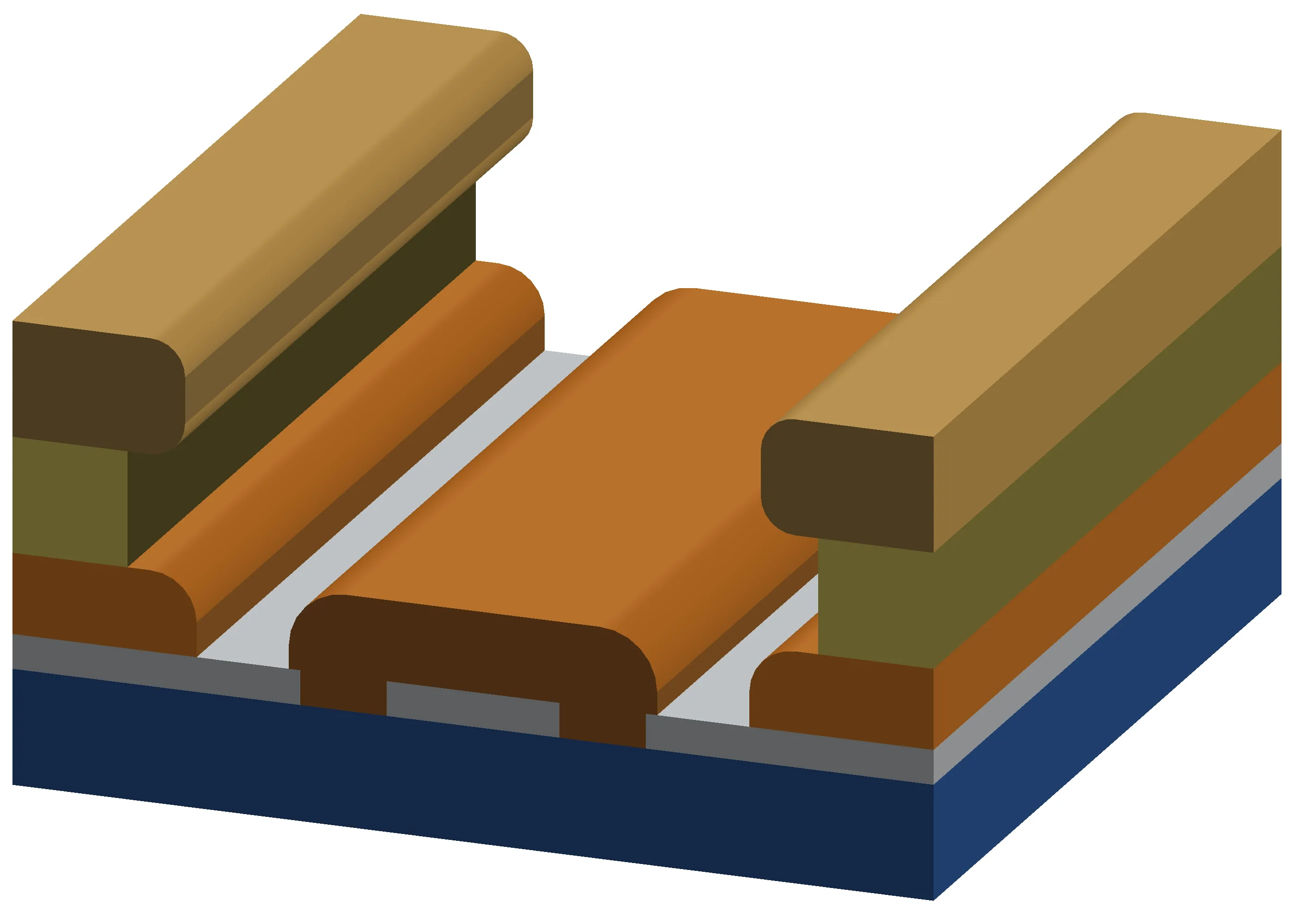
In microchips, wires usually lie flat on the surface, like rails on the ground. But sometimes one wire needs to leap over another without touching it. For that, engineers build air bridges — thin metal arches suspended above the chip.
Previously, such a bridge was assembled in several stages: deposit a layer, expose it, etch it, repeat. Each stage is a chance to mess something up. The new work shows that a single pass of the electron beam suffices. The beam draws the entire bridge at once, and then the wafer is gently heated, and the metal bends itself into a smooth arc, like a sheet of paper curling over a flame.
They tested it on quantum chips: the bridges don't interfere with the signal, but they do shield it from unwanted noise. The time during which a quantum bit retains its phase grew by a factor of two and a half. That means quantum computers will be able to compute longer without errors.
So one of the most finicky steps in chip fabrication has turned into a simple print job. Fewer steps mean less waste and cheaper future devices.
Original abstract
as written by the authors arXiv:2601.16416
Airbridges are essential for creating high-performance, low-parasitic interconnects in integrated circuits and quantum devices. Conventional multi-step fabrication methods hinder miniaturization and introduce process-related defects. We report a simplified process for fabricating nanoscale airbridges using only a single electron-beam lithography step. By optimizing a multilayer resist stack with a triple-exposure-dose scheme and a thermal reflow step, we achieve smooth, suspended metallic bridges with sub-200-nm features that exhibit robust mechanical stability. Fabricated within a gradiometric SQUID design for superconducting transmon qubits, these airbridges introduce no measurable additional loss in the relaxation time $$T_1$$, while enabling a 2.5-fold enhancement of the dephasing time $$T_2^*$$. This efficient method offers a practical route toward integrating high-performance three-dimensional interconnects in advanced quantum and nano-electronic devices.
Air bridges were first needed not for quantum chips but for ordinary radio circuits: to keep signals from getting delayed at wire crossings.