Quantum qubit engineering is the science of designing and controlling the fundamental units of quantum information, known as qubits. Unlike classical bits, which are either 0 or 1, qubits can exist in superpositions of both states simultaneously, enabling quantum computers to perform certain calculations exponentially faster than classical machines. The field focuses on creating stable, controllable qubits using various physical systems, such as trapped ions, superconducting circuits, or atomic defects in solids.
History
The concept of quantum computation was introduced by Richard Feynman in 1982, and the first working qubit implementations emerged in the late 1990s with trapped ions and nuclear magnetic resonance systems.
How it works
Qubits are engineered by isolating quantum systems, such as individual atoms or electrons, and manipulating their quantum states using precise electromagnetic fields or lasers. The key challenges are maintaining coherence (the qubit's quantum state) long enough to perform computations, and implementing reliable quantum gates that entangle qubits. Techniques like laser cooling, ion trapping, and cryogenic superconducting circuits are used to minimize environmental disturbances.
In practice
Qubits are used in quantum computers for applications in cryptography, drug discovery, optimization problems, and simulating quantum systems that are intractable for classical computers.
Fun fact
Some qubit designs use the spin of a single electron, which can be manipulated with microwave pulses, and the entire quantum computer must be cooled to temperatures colder than outer space to function.
A ship in a bottle is assembled from the inside, not the outside: masts and sails are pulled through the narrow neck, and once inside the glass they settle into the right pose on their own. Chemists have done something similar with a single cobaltocene molecule, which they pulled into the gap between layers of a two-dimensional crystal.
A lone erbium atom sits on a silver substrate, and its spin, the electron's internal rotation, stores quantum information. Previously, flipping this spin required a magnetic pulse: a blunt tool that disturbs neighbors and works slowly. Now physicists from Germany and Korea have shown that a single electric voltage suffices.
In any city project, residents' behavior is a invisible force that determines success. One skeptical neighbor can slow down solar panel installation across an entire block: their caution triggers a rise in disorder.
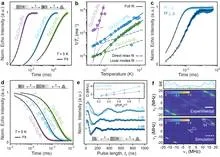
In the world of atoms and particles, everything tends toward rest: particles lose energy, just as a swing slows down due to energy loss (friction). But many devices — from hydrogen masers to atomic clocks — live by repetitive cycles.
A superconductor carries current without resistance, like water running through a pipe without friction. The secret lies in electron pairs: two electrons stick together as one, even though they normally repel. In an ordinary superconductor, the spins of the electrons in a pair point in opposite directions: this is the singlet state.
A quantum computer is like an orchestra where each musician is an electron spin: its tiny magnetic moment. For the orchestra to play in harmony, the conductor must hear each musician individually.
Inside every cell, there's a network of thin tubes — microtubules. They act as both scaffolding and rails: they hold the cell's shape and transport cargo. These tubes are built from the protein tubulin and naturally glow faintly under ultraviolet light. Scientists wondered: can we make this glow stronger or weaker on demand?
The key to control is the amino acid tryptophan.
A quantum computer is like an orchestra where electrons and nuclei play different instruments. Usually, the conductor needs two batons: microwaves for electrons and radio waves for nuclei.
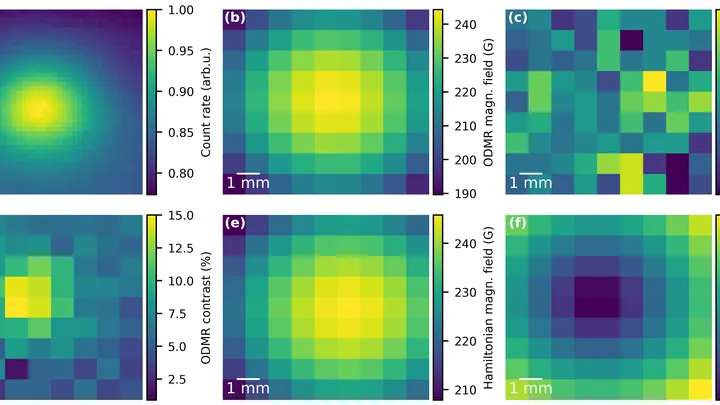
In a diamond crystal, a tiny defect sometimes occurs: a nitrogen atom takes the place of a carbon atom, and nearby a lattice site is empty. Electrons in this spot behave like a spinning top that can rotate in different directions. These 'spinning tops' are ready-made cells for future quantum computers and ultra-sensitive sensors.
Quantum dots are tiny traps for electrons, about the size of an atom, but artificially made. They can store and process information, like miniature cells of a future computer. Usually, to change the state of such a dot, you need to run a wire to it and apply a voltage. But in the new work, scientists showed that this can be done without direct contact — simply by acting on a neighboring dot.
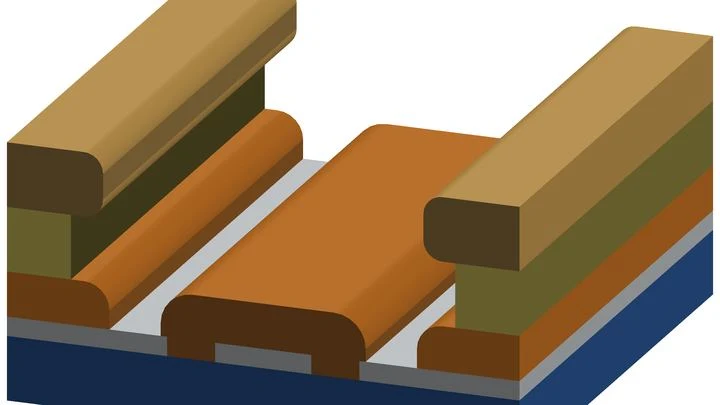
In microchips, wires usually lie flat on the surface, like rails on the ground. But sometimes one wire needs to leap over another without touching it. For that, engineers build air bridges — thin metal arches suspended above the chip.
Previously, such a bridge was assembled in several stages: deposit a layer, expose it, etch it, repeat. Each stage is a chance to mess something up.
The resonator vibrates at 100 megahertz, and its mechanical damping is only 15 hertz. That is like a bell that rings for thousands of years after a single strike. Next to it sits a qubit, a quantum two-level element that decays in milliseconds. It is this contrast in lifetimes that opens the door to Schrödinger's cat.
In 1963, a Tanzanian schoolboy named Erasto Mpemba noticed that hot ice cream freezes faster than cold. That paradox, named after him, long remained a subject of debate in classical thermodynamics. Now the quantum world offers its own version: a state with more strongly broken symmetry can recover it faster than a less broken one.