Phase is the position of a point in time on a waveform cycle, measured in degrees or radians. It determines how waves align with each other, which is crucial for interference, diffraction, and resonance. When two waves of the same frequency meet, their phase difference dictates whether they reinforce (constructive interference) or cancel (destructive interference), a principle underlying many optical and acoustic phenomena.
History
The concept of phase in wave motion was developed in the 19th century, particularly through the work of Thomas Young on interference and Augustin-Jean Fresnel on wave optics.
How it works
A wave, such as a light or sound wave, oscillates sinusoidally. Phase describes where in that cycle the wave is at a given moment. When waves combine, their amplitudes add vectorially, with phase differences of 0° producing maximum reinforcement and 180° producing cancellation. Phase is also essential in quantum mechanics, where the wavefunction's phase leads to interference effects like those in the double-slit experiment.
In practice
Phase control is used in technologies like phased-array radar, noise-canceling headphones, and optical interferometry for precision measurements.
Fun fact
In quantum computing, the phase of a qubit's wavefunction is a key resource, and manipulating it allows for algorithms that outperform classical computers on certain tasks.
A spotlight with an adjustable beam width sweeps along the shore. Its light is the long ocean waves that are born in the surf zone and spread in both directions: toward the beach and out to the open sea. Previously, this spotlight was considered a point source, but the actual breaking zone, where short waves break, has a finite width, and it changes as the wave front advances and retreats.
Light loves symmetry: in an open channel, it flows equally both ways. To steer it one way, physicists often use magnets. A new approach does without, using rotation — just the speed of a vinyl record — and interference from two atoms. Rotation changes the “pitch” of light for different directions, just as a siren’s tone shifts when a car approaches or recedes.
A pebble tossed into a pond sends ripples spreading in all directions. Now imagine the pond itself suddenly turning into jelly — instantly, faster than the wave can complete a single crest. Some ripples would keep spreading but change their spacing, while others would unexpectedly turn around and run back toward the point of impact, as if time were flowing backward for them.
The light an atom emits is not just a flash. It carries an imprint of the atom's state at the moment of emission. Physicists took a superconducting qubit, an artificial atom the size of a microchip, and made it glow into an open waveguide, like a bulb in a long corridor.
If you shake a box of sand long enough, patterns appear on its surface — patterns that weren't there when the box was still. It's the same here: physicists took a cloud of cold atoms, trapped them in an optical lattice, and began shaking it periodically. This gave rise to a new state in the atoms, like a new pattern in the sand that doesn't exist without the shaking.
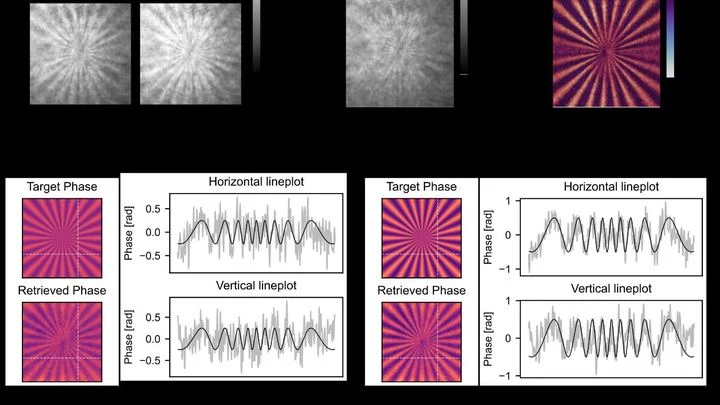
A glass marble in a glass of water is nearly invisible, but if you look through it at a checkered tablecloth, the lines behind it appear distorted. Transparent cells behave the same way: light passes through them but is slightly slowed and changes direction.
A laser pulse racing through plasma is like a runner carving a path through a crowd. It shoves electrons aside, leaving behind a rarefied channel, just as the crowd parts for a sprinter. In this channel, the crest of the light wave moves slightly faster than light in a vacuum, and it is this speed that determines how efficiently the pulse transfers energy to particles.