How a Chain Becomes a Ring express
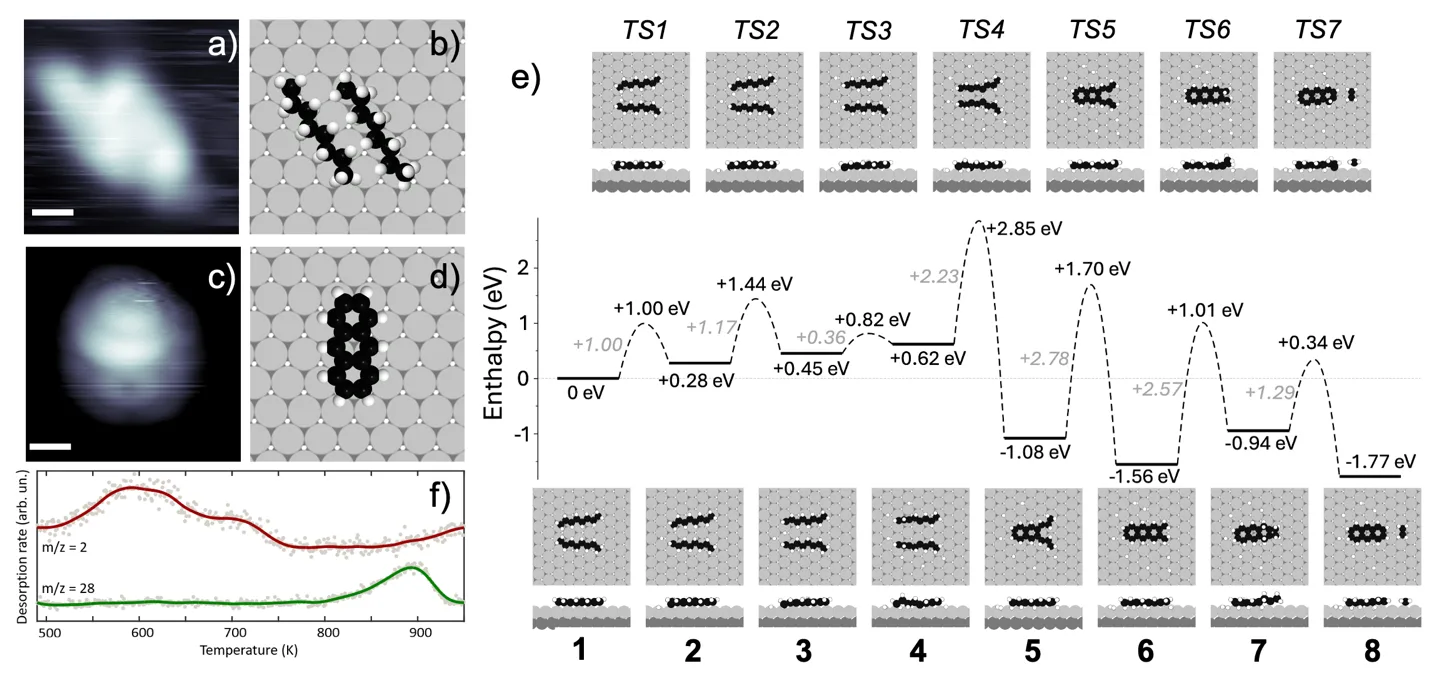
An ordinary octane molecule is a chain of eight carbon atoms, like a flexible wire. On a hot platinum surface (above 600 K), it doesn't just lie still: it starts to squirm. First, the chain bends so that its ends come closer together. Then hydrogen atoms are stripped off, and a strong bond forms between the ends — the molecule closes into a hexagonal benzene ring. This transformation is called aromatization: a flexible chain becomes a rigid, flat ring.
Sometimes two octane molecules lie side by side. Then platinum stitches their ends together, and the bond propagates along both chains like a zipper. The result is a long double molecule that can fold into more complex structures. This is how polycyclic compounds (the basis of many dyes, drugs, and plastics) are born on the surface.
Original abstract
as written by the authors arXiv:2601.18600
Aliphatic hydrocarbons, such as normal alkanes, constitute a naturally abundant source of carbon atoms. Of special interest is the formation of cyclic and aromatic products from aliphatic reactants. Combining scanning tunneling microscopy and ab initio calculations, we investigate the thermal induced aromatization of linear n octane molecules on the catalytic Pt(111) surface and the reactions of intermolecular homocoupling between them at temperatures above 600 K. The cycloaromatization of individual n octane molecules requires bending the linear adsorbates prior to their dehydrogenation and the formation of an intramolecular C-C bond, yielding adsorbed benzene rings. In addition, the Pt(111) surface catalyzes a homocoupling reaction by initiating the formation of a C-C bond between the dehydrogenated methyl ends of the chemisorbed n octane molecules and then propagating along the carbon backbone in a zipper like fashion. Our findings provide molecular level insight into the heterogeneous catalytic processes underlying the generation of aromatic products and stable on surface polycyclic species.
The benzene ring is one of the toughest structures in chemistry: its hexagon of carbon atoms doesn't break even under strong heating.